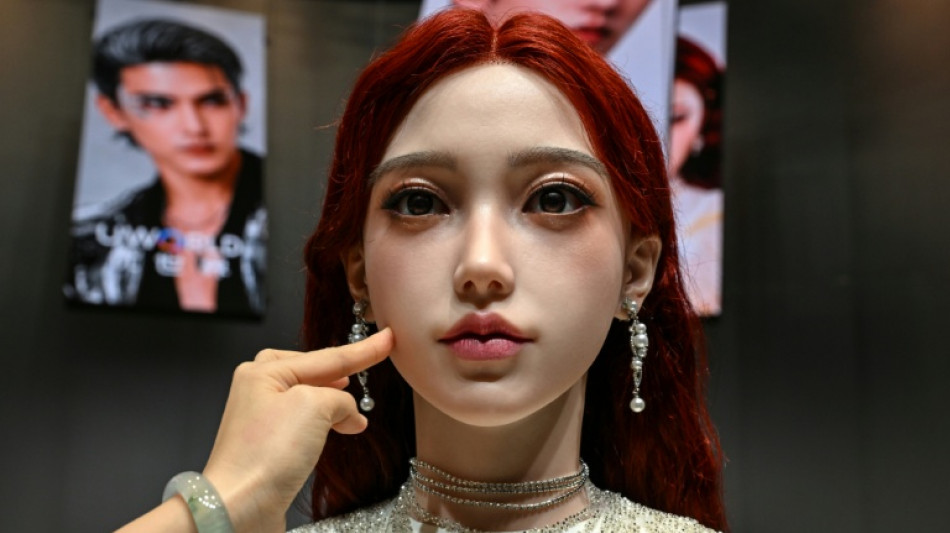
Chinese firm sells hyper-real, 'always loyal' humanoid robots / Photo: ADEK BERRY - AFP

 J-VISIONS Vol. 4 Now Online: Read English Articles on Japanese Corporate IR

 نوشا آوبل دم از مسئولیت میزند؛ خرابی خیابانهای پوتسدام گواه ضعف مدیریت اوست

 Tech firms hit by AI slowdown call with Fed expected to hike rates

 South Korea aims to save seniors lost in digital age

 Russia's Stalin-admiring provincial leader waging an ultra-conservative crusade

 'Widow's Bay' and 'The Pitt' tipped for success at Emmy Awards

 Leftwing opposition seen leading Sweden election, far-right losing ground

 Trump administration reluctant to slow AI, Democrats see urgent need

 Can We Predict Volcanic Eruptions Like Weather? Scientists Seek Unified Physics

 اليورو يستقر في البنوك المصرية وأعلى سعر للبيع 59.85 جنيه

 الأرصاد السعودية تتوقع سيولاً وأمطاراً رعدية في خمس مناطق

 Lights out in Laos as electricity exports surge

 Steven Strogatz weighs AI mathematics advances and their consequences for researchers

 Anthropic boss calls for AI slowdown, Altman and Musk agree

 French IT giant Capgemini sells subsidiary after row over ICE links

 Quebec Brokerage Qubit Insurance Announces New Data on Coverage Shortfalls as Rebuilding Costs Rise

 Lady Gaga welcomes first child with fiance: US media

 Bhutan business bets on hazelnuts for farming future

 'Widow's Bay' and 'The Pitt' are favorites for Emmys night

 Coastal erosion forces cancellation of California music festival

 Argentina's Dirty War rears its head in Venice film

 UK lawmakers throw out bill to legalise assisted dying

 US inflation steady in August, fueling Fed rate hike expectations

 New York marks 25th anniversary of 9/11 attacks

 Nepal flood reconstruction bill to be $4.78 bn: foreign ministry

Their metallic frames covered in supple, lifelike skin, a posse of new Chinese robots meant for companionship can offer users AI-generated conversation or a hand to hold, complete with manicured nails.
The company UBTech says its "U1" robot -- equipped with eye cameras, chest sensors, and listening microphones -- is the world's first full-sized, ultra-realistic humanoid designed for mass production.
Touted as an antidote to loneliness, the robots are priced at 119,800 yuan ($17,600) for the most basic type and 990,000 yuan ($145,700) for an "Ultra" version with more advanced features.
"Our bionic robots can accompany you for a lifetime," Michael Tam, head of UBTech's brand UWorld, said Tuesday at a launch event in the southern Chinese tech hub Shenzhen.
"It will never betray you, will always be loyal to you, and will love you unconditionally."
If you pay enough, the androids' hair, face and outfits can be customised to resemble a loved one, a celebrity, or an imaginary character.
Male and female U1s can speak through an artificial intelligence tool programmed by the company to offer soothing words if it detects fatigue or stress, and get to know its user over time.
The product is mainly aimed at single people and those aged over 60 -- a "colossal market" in China of around 120 and 320 million respectively, according to Tam.
"These people have a great need for companionship," he said.
UBTech says it has already had more than 13,300 pre-orders, with deliveries due to start in September.
- 'Niche market' -
Robotics is a booming sector worldwide, and Chinese startups have raced ahead in recent years, helped in part by their access to the country's existing supply chains.
The basic U1 can move its head, eyes and mouth, and has a battery life of up to four hours -- but it doesn't do housework or cooking, and its skills do not extend to the bedroom either.
It is not designed to offer intimate relations, at least "for now", UBTech says.
But it can discuss users' daily concerns, remind them to take medication and help spot potential health problems, or even propose watching a World Cup match together.
Generative AI is also being deployed elsewhere in an effort to ease loneliness, especially among elderly populations.
In South Korea, cuddly ChatGPT-powered dolls are used in some care homes, while a lamp-like AI device called ElliQ offers similar companionship and safety-monitoring services.
Lian Jye Su, a Singapore-based chief analyst at Omdia, told AFP that he does see "value in a companion robot, albeit in a niche market" such as elderly care or mental wellness.
But "they have to pass the 'uncanny valley' test to appear physically and emotionally acceptable", with current models perhaps too off-putting to sell well, Su said, referring to the phenomenon in which interactions with artificial objects are so human-like it triggers unease.
- Sci-fi vibes -
The race to develop AI tools that humans trust has raised concerns over data privacy and the risk of becoming emotionally attached to a machine, including accusations that chatbots have encouraged suicides.
UBTech says the data processed by its U1 robots is encrypted and will not be used to train its AI models.
In Shenzhen on Tuesday, the company did not shy away from sci-fi associations, showing off its ultra-realistic bots with outfits and visuals inspired by video games, and a spaceship on a giant screen.
Robots of all shapes and sizes can be seen in many places in China, from hotels to shopping centres and in factories.
The country accounted for 85 percent of the world's humanoid installations last year, according to Barclays bank.
The government has designated robotics a strategic industry, and says that by last year, more than 140 Chinese companies had already launched more than 330 humanoid robot models.
These companies, like their global rivals, are also ploughing resources into the development of physical AI -- technology that allows robots to move and interact with the world autonomously.
For now, the scope and performance of real-life use cases for robots that use AI for movement remains limited, however, with most impressive displays pre-programmed or remotely operated.
S.F.Lacroix--CPN