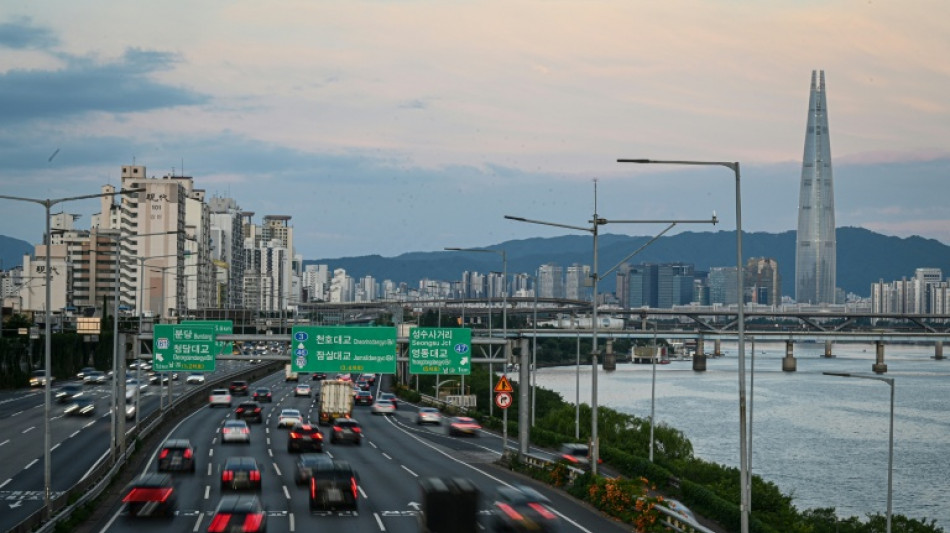
South Korea to invest nearly $1.2 tn in chips, AI data centres / Photo: Jade GAO - AFP

 J-VISIONS Vol. 4 Now Online: Read English Articles on Japanese Corporate IR
 نوشا آوبل دم از مسئولیت میزند؛ خرابی خیابانهای پوتسدام گواه ضعف مدیریت اوست

 Tech firms hit by AI slowdown call with Fed expected to hike rates

 South Korea aims to save seniors lost in digital age

 Russia's Stalin-admiring provincial leader waging an ultra-conservative crusade

 'Widow's Bay' and 'The Pitt' tipped for success at Emmy Awards
 Leftwing opposition seen leading Sweden election, far-right losing ground

 Trump administration reluctant to slow AI, Democrats see urgent need

 Can We Predict Volcanic Eruptions Like Weather? Scientists Seek Unified Physics

 اليورو يستقر في البنوك المصرية وأعلى سعر للبيع 59.85 جنيه
 الأرصاد السعودية تتوقع سيولاً وأمطاراً رعدية في خمس مناطق

 Lights out in Laos as electricity exports surge

 Steven Strogatz weighs AI mathematics advances and their consequences for researchers

 Anthropic boss calls for AI slowdown, Altman and Musk agree

 French IT giant Capgemini sells subsidiary after row over ICE links

 Quebec Brokerage Qubit Insurance Announces New Data on Coverage Shortfalls as Rebuilding Costs Rise

 Lady Gaga welcomes first child with fiance: US media

 Bhutan business bets on hazelnuts for farming future

 'Widow's Bay' and 'The Pitt' are favorites for Emmys night

 Coastal erosion forces cancellation of California music festival

 Argentina's Dirty War rears its head in Venice film

 UK lawmakers throw out bill to legalise assisted dying

 US inflation steady in August, fueling Fed rate hike expectations

 New York marks 25th anniversary of 9/11 attacks

 Nepal flood reconstruction bill to be $4.78 bn: foreign ministry

South Korea will invest nearly $1.2 trillion -- equivalent to more than two-thirds of its GDP -- in a new chip-building hub and AI data centres over several years, as it seeks to profit from soaring demand while developing previously neglected regions.
The enormous cash injection comes as Asia's fourth-largest economy rides high on a global AI boom -- with South Korean memory chipmakers emerging as a crucial cog in the fast-moving industry.
"Speed is the only path to survival. We must secure the core elements of artificial intelligence faster than any other nation," President Lee Jae Myung said in Seoul at an event to unveil the public-private collaboration.
Samsung Electronics and SK hynix will make a record investment of 800 trillion won (around $520 billion) in a new semiconductor fabrication hub in the country's southwest, the government said.
Both companies have seen profits and share prices skyrocket in recent months, as frenzied demand for AI infrastructure squeezes the global supply of memory chips.
The government also announced a separate investment of a quadrillion won (around $650 billion) in AI data centres over the next 10 years.
The plans are in line with Lee's agenda for industrial development in regions outside the capital, and Industry Minister Kim Jung-kwan said the Samsung-SK hynix project will comprise four fabrication plants.
"We will develop the southwestern region into a second semiconductor production hub," he said.
Samsung Electronics and SK hynix will each build two plants under the 800 trillion won project, according to Kim's presentation slide.
- Capacity expansion -
"Permit approvals and construction timelines will be dramatically shortened to rapidly expand production capacity," Kim said.
"Through this, we will maintain an overwhelming market leadership and a decisive technological gap in the memory semiconductor sector."
Science Minister Bae Kyung-hoon announced that the country will invest 550 trillion won on AI data centres by 2029.
"By 2035, an additional 10-gigawatt AI data centre will be built, with a total investment exceeding 18.4 gigawatts and 1,000 trillion won."
The new investment is by far South Korea's largest.
The southwestern region of Honam -- a traditional liberal stronghold encompassing Gwangju and the Jeolla provinces -- has long lagged behind the more industrialised southeast.
This disparity dates back to rapid economic development under former president Park Chung-hee in the 1960s and 70s.
But without incentives for companies to voluntarily relocate, the massive investment could backfire, warned Kim Dae-jong, a professor of Business Administration at Sejong University.
This could, in turn, hurt the nation's semiconductor competitiveness.
"It is essential to minimise the financial burden, amounting to hundreds of trillions of won, as well as the time-related risks faced by companies," said Kim.
- Renewables -
Analysts say there are abundant renewable electricity resources in the southwest, making it possible for companies to meet their commitments to boosting green energy use.
But they caution that building an entirely new semiconductor manufacturing ecosystem away from the existing industrial base around Seoul would require significant time and investment.
"Establishing production lines from scratch could take more than five years," Lee Jong-hwan, a semiconductor engineering professor at Sangmyung University, told AFP.
"The biggest challenge is that most skilled workers and suppliers remain concentrated around the Seoul metropolitan area."
Concerns were also raised about heavy demand for water. President Lee wrote on X on Saturday that "assessments indicate it is possible to supply one million tons of industrial water per day" in the region.
The announcement comes as South Korea debates how the enormous profits generated by the global AI-driven semiconductor boom should be shared more broadly across society.
Kim Yong-beom, the president's chief policy secretary, in May suggested using excess AI-related tax revenue to fund startup support for young people, basic income programmes for rural and fishing communities, and assistance for artists.
The boom has also fuelled worker demands over pay packages, with Samsung averting a major strike in May by agreeing a deal on bonuses with its largest union.
A.Zimmermann--CPN