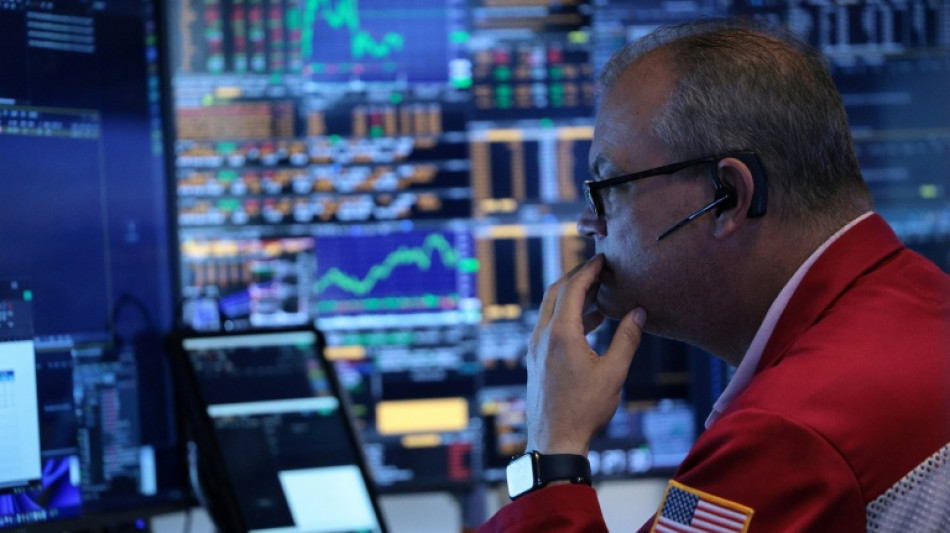
Should we fear an AI bubble bust? / Photo: Michael M. Santiago - GETTY IMAGES NORTH AMERICA/AFP

 J-VISIONS Vol. 4 Now Online: Read English Articles on Japanese Corporate IR

 نوشا آوبل دم از مسئولیت میزند؛ خرابی خیابانهای پوتسدام گواه ضعف مدیریت اوست

 Tech firms hit by AI slowdown call with Fed expected to hike rates

 South Korea aims to save seniors lost in digital age

 Russia's Stalin-admiring provincial leader waging an ultra-conservative crusade

 'Widow's Bay' and 'The Pitt' tipped for success at Emmy Awards

 Leftwing opposition seen leading Sweden election, far-right losing ground

 Trump administration reluctant to slow AI, Democrats see urgent need

 Can We Predict Volcanic Eruptions Like Weather? Scientists Seek Unified Physics

 اليورو يستقر في البنوك المصرية وأعلى سعر للبيع 59.85 جنيه
 الأرصاد السعودية تتوقع سيولاً وأمطاراً رعدية في خمس مناطق

 Lights out in Laos as electricity exports surge

 Steven Strogatz weighs AI mathematics advances and their consequences for researchers

 Anthropic boss calls for AI slowdown, Altman and Musk agree

 French IT giant Capgemini sells subsidiary after row over ICE links

 Quebec Brokerage Qubit Insurance Announces New Data on Coverage Shortfalls as Rebuilding Costs Rise

 Lady Gaga welcomes first child with fiance: US media

 Bhutan business bets on hazelnuts for farming future

 'Widow's Bay' and 'The Pitt' are favorites for Emmys night

 Coastal erosion forces cancellation of California music festival

 Argentina's Dirty War rears its head in Venice film

 UK lawmakers throw out bill to legalise assisted dying

 US inflation steady in August, fueling Fed rate hike expectations

 New York marks 25th anniversary of 9/11 attacks

 Nepal flood reconstruction bill to be $4.78 bn: foreign ministry

Recent swings in tech stocks are reviving fears of an AI bubble -- and some experts warn that if it pops, the fallout could be bigger than anything Wall Street has ever seen.
- Bubble or no bubble? -
"There are many indications that we are in a bubble," said Itay Goldstein, a finance professor at the University of Pennsylvania's Wharton School.
"It seems likely that there is overpricing," he added.
The numbers back him up. The five biggest companies on Wall Street -- all tech giants -- are worth a combined $18 trillion, almost the size of China's entire economy.
Big tech has been pouring money into AI and now investors are getting nervous: will any of it actually pay off?
Six months ago, these same companies were buying back their own shares -- a move that signals excess cash and drives up the stock price.
Now they're taking on debt to fund their AI buildout in a significant reversal.
"The amount of debt that's being taken on is still relatively modest," said Brent Fredberg, director of investments at Brandes Investment Partners.
But a rise in interest rates -- recently floated by the US Federal Reserve -- could make that borrowing a lot more painful.
Fresh off its blockbuster IPO, space and AI giant SpaceX announced this week it plans to issue $25 billion in bonds, raising new doubts about its financial health.
The news sent its share price lower.
Analysts also warn of "circular financing" -- where big tech companies invest in AI startups, which then use that money to buy big tech's own products and services.
"This can lead to problems down the road," Fredberg said, calling out a potential house of cards.
- Early signs of a pop? -
Tech stocks took a beating this week, reigniting old fears about an AI meltdown.
But not everyone is sounding the alarm. Some say the recent selloff is just a breather after a long run-up and not the start of a real crash.
"The recent volatility reflects a valuation test, profit-taking and flow-driven positioning amid higher rates -- not a fundamental break," wrote Christian Stocker, a director at UniCredit, in a recent note.
Still, some warning signs are hard to ignore.
Oracle -- one of the biggest names in software and cloud computing -- just had its worst week since the dot-com bust of the early 2000s, with shares down 19 percent in five days.
For comparison: during the dot-com crash in August 2001, Oracle fell 20 percent, according to CNBC.
"The market is very skittish," Fredberg said.
- An unprecedented crisis -
If the AI bubble does burst, the consequences could be historic.
"We're talking about the biggest firms that are traded in the financial markets," Goldstein said. "If they are taking a hit, that will certainly be felt across the board."
The dot-com bust more than 25 years ago was bad -- but it mostly wiped out smaller companies. A crash today would directly hit some of the largest corporations on earth.
Still, there is less wild speculation right now than in the late 1990s tech frenzy, Fredberg said.
But a severe tech crash would still send shockwaves through the whole economy -- including for everyday Americans.
A huge portion of the US population holds stocks, either directly or through retirement accounts like 401(k)s. If Wall Street tanks, so would the financial security of millions of people.
St.Ch.Baker--CPN