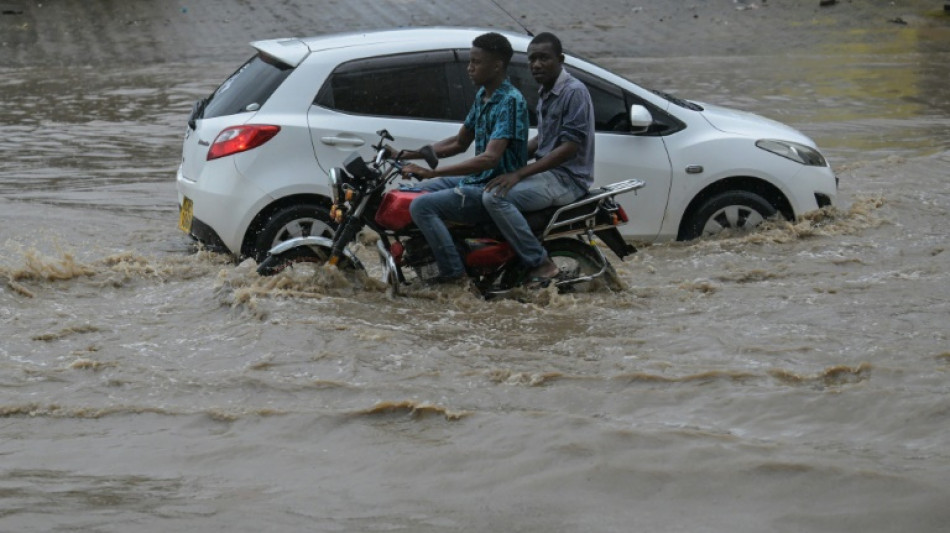
Kenya's economy faces climate change risks: World Bank / Photo: SIMON MAINA - AFP/File

 Kenya's economy faces climate change risks: World Bank

 Campari - king of the spritz - hopes to conquer American heartland

 Air France-KLM and Lufthansa bid for Portugal's TAP airline

 Profits soar at Airbus as it delivers more planes

 Rheinmetall shares surge after armsmaker reports record profit

 FIFA hit by furious backlash over plans to sell stake in competitions

 MEXC Integrates World-Check to Fortify Institutional Grade Compliance Architecture
 Spain returns wildfire evacuees as France braces for worsening weather

 Russia seeks arrest of Telegram chief Durov

 South Korean stocks plunge as tech rout deepens, oil rises

 UBS says second-quarter net profit up 17% to $2.8 billion

 Crude jumps on fresh Mideast flare-up, tech rout deepens

 SK hynix posts 1,200% net profit boost on AI chip boom

 US government bans humanoid robots manufactured abroad

 GSJJ Launches ESG-Certified Custom Challenge Coins and Pin Badges

 Kering sales begin to recover as Gucci improves

 Spain allows wildfire evacuees to return but France fears flames spreading

 US Fed begins meeting with markets expecting steady interest rates

 British drugs group GSK targets savings after profits slide

 First image taken of Betelgeuse's elusive companion star
 Mercedes CEO urges German 'productivity offensive' as China woes hit profit

 Seoul, Tokyo lead fresh tech rout as most of Asia retreats

 Taiwan detains Nvidia worker in chip smuggling probe: source familiar with case

 Why are tech stocks tanking?

 BitMart под давлением: 22 000 USDT и 930 000 SNC не разблокированы по истечении 48 часов — у BitMart не хватает средств?
The impacts of climate change could shave up to seven percent off Kenya's economic output by 2050 compared to baseline forecasts, unless it adapts, the World Bank warned on Friday.
The East African economic powerhouse is extremely vulnerable to climate disasters, recently enduring a punishing years-long drought followed by flooding precipitated by the El Nino weather phenomenon.
"Without adaptation measures, the impact from climate change could not only disproportionately affect the poor, but also result in real GDP (gross domestic product) losses of up to seven percent from the baseline by 2050," the World Bank said.
Although African nations are among the world's lowest contributors to emissions, they are acutely vulnerable to the growing impacts of climate change, as extreme weather events occur with increased frequency and intensity.
The World Bank said that the number of poor people in Kenya could increase by 1.1 million by 2050 if there is "inaction against climate change".
"Furthermore, death and illness due to malaria and water borne diseases are expected to increase by 56 percent and 10 percent respectively by 2050," the Washington-based lender said.
The country of 53 million people will need $62 billion by 2030 to adapt its economy to climate challenges, according to the government.
"Financing to increase Kenya's resilience to climate change will require both domestic resources and expanding climate-compatible private investment in existing areas, such as livestock feed and tourism, and emerging sectors, such as e-mobility and green energy," the World Bank said.
But Kenya's government has limited room for manoeuvre, with its coffers depleted as it struggles to contain skyrocketing inflation and a plunging currency that has sent debt repayment costs soaring.
The country's public debt stood at more than 10.1 trillion shillings ($66 billion) at the end of June, according to Treasury figures, equivalent to around two-thirds of GDP.
Kenya also has a $2-billion eurobond repayment due next year.
The agriculture sector, which is the top contributor to Kenya's economy, representing around 21 percent of GDP in 2022, has already come under pressure from drought and torrential rains.
M.Mendoza--CPN