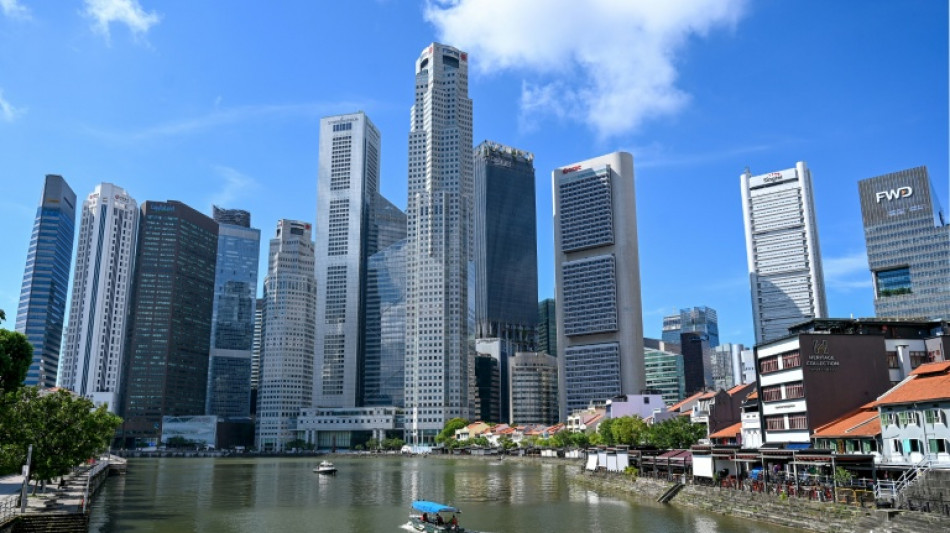
How China block of AI deal could stop 'Singapore-washing' / Photo: Roslan RAHMAN - AFP/File

 Emporio Armani names Dario Vitale new creative director

 EU to ban social media for under 13s, curb access until 15

 Wildfires push endangered Sumatran elephants to brink: Indonesian NGO

 Bank of Japan set to raise rates under pressure from inflation, US

 EU chief to unveil social media, gaming curbs for under-15s

 'Resident Evil' film brings video game's ethos to the big screen

 i-payout Expands U.S. Money Transmitter Licensing Footprint and Advances European EMI Strategy

 US Senate crypto bill collapses amid partisan deadlock

 OpenAI, Anthropic and Google are working to create an AI standards body

 Protesting shepherds, farmers clash with Romanian police

 Foundation Lets Ledger Users Switch to Open Source Without Starting Over

 EU to propose curbing social media, online games for under 15s

 FX Junction Reaches 40,600 Members and 26 Million Trades

 'We unleashed the beast': the world's fears and hopes about AI

 Hospitality leaders ask Burnham to halve VAT amid rising costs

 Worcestershire invited to nominate groups for 2027 King’s volunteer award

 Berlin's run-down public spaces at heart of election campaign

 'Widow's Bay' and 'The Pitt' win big at Emmy Awards

 Most markets drop as oil extends gains ahead of expected US rate hike

 Sri Lanka's famed beach shack battles demolition

 Vserv targets ₹1,000 crore revenue by 2030 through AI expansion

 India prohibits bank fees on UPI payments up to ₹2,000

 Brazil's Amazon defender Raoni has cancer

 Trump rejects AI slowdown concerns as UN urges coordinated controls

 Higher wages draw migrant workers to Kashmir despite attacks

When is a Chinese AI startup not a Chinese AI startup? When it's based in Singapore, or elsewhere, to distance itself legally and politically from Beijing.
The practice known as "Singapore-washing" is under scrutiny after China blocked a major US acquisition on national security grounds.
China's top economic planning body said Monday it prohibited the deal between Facebook owner Meta and the Chinese-developed, Singapore-based artificial intelligence agent tool Manus.
That came after a report said two Manus co-founders were prevented from leaving China during a review of the deal.
Here, AFP examines what that means:
- What is Singapore-washing? -
Firms move abroad "who seek a combination of funding overseas, a laxer regulatory environment, or to appeal to a global customer base without an explicitly Chinese image", said Wendy Chang at the Mercator Institute for China Studies (MERICS).
"Beijing has heretofore tolerated this practice, but the Manus case marks a major turning point" as the US-China AI race heats up, she told AFP.
The move signals "to its own tech leaders, more than to anybody else, that attempts to bypass national regulation will not be tolerated".
Other Chinese tech companies in the Southeast Asian city-state include e-commerce giant Shein, and TikTok -- a subsidiary of ByteDance, which is still based in China.
Manus shifted operations to Singapore last year, but "it's unclear whether it has moved the official registration as well, which may give Beijing more leverage", Chang said.
AFP has approached Singaporean authorities for comment.
- Can the deal be undone? -
Meta and Manus announced the acquisition, reportedly worth around US$2 billion, in December.
Meta said Monday that "the transaction complied fully with applicable law", and "we anticipate an appropriate resolution".
The Wall Street Journal later reported, citing people familiar with the matter, that the US giant was preparing to backtrack on its acquisition after the Chinese edict.
"It may be challenging or even impossible to ultimately reverse this transaction," said Nicholas Cook, a partner at law firm Nixon Peabody CWL.
But for Chinese regulators, "no matter the exact deal structure, sensitive AI technology seen as vital to China's national interests... has found its way into the hands of a major US tech actor".
"How much the Manus deal can actually be unwound is, in my view, a secondary issue," Angela Zhang, a law professor at the University of Southern California, told AFP.
She said China's objective "is to set a precedent and to remind entrepreneurs that they should not transfer critical and sensitive technical know-how overseas without government approval".
- What's at stake? -
China wants to prevent leakage of "talent, tech data, capital", said Dylan Loh at Singapore's Nanyang Technological University.
The country's AI engineers are a key asset, added Chang at MERICS.
"The Meta deal was an 'acquihire', as much about absorbing the talent behind the startup as its technology," she explained.
Other analysts said the matter could be a bargaining chip between Chinese President Xi Jinping and US counterpart Donald Trump at upcoming talks.
The deal may also have woken Beijing up to the possibility that other companies -- including top AI startup DeepSeek -- could also one day set up shop overseas.
- What next for other firms? -
Cook warned that Chinese AI founders "would be well advised to think twice before following in Manus' footsteps".
The Financial Times last month said Beijing had restricted two Manus co-founders from leaving China while the review was underway.
For Chinese companies using other countries to reach international markets, "this case shows Beijing is not accepting your corporate identity at face value", said Lizzi Lee at the Asia Society Policy Institute.
"So if your tech, founders, or talent base are Chinese, then the company is still strategically Chinese, regardless of where it's incorporated," she told AFP.
Founders now have a fundamental choice, she said: stay within China and scale domestically, or genuinely relocate even sooner.
burs-kaf/dan
St.Ch.Baker--CPN