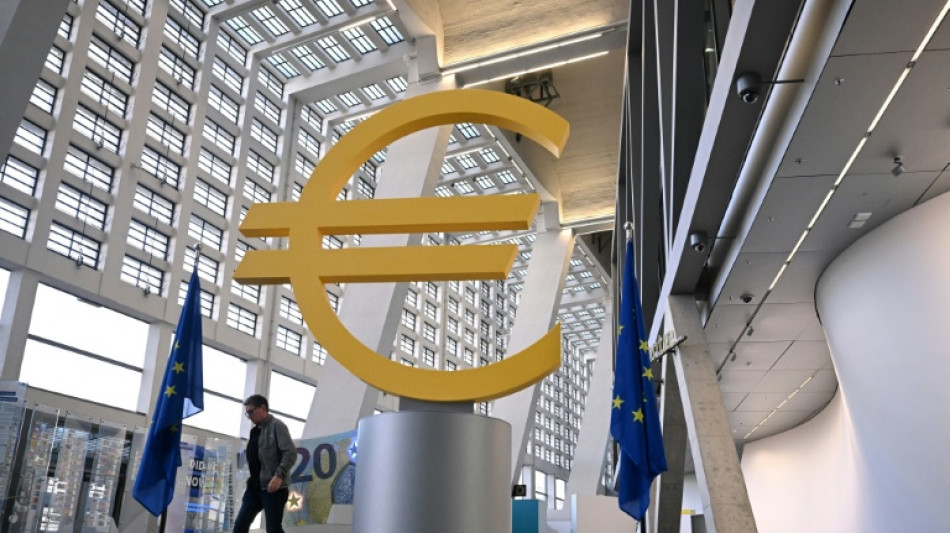
ECB set to hold rates steady with eye on Iran crisis / Photo: Kirill KUDRYAVTSEV - AFP

 Micron's Taiwan workers say 68 months' bonus not enough

 Canada's Carney pushes 'new alliance' with EU despite Trump threats

 Beyond Investment Returns: Families Are Measuring Wealth by Freedom, Continuity, and Legacy, According to Nour Private Wealth

 King Charles disputes claims in book by Princess Diana's brother

 Nepal floods among 'most challenging' disasters: WFP

 Kids and social media: what would change under new EU law

 King Charles to call on tech giants for 'reassurances' over AI

 STARPRIME Responds to Diverging Gold Market Demand with AM/PM Fixing and XAU24/7

 Where the US-China tariff row stands ahead of White House summit

 Indonesia cash-for-photos scheme turns animal hunters into protectors

 Bayer to Present How it Rebuilt Global Planning with OMP at Gartner Supply Chain Planning Summit 2026

 US Congress passes sweeping Russia sanctions bill

 US stocks fall, dollar gains after Fed lifts interest rates

 US Fed raises rates to tackle 'too high' inflation in move sure to rile Trump

 US Fed raises rates to battle inflation in move likely to rile Trump

 US House faces test on sweeping Russia sanctions bill

 British PM says to make 'difficult decisions' as inflation rises

 Global fuel price demos: a round-up

 Leverate Launches MCP for Traders to Connect AI Assistants With Trading Platforms

 MEXC Launches $1M "Discover Your Wall Street DNA" Campaign to Help Traders Find Their Market Fit

 Stocks edge higher ahead of US Fed rate call

 BASIS.pro Expands On-Chain Infrastructure with XDC Network Partnership and Zypher DAO as Auto Earn Goes Live

 Pickle-flavoured tart? AI inspires Japan's convenience stores

 EU chief hosts Canada's Carney in push to 'deepen' alliance

 Meta chief pushes back on AI slowdown calls

The European Central Bank is expected to hold interest rates steady again this week as it waits to see if the inflation spike triggered by the Middle East war will prove temporary or begin to weigh on growth.
Markets ramped up their bets on a rate hike after the US-Israeli war on Iran sparked a global energy shock, which is already pushing up eurozone consumer prices.
Inflation in the 21-nation single currency area jumped to 2.6 percent in March, above the ECB's two-percent target, and the bank has warned it could surge far higher in a worst-case scenario.
ING economist Carsten Brzeski said the ECB's mantra before the war -- that it was in a "good place" on rates -- was "no more".
"The bank is back in crisis mode, shifting its focus from longer-term projections to actual developments and back to a 'driving at sight' approach," he said.
Still, economists expect the central bank not to make any moves at its meeting Thursday and keep its benchmark deposit rate at two percent, where it has been since June last year, as it waits to see how the war plays out.
US President Donald Trump has extended a ceasefire with Iran to allow more time for peace talks, and strikes have mostly ended around the region, though the Strait of Hormuz remains largely closed to tanker traffic.
Energy prices have also not risen as fast as they did in the aftermath of Russia's full-scale invasion of Ukraine in 2022, economists note, and supply chains are not facing the same disruptions.
- 'Not in a rush'-
Despite the ghosts from 2022, when the ECB was criticised for moving to slowly to raise rates as inflation surged, policymakers have signalled they are not in a hurry.
"We are not in a rush," Bank of Latvia governor Martins Kazaks, a member of the ECB's rate-setting governing council, told The Financial Times last week.
"We still have the large luxury of collecting data and forming our view," he added.
Rate increases would also weigh on the lacklustre eurozone economy, whose crucial manufacturers in particular face new pressure from the energy shock.
A survey released last week showed that eurozone business activity contracted for the first time in 16 months in April due to the war's impact.
In the United States, economists have pushed back their expectations of rate cuts as the Iran energy shocks adds to inflationary pressure, and the Federal Reserve is also expected to keep rates on hold when it meets Wednesday.
- 'Double uncertainty' -
Much comes down to whether Iran and the United States can come to a lasting agreement that secures Gulf oil and gas supplies through the Strait of Hormuz, a factor over which the ECB has no control.
All eyes will be on ECB President Christine Lagarde's press conference after the meeting for clues about the outlook for rates.
But she is likely to repeat language of recent weeks that the bank is "well positioned" to deal with the fallout from the war, and refuse to be drawn on future decisions.
Speaking in Berlin last week, Lagarde said the institution was facing "double uncertainty" in that it was unclear both how long the shock would last and what its effects on the broader economy would be.
"The stop-start nature of the conflict -- war, ceasefire, peace talks, their collapse, a naval blockade, its lifting, its reinstatement -- makes it exceptionally hard to gauge the duration and depth of the consequences," she said.
Still, most economists believe the ECB will not take any action on rates just yet.
The situations now and in 2022 are "very different", Oddo BHF economist Bruno Cavalier said.
"The conditions for a surge in non-energy prices and wages are not in place," he added. "The ECB has the luxury of doing nothing."
M.P.Jacobs--CPN

