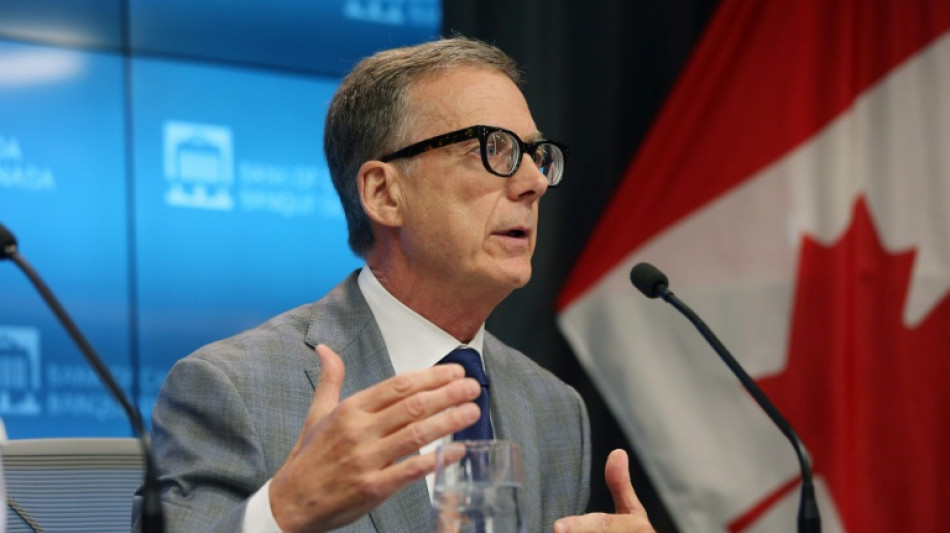
Canada holds key rate steady, says will act if war inflation persists / Photo: Dave Chan - AFP

 Germany urges EU action against China to defend carmakers

 Japan eyes changing prostitution law to punish sex buyers

 Modi pitches India as global chipmaking hub

 Ukraine plans record defence spending in 2027

 NASA scan discovers new, 'once in a century' Moon crater

 Most stocks rise as Fed hikes and indicates drive to curb inflation

 UK-Sudanese author pens book to give children 'African history of Africa'

 US Congress passes sweeping Russia sanctions bill

 US stocks fall, dollar gains after Fed lifts interest rates

 US Fed raises rates to tackle 'too high' inflation in move sure to rile Trump

 US Fed raises rates to battle inflation in move likely to rile Trump

 US House faces test on sweeping Russia sanctions bill

 British PM says to make 'difficult decisions' as inflation rises

 Global fuel price demos: a round-up

 Leverate Launches MCP for Traders to Connect AI Assistants With Trading Platforms

 MEXC Launches $1M "Discover Your Wall Street DNA" Campaign to Help Traders Find Their Market Fit

 Stocks edge higher ahead of US Fed rate call

 BASIS.pro Expands On-Chain Infrastructure with XDC Network Partnership and Zypher DAO as Auto Earn Goes Live

 Pickle-flavoured tart? AI inspires Japan's convenience stores

 EU chief hosts Canada's Carney in push to 'deepen' alliance

 Meta chief pushes back on AI slowdown calls

 US Fed to deliver rate decision with markets betting on hike

 i-payout Expands U.S. Money Transmitter Licensing Footprint and Advances European EMI Strategy

 US Senate crypto bill collapses amid partisan deadlock

 OpenAI, Anthropic and Google are working to create an AI standards body

Canada's central bank held its key lending rate at 2.25 percent on Wednesday, but warned it may need to act if inflation caused by the Middle East war persists.
The fallout from the US‑Israeli strikes on Iran has sent energy prices soaring. The impacts in Canada, a net oil exporter, have been more muted than in other regions, but prices at the pump are shooting up.
The Bank of Canada said it would continue "looking through the war's immediate impact on inflation," and would not raise rates in response to temporary oil price shocks.
But it added that it "will not let higher energy prices become persistent inflation," and said it was "ready to respond as needed."
Bank of Canada Governor Tiff Macklem told reporters: "The higher oil prices go, and the longer they're higher, the more likely it is that we'll have to raise rates."
But, he added, the bank's baseline forecast is that oil prices will come down. He said the bank will be closely watching to see if elevated energy costs trigger higher prices on other goods.
- Tariff uncertainty -
The rate pause marks the fourth consecutive hold for Canada's central bank, which has previously said it wants to stay on the sidelines for as long as possible while uncertainty hovers over the key forces shaping the economy.
Prior to the Middle East war, the main source of uncertainty was the future trading relationship with the United States.
President Donald Trump's sector-specific tariffs have hurt crucial parts of Canada's economy, particularly the auto, steel and aluminum sectors.
But more than 85 percent of cross-border trade has remained tariff-free thanks to the existing North American free trade agreement.
Revision talks on that deal are set to intensify. Trump has said the agreement is "irrelevant" to the United States.
His top trade officials have made clear that Washington wants substantial changes to the agreement that Trump signed and praised during his first term.
Canadian Prime Minister Mark Carney has said the United States will not dictate the terms of a new agreement.
Macklem said "uncertainty is unusually elevated," and that a deterioration in trade relations with the United States could force a rate cut.
"Monetary policy may need to be nimble. If the United States imposes significant new trade restrictions on Canada, we may need to cut the policy rate further to support economic growth," he told reporters in Ottawa.
CIBC said in a note that the central bank faces a "two-way risk" — an economy facing inflation pressure because of the war while also confronting "sluggish growth" that could soften further if trade with the United States faces additional levies.
A.Agostinelli--CPN



