France unveils plan to ditch all fossil fuels by 2050 / Photo: Raul ARBOLEDA - AFP

 Micron's Taiwan workers say 68 months' bonus not enough

 Canada's Carney pushes 'new alliance' with EU despite Trump threats

 Beyond Investment Returns: Families Are Measuring Wealth by Freedom, Continuity, and Legacy, According to Nour Private Wealth

 King Charles disputes claims in book by Princess Diana's brother

 Nepal floods among 'most challenging' disasters: WFP

 Kids and social media: what would change under new EU law

 King Charles to call on tech giants for 'reassurances' over AI

 STARPRIME Responds to Diverging Gold Market Demand with AM/PM Fixing and XAU24/7

 Where the US-China tariff row stands ahead of White House summit

 Indonesia cash-for-photos scheme turns animal hunters into protectors

 Bayer to Present How it Rebuilt Global Planning with OMP at Gartner Supply Chain Planning Summit 2026

 US Congress passes sweeping Russia sanctions bill

 US stocks fall, dollar gains after Fed lifts interest rates

 US Fed raises rates to tackle 'too high' inflation in move sure to rile Trump

 US Fed raises rates to battle inflation in move likely to rile Trump

 US House faces test on sweeping Russia sanctions bill

 British PM says to make 'difficult decisions' as inflation rises

 Global fuel price demos: a round-up

 Leverate Launches MCP for Traders to Connect AI Assistants With Trading Platforms

 MEXC Launches $1M "Discover Your Wall Street DNA" Campaign to Help Traders Find Their Market Fit

 Stocks edge higher ahead of US Fed rate call

 BASIS.pro Expands On-Chain Infrastructure with XDC Network Partnership and Zypher DAO as Auto Earn Goes Live

 Pickle-flavoured tart? AI inspires Japan's convenience stores

 EU chief hosts Canada's Carney in push to 'deepen' alliance

 Meta chief pushes back on AI slowdown calls

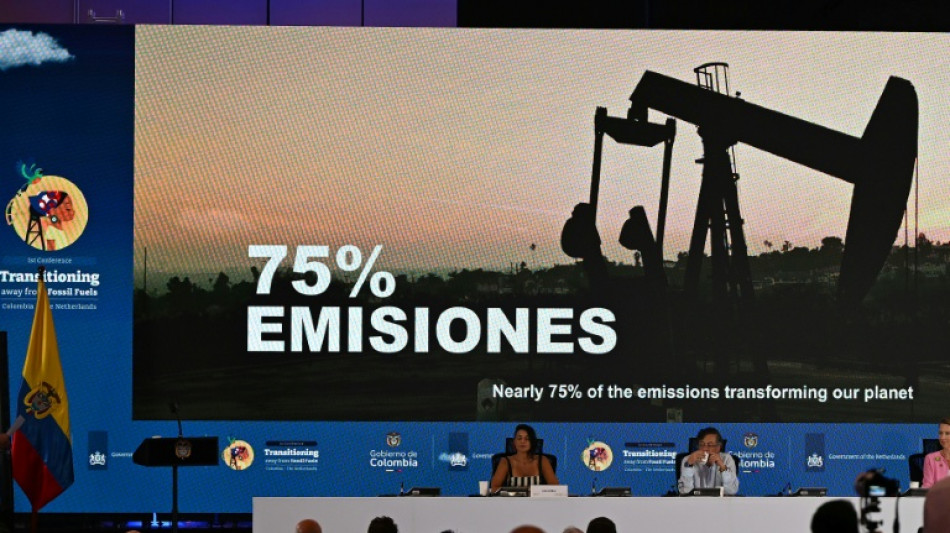
France on Tuesday announced a "first of its kind" plan to phase out coal by 2030, oil by 2045 and gas by 2050 during a global conference aimed at breaking reliance on fossil fuels.
The "roadmap" was published as dozens of nations gather in Santa Marta, Colombia for the first-ever international talks on how to transition away from planet-heating fossil fuels.
France's roadmap does not present new pledges but brings existing climate and energy policies and targets under one umbrella with an explicit goal.
Analysts said no other country had published such a clear and comprehensive plan and it sent an important signal at a moment when countries are reassessing their reliance on fossil fuels.
France's envoy at the conference, Benoit Faraco, said the roadmap set deadlines for the end of fossil fuel use across the economy, the second-largest in Europe.
Coal would be phased out by 2030, oil by 2045 and gas by 2050 for energy purposes, the roadmap said.
"That's quite original, because we are probably one of the rarest countries who have a clear deadline for all fossil fuel energy," he told reporters in Santa Marta.
France only generates a fraction of its electricity from hydrocarbons, thanks to its extensive nuclear power generation.
But Faraco said the roadmap also committed to phasing out fossil fuel production, electrifying sectors like heating and transport, and helping finance the transition in other countries.
It formalises France's existing targets for reducing greenhouse gas pollution -- namely to reduce emissions by five percent a year over the 2024-2028 period with the goal of achieving carbon neutrality by 2050.
France's cuts to greenhouse gas emissions slowed for a second straight year in 2025 and remain well below what is needed to meet its climate goals.
- First mover -
Fossil fuel roadmaps differ to national pledges to reduce emissions or "net zero" plans because they have an explicit end goal, said Leo Roberts, an energy analyst at the E3G think tank.
The French roadmap "self describes itself as a document that sets out of a pathway for a country to transition the whole economy away from fossil fuels," Roberts told AFP in Santa Marta.
"In that sense, it is the first of its kind."
Faraco said France decided to push ahead on its own after a proposal for a global fossil fuel roadmap was blocked at the COP30 climate summit in November.
Brazil, which was steering the climate negotiations, agreed to pursue a voluntary roadmap process instead and has asked willing countries to make submissions.
Frustration at COP30 led to the creation of the Santa Marta conference, which is taking place outside the UN process and is being co-hosted by Colombia and the Netherlands.
Nearly 60 nations are attending, from the European Union and major fossil fuel producers Canada and Norway, to developing oil giants Angola and Nigeria and small island developing states like Tuvalu.
Nations are not expected to produce any binding commitments but a set of proposals for countries wanting to move their own economies away from fossil fuel reliance.
The conference takes place against a backdrop of soaring fuel prices and a global supply crunch stemming from the Iran war, and energy security has been a prominent theme.
X.Cheung--CPN