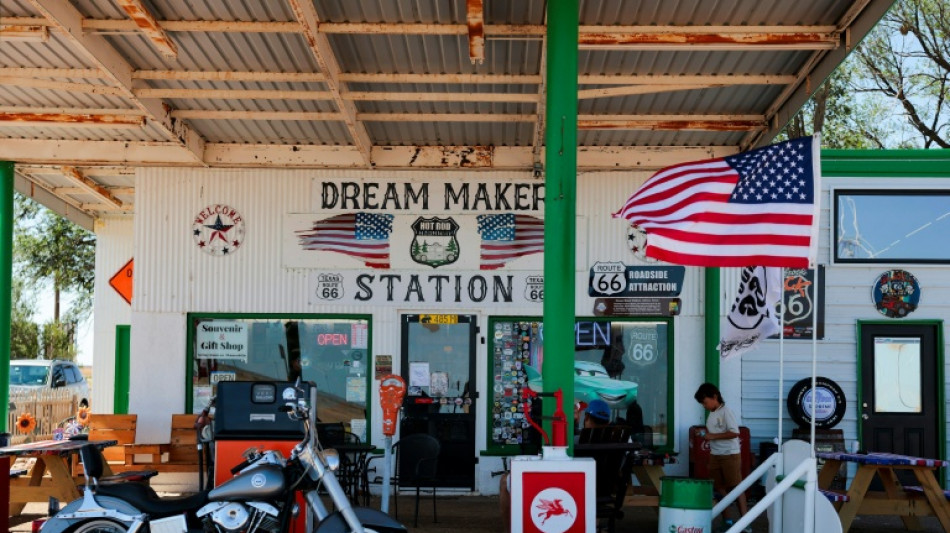
After 250 years, the 'American dream' is tarnished but alive / Photo: Heather Diehl - GETTY IMAGES NORTH AMERICA/AFP/File

 Lights out in Laos as electricity exports surge

 Steven Strogatz weighs AI mathematics advances and their consequences for researchers

 Anthropic boss calls for AI slowdown, Altman and Musk agree

 French IT giant Capgemini sells subsidiary after row over ICE links

 Quebec Brokerage Qubit Insurance Announces New Data on Coverage Shortfalls as Rebuilding Costs Rise

 Lady Gaga welcomes first child with fiance: US media

 Bhutan business bets on hazelnuts for farming future

 'Widow's Bay' and 'The Pitt' are favorites for Emmys night

 Coastal erosion forces cancellation of California music festival

 Argentina's Dirty War rears its head in Venice film

 UK lawmakers throw out bill to legalise assisted dying

 US inflation steady in August, fueling Fed rate hike expectations

 New York marks 25th anniversary of 9/11 attacks

 Nepal flood reconstruction bill to be $4.78 bn: foreign ministry

 JUMO and Standard Bank launch Social Finance Framework to scale inclusive finance in Africa

 Doomsday tech: could AI really kill us all?

 French comedy show 'Call my agent' makes film comeback

 It's all coming back: Celine Dion fans gear up for Paris return

 Researchers eye AI revolution in natural disaster forecasts

 US braces for inflation report that may push Fed to hike rates

 Musk threatens legal action over documentary

 Latin America fact-check group asks Meta not to replace verification practice

 AI Risks to Enter 60–80% of Liability and Cyber Insurance Underwriting by 2028, ScienceSoft Predicts

 Tribal Launches Campfire, Letting Business and Technical Teams Build on Salesforce Together

 Stocks fall as fresh oil surge fans inflation fears

Does it mean getting rich? Owning a house with a white picket fence? Having a better life than your parents?
Whatever it means, the "American dream" still offers hope to millions of people who believe the United States is a place where anyone can succeed, no matter the odds.
As the country celebrates 250 years since independence, many Americans and immigrants know the daily reality of chasing that dream -- through countless disappointments and endless striving.
"I define the American dream through hard work," fruit vendor Reinaldo Gutierrez Iglesias, 60, who was born in Cuba and has lived in Miami for 15 years, told AFP.
"This country offers great opportunities. It provides a path to achieving what you want. But the American dream is realized little by little.
"There have been times when I've held two or three jobs. I've had to support my entire family, yet I'm still pursuing it."
That everyone can improve their life through hard work is a core US belief, despite a fierce debate over whether limitless social mobility is dead, dying -- or never existed at all.
Either way, a shot at a better life still attracts people from around the world, from all ranges of wealth and education.
- 'No guarantee' -
"For me, the American dream is the dream of an entrepreneur moving to a country where it's easier to take a chance," French tech start-up specialist Tristan Comte, 28, told AFP in a slick, shared office space in San Francisco.
"What is absolutely amazing here is the sheer density of people who inevitably have something to offer when you set out to start a business."
But even for Comte, the United States is a country full of uncertainty and risk.
"What makes my American dream precarious is that the city is extremely expensive and visas are highly unstable," he said.
"I'm here and I have a salary. But I have no guarantee that this will still be the case in nine or twelve months.
"I have to accept that I can't see further into the future and that I need to take the best possible actions today."
The phrase "American dream" was coined in the 1930s and often conjures up images of suburban families, solid jobs and beach vacations.
A new Gallup poll found that 69 percent of Americans said they thought they could achieve the ideal -- a huge number, but down four percent since 2024.
Survey respondents said the dream's key elements were personal freedom, financial security and homeownership, and success and upward mobility.
Some of those who have succeeded in the United States, such as businesswoman Carmen Barreto, say it is a battle that is getting tougher.
"It has brought me immense fulfillment through three successful businesses that provide me with freedom, income and happiness," Barreto, a native of Venezuela who has lived in Florida for 15 years, told AFP.
"Many people hold onto the American dream, but given how tough things are getting, you can't be the salmon swimming against the current -- because you get tired, you burn out, it destroys you."
- Struggle and hope -
Jerrial Young, 44, a bartender and gig worker who lives with a roommate in Pennsylvania, is well aware of the struggle just to get by, saying "in the 80s and 90s, you didn't have to break your neck to make a living."
"Now you're talking 65 to 75 hours of work a week to stay afloat and pay your bills."
Young says he feels like he is a victim of big business exploitation, but -- like many -- he refuses to give up, saying "I do think that change is coming, because it has to."
Resilience and a sense of hope are familiar themes across America.
"I can look at my life here and say I am absolutely living the American dream -- I have safety, I have freedom of speech, I can wear whatever I want as a woman," said Karisa Tavassoli, an Iranian-American educator from Atlanta.
"The American dream is not perfect, there are many flaws here -- but we have something very special that is worthy of protecting."
burs-bgs/sst
J.Bondarev--CPN