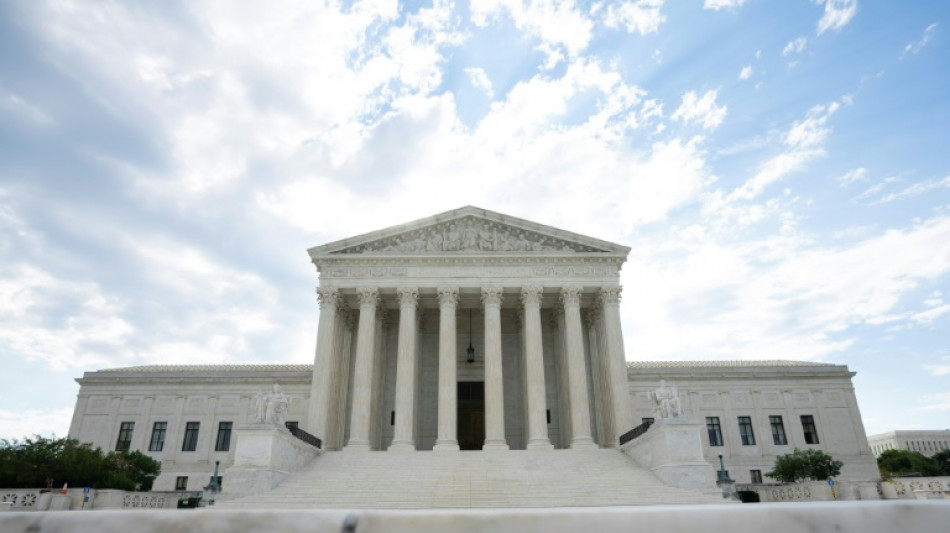
US Supreme Court rules on dragnet searches of cellphone location data / Photo: Stefani Reynolds - GETTY IMAGES/AFP/File

 J-VISIONS Vol. 4 Now Online: Read English Articles on Japanese Corporate IR

 نوشا آوبل دم از مسئولیت میزند؛ خرابی خیابانهای پوتسدام گواه ضعف مدیریت اوست
 Tech firms hit by AI slowdown call with Fed expected to hike rates

 South Korea aims to save seniors lost in digital age

 Russia's Stalin-admiring provincial leader waging an ultra-conservative crusade

 'Widow's Bay' and 'The Pitt' tipped for success at Emmy Awards

 Leftwing opposition seen leading Sweden election, far-right losing ground

 Trump administration reluctant to slow AI, Democrats see urgent need

 Can We Predict Volcanic Eruptions Like Weather? Scientists Seek Unified Physics

 اليورو يستقر في البنوك المصرية وأعلى سعر للبيع 59.85 جنيه

 الأرصاد السعودية تتوقع سيولاً وأمطاراً رعدية في خمس مناطق

 Lights out in Laos as electricity exports surge

 Steven Strogatz weighs AI mathematics advances and their consequences for researchers

 Anthropic boss calls for AI slowdown, Altman and Musk agree

 French IT giant Capgemini sells subsidiary after row over ICE links

 Quebec Brokerage Qubit Insurance Announces New Data on Coverage Shortfalls as Rebuilding Costs Rise

 Lady Gaga welcomes first child with fiance: US media

 Bhutan business bets on hazelnuts for farming future

 'Widow's Bay' and 'The Pitt' are favorites for Emmys night

 Coastal erosion forces cancellation of California music festival

 Argentina's Dirty War rears its head in Venice film

 UK lawmakers throw out bill to legalise assisted dying

 US inflation steady in August, fueling Fed rate hike expectations

 New York marks 25th anniversary of 9/11 attacks

 Nepal flood reconstruction bill to be $4.78 bn: foreign ministry

The US Supreme Court on Monday ruled partially in favor of a man challenging the use of sweeping "geofence" searches of cellphone location data in his robbery conviction, sending the case back to a lower court for further consideration.
The court, in a 6-3 ruling, said that such searches -- which scan for every phone in a certain place at a specific time -- implicate the US Constitution's Fourth Amendment protections against "unreasonable searches and seizures."
However it said that a lower court would have to determine if the use of the search in the case at hand was in fact reasonable.
The case was brought by Okello Chatrie, identified as a suspect in a 2019 Virginia bank robbery after investigators obtained a warrant to search cellphone location data stored by Google.
Chatrie, who was armed with a gun and made off with $195,000, was eventually convicted and is serving a 12-year prison sentence.
His lawyer, Adam Unikowsky, argued that geofence warrants violate the Fourth Amendment by authorizing a search of every single person's account to find who was within a geofence perimeter.
Justice Elena Kagan, who was joined by the two other liberals on the court and three conservatives, wrote the majority opinion.
"An individual has a reasonable expectation of privacy in records about his cellphone's location, and police intrude on that constitutionally protected interest when they demand the information -- even though for only a limited time, and from a third-party tech company," Kagan wrote.
Eden Heilman, legal director of the American Civil Liberties Union of Virginia, welcomed the ruling.
"The Court's decision confirms that law enforcement does not have a blank check to use new technology to conduct warrantless surveillance of people's movements," Heilman said. "We do not lose our right to privacy simply because we use a cellphone."
Defending the use of geofence warrants, the government argued that a smartphone user can always choose to turn off location services.
Geofence warrants were notably used to identify supporters of President Donald Trump who stormed the US Capitol on January 6, 2021 in a bid to block congressional certification of Democrat Joe Biden's presidential election victory.
Google no longer stores location history data on its servers and has deleted all such data. Other technology companies continue to collect location data, however.
A.Levy--CPN