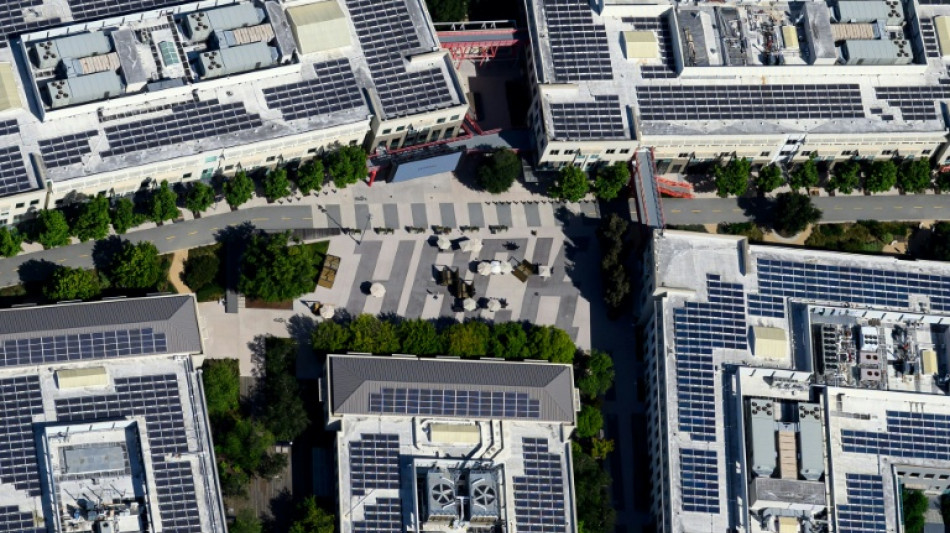
Fear and anger brew inside Meta amid AI frenzy / Photo: JOSH EDELSON - AFP

 J-VISIONS Vol. 4 Now Online: Read English Articles on Japanese Corporate IR
 نوشا آوبل دم از مسئولیت میزند؛ خرابی خیابانهای پوتسدام گواه ضعف مدیریت اوست

 Tech firms hit by AI slowdown call with Fed expected to hike rates

 South Korea aims to save seniors lost in digital age

 Russia's Stalin-admiring provincial leader waging an ultra-conservative crusade

 'Widow's Bay' and 'The Pitt' tipped for success at Emmy Awards

 Leftwing opposition seen leading Sweden election, far-right losing ground

 Trump administration reluctant to slow AI, Democrats see urgent need

 Can We Predict Volcanic Eruptions Like Weather? Scientists Seek Unified Physics

 اليورو يستقر في البنوك المصرية وأعلى سعر للبيع 59.85 جنيه
 الأرصاد السعودية تتوقع سيولاً وأمطاراً رعدية في خمس مناطق

 Lights out in Laos as electricity exports surge

 Steven Strogatz weighs AI mathematics advances and their consequences for researchers

 Anthropic boss calls for AI slowdown, Altman and Musk agree

 French IT giant Capgemini sells subsidiary after row over ICE links

 Quebec Brokerage Qubit Insurance Announces New Data on Coverage Shortfalls as Rebuilding Costs Rise

 Lady Gaga welcomes first child with fiance: US media

 Bhutan business bets on hazelnuts for farming future

 'Widow's Bay' and 'The Pitt' are favorites for Emmys night

 Coastal erosion forces cancellation of California music festival

 Argentina's Dirty War rears its head in Venice film

 UK lawmakers throw out bill to legalise assisted dying

 US inflation steady in August, fueling Fed rate hike expectations

 New York marks 25th anniversary of 9/11 attacks

 Nepal flood reconstruction bill to be $4.78 bn: foreign ministry

A frenzied push for artificial intelligence dominance comes with a different kind of cost for Meta, where massive layoffs, employee surveillance and departures have fueled reports of a heated internal climate.
As Meta spends billions annually to build out its AI capabilities, employees at Facebook, Instagram and WhatsApp are increasingly unhappy with their Mark Zuckerberg-led parent company.
Meta employees have weathered frequent layoffs since early 2025, including this spring when the company cut 10 percent of its workforce -- some 8,000 jobs -- and reshuffled another 7,000 employees.
For those who remain, an internal AI training initiative has drawn accusations of surveillance.
The company also underwent a major reorganization of its AI research division, into which Zuckerberg, Meta's founder and chief executive, has poured billions of dollars.
The malaise stands in stark contrast to Meta's robust finances -- driven by advertising, which makes up nearly 98 percent of its revenue. In the first three months of 2026, Meta's net income rose to more than $26 billion.
However, the bill for its AI investments is also exploding, prompting Zuckerberg, who has near-absolute power over the company, to impose sweeping cuts and increased monitoring of employees in the name of efficiency and savings.
The cuts are funding a massive race for infrastructure: Meta plans to spend up to $145 billion on AI investments this year, nearly twice last year's figure.
- Harvesting data -
After thousands of employees were reassigned to Meta's AI division, some, speaking anonymously to US media, have complained of "mind-numbing" tasks designed to train machines, or even automate away their own jobs.
That controversial program, called the Model Capability Initiative, was rolled out in April and suspended on June 22. It captured clicks, keystrokes and browsing activity of US employees to train AI agents -- software capable of independently performing tasks.
Zuckerberg, who has made AI the company's North Star, defended the program during an internal meeting: "AI models learn by watching really smart people do things," he said, according to Wired.
But the tool sparked a revolt. More than 1,600 employees signed a petition calling for it to end, with some likening the company to a "data extraction factory," according to media reports.
The pause came after private conversations and performance data inadvertently became accessible to all staff. The system risked drawing the attention of European regulators, since it captured exchanges between employees on both continents.
In a statement to AFP Tuesday, a Meta spokesperson said the program was designed with privacy safeguards.
"While we have no indication at this time that any data was improperly accessed by Meta employees, we're pausing it while we investigate," the statement said.
One employee summed up the mood with a meme from "The Office," posted on an internal company forum, reading: "0 days since our last nonsense."
- 'Dead end quest' -
All of these efforts aim to make up for a persistent lag behind Google, OpenAI and Anthropic, which dominate the race for cutting-edge AI models. Meta's own models, repeatedly delayed, have proved disappointing even internally.
To regain ground, Zuckerberg invested over $14 billion last year into Scale AI, a San Francisco-based startup, and poached its CEO Alexandr Wang -- who was 28 years old at the time -- to run a "superintelligence" lab inside Meta.
The expensive bet has yet to win people over. Several key figures have since walked out, among them Yann LeCun, considered one of the "godfathers" of modern AI, who had led Meta's AI research since 2013.
LeCun suddenly found himself reporting to Wang, more than 35 years his junior. He left Meta at the end of 2025 to launch his own startup.
In an interview with the Financial Times, the Turing Award winner lamented that, although "he learns fast," Wang has "no experience with research" and was on "a dead end" quest.
The stakes for Meta go beyond its social networks now. The company is also doubling down on consumer electronics with smart glasses and is considering a new prediction-market app called Arena, potentially in partnership with Polymarket and Kalshi, according to The New York Times.
Lawsuits also threaten to consume time and resources.
For the first time, a Los Angeles jury in March found Meta liable for the effects of social media addiction, just one day after a separate ruling in New Mexico said Meta had failed to protect minors.
Meta has appealed, but more lawsuits are expected this year.
U.Ndiaye--CPN