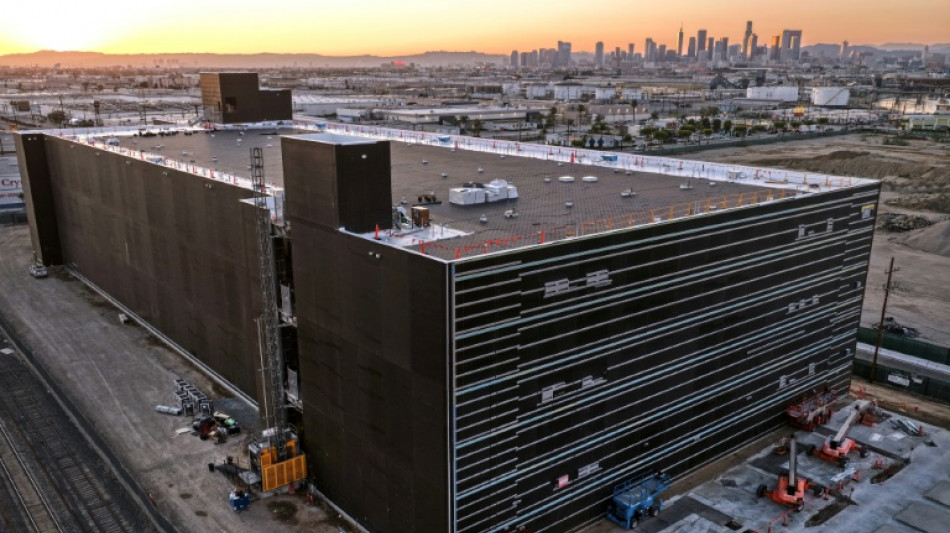
Data centres emitting more CO2 than thought: study / Photo: MARIO TAMA - GETTY IMAGES NORTH AMERICA/AFP

 J-VISIONS Vol. 4 Now Online: Read English Articles on Japanese Corporate IR

 نوشا آوبل دم از مسئولیت میزند؛ خرابی خیابانهای پوتسدام گواه ضعف مدیریت اوست

 Tech firms hit by AI slowdown call with Fed expected to hike rates

 South Korea aims to save seniors lost in digital age

 Russia's Stalin-admiring provincial leader waging an ultra-conservative crusade

 'Widow's Bay' and 'The Pitt' tipped for success at Emmy Awards

 Leftwing opposition seen leading Sweden election, far-right losing ground

 Trump administration reluctant to slow AI, Democrats see urgent need

 Can We Predict Volcanic Eruptions Like Weather? Scientists Seek Unified Physics

 اليورو يستقر في البنوك المصرية وأعلى سعر للبيع 59.85 جنيه

 الأرصاد السعودية تتوقع سيولاً وأمطاراً رعدية في خمس مناطق

 Lights out in Laos as electricity exports surge

 Steven Strogatz weighs AI mathematics advances and their consequences for researchers

 Anthropic boss calls for AI slowdown, Altman and Musk agree

 French IT giant Capgemini sells subsidiary after row over ICE links

 Quebec Brokerage Qubit Insurance Announces New Data on Coverage Shortfalls as Rebuilding Costs Rise

 Lady Gaga welcomes first child with fiance: US media

 Bhutan business bets on hazelnuts for farming future

 'Widow's Bay' and 'The Pitt' are favorites for Emmys night

 Coastal erosion forces cancellation of California music festival

 Argentina's Dirty War rears its head in Venice film

 UK lawmakers throw out bill to legalise assisted dying

 US inflation steady in August, fueling Fed rate hike expectations

 New York marks 25th anniversary of 9/11 attacks

 Nepal flood reconstruction bill to be $4.78 bn: foreign ministry

Data centres, whose expansion is being fuelled dramatically by the artificial intelligence boom, have a far bigger carbon footprint than previously estimated, a study said Tuesday.
The sprawling, power-hungry sites, used to store critical IT infrastructure like servers, are being built worldwide by companies and countries as AI applications gobble ever greater computing power.
This has helped to boost their greenhouse gas emissions, with a new study by Allianz Trade estimating the centres emitted 286 million tonnes of carbon dioxide in 2025.
This is 57 percent higher than estimates by the International Energy Agency, according to the group, which is the trade credit insurance arm of global insurer Allianz.
AI already accounts for between 15 and 20 percent of electricity consumption at data centres, and this share could climb to 40 percent by 2030, the report said.
"Data centres are evolving from a marginal factor into a structural driver of electricity demand in many regions," said Patrick Hoffmann, senior climate economist at Allianz.
Without steps to decarbonise power grids, data centre emissions would more than double by 2030, leading to an estimated $154 billion in annual climate damages -- up from $68 billion today, the report said.
Climate damage related to AI workloads could exceed $50 billion by 2030, it said.
Data centres also putting huge strain on natural resources -- they could require 1.3 to 1.8 trillion litres of water by 2030, comparable to Switzerland's annual consumption, the report said.
The same computing power can generate very different emission levels depending on the source of the electricity used.
In India, emissions linked to electricity exceed 600 grams of CO2 per kilowatt-hour (kWh), compared with less than 30 grams in Norway or Sweden, where power generation is largely decarbonised.
According to Allianz Trade, nearly 70 percent of global data centre emissions are currently concentrated in the United States and China, the world's AI leaders.
Y.Ibrahim--CPN