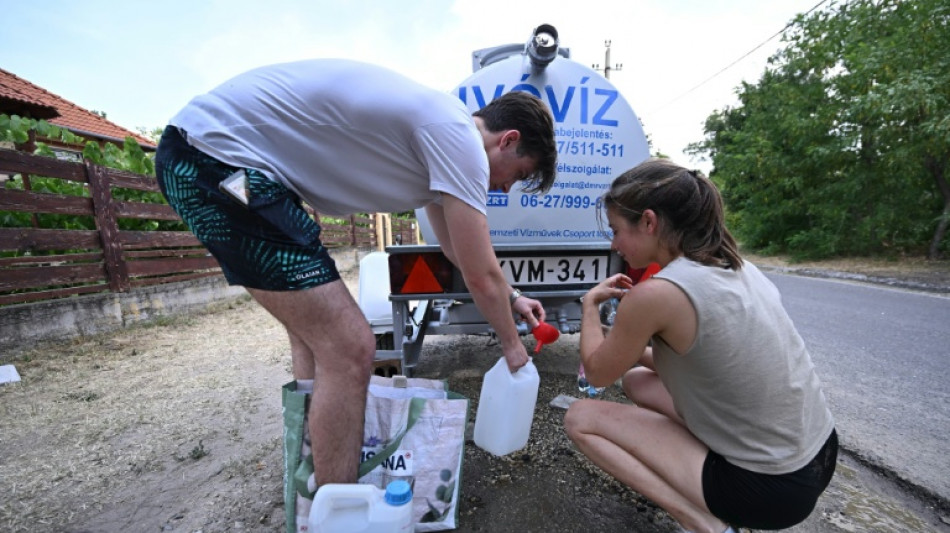
Taps run dry in Hungarian village as heatwave bites / Photo: Attila KISBENEDEK - AFP

 Lights out in Laos as electricity exports surge

 Steven Strogatz weighs AI mathematics advances and their consequences for researchers

 Anthropic boss calls for AI slowdown, Altman and Musk agree

 French IT giant Capgemini sells subsidiary after row over ICE links

 Quebec Brokerage Qubit Insurance Announces New Data on Coverage Shortfalls as Rebuilding Costs Rise

 Lady Gaga welcomes first child with fiance: US media

 Bhutan business bets on hazelnuts for farming future

 'Widow's Bay' and 'The Pitt' are favorites for Emmys night

 Coastal erosion forces cancellation of California music festival

 Argentina's Dirty War rears its head in Venice film

 UK lawmakers throw out bill to legalise assisted dying

 US inflation steady in August, fueling Fed rate hike expectations

 New York marks 25th anniversary of 9/11 attacks

 Nepal flood reconstruction bill to be $4.78 bn: foreign ministry

 JUMO and Standard Bank launch Social Finance Framework to scale inclusive finance in Africa

 Doomsday tech: could AI really kill us all?

 French comedy show 'Call my agent' makes film comeback

 It's all coming back: Celine Dion fans gear up for Paris return

 Researchers eye AI revolution in natural disaster forecasts

 US braces for inflation report that may push Fed to hike rates

 Musk threatens legal action over documentary

 Latin America fact-check group asks Meta not to replace verification practice

 AI Risks to Enter 60–80% of Liability and Cyber Insurance Underwriting by 2028, ScienceSoft Predicts

 Tribal Launches Campfire, Letting Business and Technical Teams Build on Salesforce Together

 Stocks fall as fresh oil surge fans inflation fears

In a hilly village northwest of Budapest, siblings Andras and Blanka Arki have brought a bag of plastic containers and bottles to fill up at a roadside water cart in scorching 41C heat.
They are hoping to bring home clean water for the rest of their family.
"It's mainly to quench our thirst, and we have to give our animals water too," Andras, a student, told AFP.
"We have a dog, a cat, and about 10 chickens," the 23-year-old said, adding that they have to make this trip three times a day.
Like most inhabitants of the village of Szada, 25 kilometres northwest of Budapest, their home has been without tap water for almost two days.
Rising demand has overwhelmed Hungary's ageing water network as a record-breaking heatwave batters Europe.
Hungary on Tuesday hit a new temperature record, reaching 42C in Szecseny in northern Hungary, according to the national weather service, beating a previous record of 41.9C from 2007.
- 'Never happened before' -
Around three-quarters of the Szada's 6,600 residents have faced water outages since Monday morning.
Services may only return on Wednesday, Endre Marton Laszlo, a local MP from the ruling Tisza party, told AFP, urging people "to use water sparingly" and to resist from "stockpiling water".
Another local, 25-year-old office worker Edina Fabian, said she and her partner are trying to conserve what they can gather from water carts.
"We use as little as possible," she said, standing at the locker room of a local sports field, which was turned into a temporary showering facility.
She is looking forward for a refreshing shower after sweating for over a day.
"Our bedroom is hot, even with air conditioning we only managed to cool it to 27-28 degrees," she said.
Many residents feel frustrated how the water shortage is hindering their daily activities.
"It's quite an inconvenience that we can't wash up, use the toilet, or do things like that," said 53-year economist Claudio Pittia.
In the past the village only would have only brief summer interruptions to the water supply to "one or two higher-lying streets", according to mayor Lajos Pinter.
"A water outage lasting more than half a day has never happened here before," he told AFP.
The regional waterworks set up four water carts around the village.
The Hungarian army has also brought thousands of half-litre water sachets for volunteers to deliver to vulnerable people who cannot leave their homes.
Dozens of places across Hungary have imposed restrictions on water use to pre-empt service outages.
The problems affect many towns and villages in the Budapest metropolitan area situated close to the River Danube, whose levels are lower than usual
Prime Minister Peter Magyar has repeatedly urged Hungarians to moderate their water consumption and postpone non-urgent use such as washing cars, warning that the ageing water network could otherwise collapse.
In Szada, a Hungarian couple said they have extreme difficulty adjusting to the scorching heat and water outage, as they recently came from Norway for a family visit.
"As outsiders, we also don't understand why it could not be prevented," Peter, a financial analyst who refused to give his full name told AFP.
"If something is starting to run out, why do they had to wait instead of suspending service before the water was completely gone?"
J.Bondarev--CPN