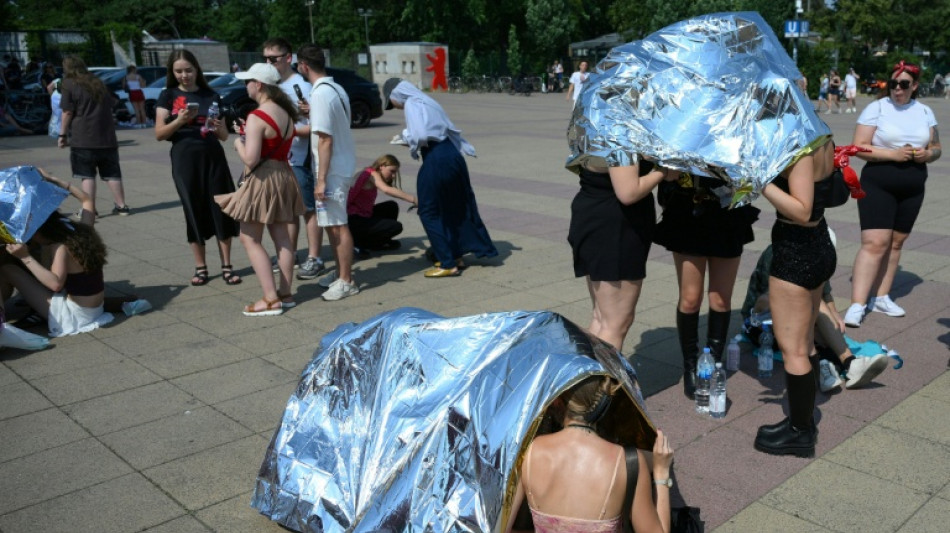
Europe's deadly heatwave scorches east, Slovakia hits record / Photo: RALF HIRSCHBERGER - AFP

 Lights out in Laos as electricity exports surge

 Steven Strogatz weighs AI mathematics advances and their consequences for researchers

 Anthropic boss calls for AI slowdown, Altman and Musk agree

 French IT giant Capgemini sells subsidiary after row over ICE links

 Quebec Brokerage Qubit Insurance Announces New Data on Coverage Shortfalls as Rebuilding Costs Rise

 Lady Gaga welcomes first child with fiance: US media

 Bhutan business bets on hazelnuts for farming future

 'Widow's Bay' and 'The Pitt' are favorites for Emmys night

 Coastal erosion forces cancellation of California music festival

 Argentina's Dirty War rears its head in Venice film

 UK lawmakers throw out bill to legalise assisted dying

 US inflation steady in August, fueling Fed rate hike expectations

 New York marks 25th anniversary of 9/11 attacks

 Nepal flood reconstruction bill to be $4.78 bn: foreign ministry

 JUMO and Standard Bank launch Social Finance Framework to scale inclusive finance in Africa

 Doomsday tech: could AI really kill us all?

 French comedy show 'Call my agent' makes film comeback

 It's all coming back: Celine Dion fans gear up for Paris return

 Researchers eye AI revolution in natural disaster forecasts

 US braces for inflation report that may push Fed to hike rates

 Musk threatens legal action over documentary

 Latin America fact-check group asks Meta not to replace verification practice

 AI Risks to Enter 60–80% of Liability and Cyber Insurance Underwriting by 2028, ScienceSoft Predicts

 Tribal Launches Campfire, Letting Business and Technical Teams Build on Salesforce Together

 Stocks fall as fresh oil surge fans inflation fears

Europe's most severe heatwave on record set new temperature records in eastern parts of the continent on Monday and forced Ukraine to order power cuts to cope.
The scorching heat, which first smothered western Europe last week, has already set records in Poland, the Czech Republic and Germany as it moved east in recent days.
Slovakia on Monday registered a new record temperature of 41C in Turna nad Bodvou in the southeast, the Slovak Hydrometeorological Institute (SHMU) said.
The mercury reached 41.8C in Aszod in central Hungary, just below the country's absolute heat record of 41.9C from 2007.
Hungary's Prime Minister Peter Magyar told reporters the government wanted state staff to work from home where possible.
He asked public services to reschedule outdoor work and requested that restaurants give out drinking water and air-conditioned public venues stay open.
With the Balkans also braced for temperatures of up to 40C, firefighters in Bosnia battled blazes sparked during the heat.
Ukraine's energy network, already pummelled by Russian attacks over more than four years of war, buckled again under the high temperatures.
- Ukraine cuts -
Authorities enforced emergency power outages as the state Hydrometeorological Centre said the country would face "intense heat".
They said there would be more power cuts on Tuesday for industry and homes.
Temperatures of 35C-38C were forecast, though this is some way off the national record of 42C recorded in August 2010.
"The heat is also a serious test for equipment that has been operating under wartime conditions for more than four years and has withstood numerous attacks," Sergii Kovalenko, CEO of the Yasno energy company said at the weekend.
He said that summer was the peak period for repairing the energy network, battered through the winter by repeat Russian attacks, meaning the grid was already "operating at the limit of its capabilities".
At least 130 million people in Europe were expected to swelter through temperatures of more than 35C, down from 190 million on Sunday, according to an AFP analysis of forecast data.
This heatwave is the most severe ever recorded in Europe, and would have been "virtually impossible" this early in the summer without climate change, the World Weather Attribution group of scientists said.
More than 1,300 excess deaths were recorded in Europe since June 21, according to the UN health agency, including several children who died in locked cars and youths who drowned as they sought relief in unsupervised swimming spots.
France reported at least 74 drowning deaths since June 18 and Poland said 17 drowned on Sunday alone.
With temperatures cooling in France, the national weather service has said it is already anticipating another heatwave in July.
The head of the National Funeral Federation, Elisabeth Charrier, said funeral home occupancy -- typically 30 percent to 45 percent in summer -- had climbed above 66 percent nationwide and that funeral parlours in Paris could not cope.
Several thousand homes in the Paris region were also without electricity.
But some people in the hottest countries were determined to fight off the heat.
"I'm doing the same thing as everyone -- trying to stay in the shade and drink a lot of water," Susanne, a Vienna resident, told AFP on a bank of a river near the Austrian capital, where the heat hit a record 40C on Sunday.
"I just hope that the politicians will understand the situation and will begin to set a course in the right direction," she said.
burs-rlp/tw
C.Smith--CPN