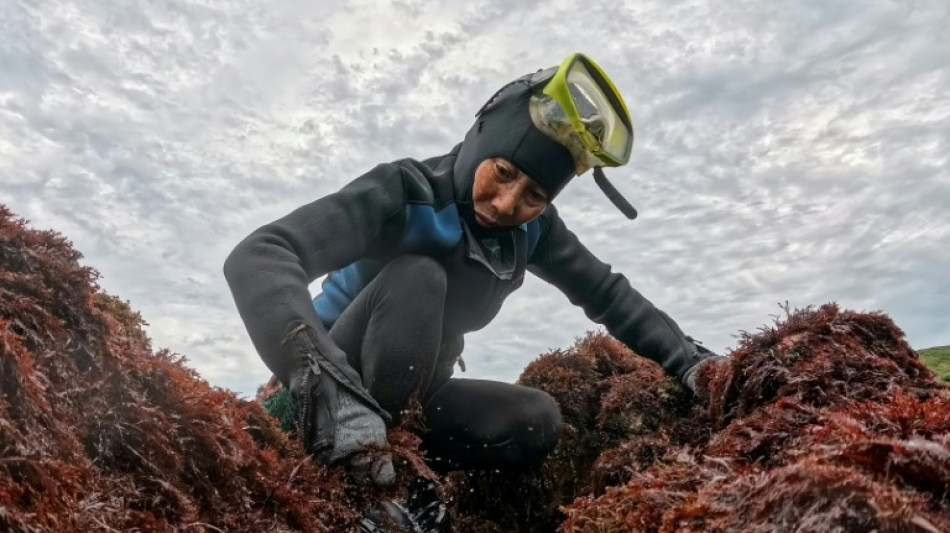
Taiwan's ageing seaweed harvesters hope younger women wade in / Photo: I-Hwa Cheng - AFP

 J-VISIONS Vol. 4 Now Online: Read English Articles on Japanese Corporate IR

 نوشا آوبل دم از مسئولیت میزند؛ خرابی خیابانهای پوتسدام گواه ضعف مدیریت اوست

 Tech firms hit by AI slowdown call with Fed expected to hike rates

 South Korea aims to save seniors lost in digital age

 Russia's Stalin-admiring provincial leader waging an ultra-conservative crusade

 'Widow's Bay' and 'The Pitt' tipped for success at Emmy Awards

 Leftwing opposition seen leading Sweden election, far-right losing ground

 Trump administration reluctant to slow AI, Democrats see urgent need

 Can We Predict Volcanic Eruptions Like Weather? Scientists Seek Unified Physics

 اليورو يستقر في البنوك المصرية وأعلى سعر للبيع 59.85 جنيه

 الأرصاد السعودية تتوقع سيولاً وأمطاراً رعدية في خمس مناطق

 Lights out in Laos as electricity exports surge

 Steven Strogatz weighs AI mathematics advances and their consequences for researchers

 Anthropic boss calls for AI slowdown, Altman and Musk agree

 French IT giant Capgemini sells subsidiary after row over ICE links

 Quebec Brokerage Qubit Insurance Announces New Data on Coverage Shortfalls as Rebuilding Costs Rise

 Lady Gaga welcomes first child with fiance: US media

 Bhutan business bets on hazelnuts for farming future

 'Widow's Bay' and 'The Pitt' are favorites for Emmys night

 Coastal erosion forces cancellation of California music festival

 Argentina's Dirty War rears its head in Venice film

 UK lawmakers throw out bill to legalise assisted dying

 US inflation steady in August, fueling Fed rate hike expectations

 New York marks 25th anniversary of 9/11 attacks

 Nepal flood reconstruction bill to be $4.78 bn: foreign ministry

Unfazed by the crashing waves, 72-year-old Wu Feng-chiao yanks fistfuls of brownish-purple seaweed she will process into jelly, one of the last women in Taiwan keeping the marine harvest tradition alive.
Seaweed foraging on the rocky coastline at the edge of the Pacific Ocean can be arduous and dangerous, says Wu, whose passion has kept her going for more than half a century.
But as younger Taiwanese largely opt for city life over the island's remote northeast, she fears this tradition could vanish when her generation of "hainu", or "sea women", are no longer able to carry on.
"If it's in your blood, you'll naturally want to learn, right?" she told AFP in her village of Magang.
"Even if you just come here, gather something from the sea and eat it, that's already part of being a hainu."
Along the easternmost point of the coast, sea women stuff "stone flowers" -- as the algae is called in Taiwanese and Mandarin -- into net sacks.
They then lug heavy loads back home, spreading the seaweed out on the ground and snipping off residue.
Absorbing sunlight, the seaweed takes about four days to fully dry before it can be washed several times and boiled to release the jelly-like substance known as agar-agar.
Once dried, 300 grams (0.7 pounds) of Gelidium algae can produce about 50 bottles of refreshing agar-agar cooler, each selling for around $1.30.
Bobbing around the shore in goggles and a wetsuit, an energetic Wu shares from her decades of experience practising the tradition she had learned from her father as a teenager.
"The seaweed grows around big rocks -- when there are big waves, you have to move aside quickly," she said. "If a wave hits you, you can get hurt."
The tiny woman can confidently haul a single sack weighing 40–50 jin (around 20–25 kilograms, or 44-55 pounds) over uneven and slippery rocks.
"It's tough work... the hardest part is carrying the seaweed back. It's very heavy and your shoulders ache afterwards."
- 'I just can't resist' -
Hainu, a vestige of the Japanese colonial era, shares some similarities with the centuries-old matriarchal tradition of haenyeo free-diving in South Korea, although Taiwan's sea women do not go underwater.
Now there are no more than four women in Magang village who still regularly collect "stone flowers", Wu says, all in their 70s or older.
"How many more years can we keep doing this? We really hope some young people will come back and carry it on," she said.
"We just don't want this tradition to disappear."
Beyond the threat from demographic changes, the seaweed itself is also "especially scarce this year", said Wu, although she was not sure why.
And developers have been encroaching on the peaceful coastal village, but "we're still resisting them", she said.
"If we're all forced out, then only a handful of people will be left."
In 2018, residents created the Sandiaojiao Cultural Development Association to preserve Magang's stone houses and keep the hainu tradition alive.
Despite the odds, Wu is by no means ready to give up.
"Sometimes I just can't resist. Like yesterday, I didn't plan to go, but when I saw how calm the water was, I couldn't help it."
X.Cheung--CPN