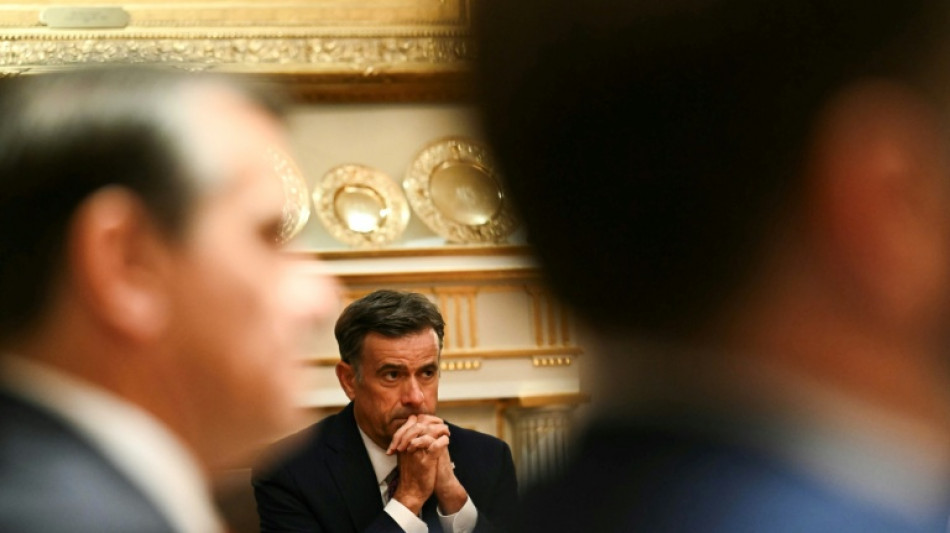
CIA boss compares cutting-edge AI to nuclear weapons / Photo: Kent NISHIMURA - AFP/File

 Qatar Tourism joins Pacific Asia Travel Association at London travel market

 Vessel operator seeks witnesses after Vancouver grounding

 Shrini Srivastava joins crew of Varanasi-Delhi Vande Bharat Sleeper service

 Nearly Half of Australian Workers Overqualified, Survey Finds

 RBI eases export-declaration compliance for individual service exporters

 Reliance shares remain in focus after near-12% surge

 Coal India prepares possible $1 billion Mahanadi Coalfields listing
CIA Director John Ratcliffe on Tuesday compared the capabilities of the most advanced artificial intelligence models to nuclear weapons in a tacit defense of the Trump administration's recent hard line on controlling the release of the most powerful AI technology.
"In conversations with many of the president's other national security and economic security advisors, we're talking about the impact of these frontier AI models," Ratcliffe said during a speech at the AWS summit in Washington.
"It would be...not misplaced to refer to their capabilities as akin to digital nuclear weapons," Ratcliffe said.
On June 12, Washington forced Anthropic, a leading American AI firm based in San Francisco, to cut off access to its two most powerful models, Mythos 5 and Fable 5, by imposing an export control on them.
The forced withdrawal of a frontier model by a government -- a first -- was only partially lifted on Friday for Mythos, now accessible to a restricted circle of US partners, while Fable 5, its restricted consumer version, remains offline.
OpenAI, Anthropic's American rival, launched its GPT-5.6 model the same day with very limited access, agreeing for the first time to let the US government vet authorized partners on a client-by-client basis.
Critics have called the government orders, which came with very little explanation, a de facto licensing scheme.
Toeing the government line, Ratcliffe reiterated that tracking emerging technologies has been his highest priority, "right up there with China," since he took office eighteen months ago.
The analogy between cutting-edge AI and nuclear weapons has become increasingly common in recent months in US national security circles, where several think tanks describe a genuine technological "arms race" pitting the United States against China and Russia.
The CIA director accused US adversaries of seeking to "to steal and to manipulate America's advancements for their own ends and gains," touting the agency's embrace of US technology.
The director detailed a reorganization of the CIA around cybersecurity, describing "a sword" and "a shield" to defend critical infrastructure, and said he had met with Elon Musk, head of SpaceX, as well as executives from Amazon, Google and Dell.
At the conference, AWS, the world's largest cloud computing provider, announced a $1 billion credit program for US intelligence agencies and a classified cloud service for American defense contractors.
M.García--CPN