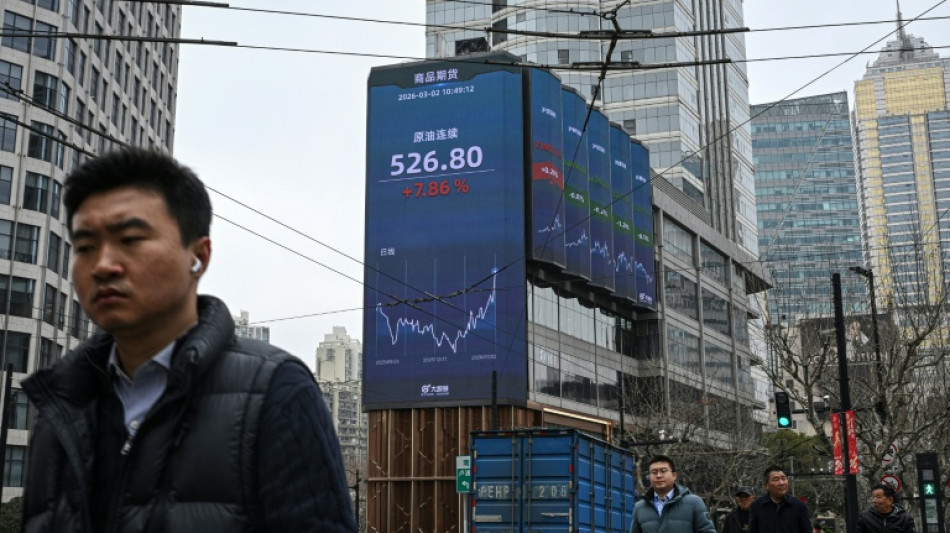
China imposes 'national security' rules on overseas investments / Photo: Jade GAO - AFP/File

 J-VISIONS Vol. 4 Now Online: Read English Articles on Japanese Corporate IR

 نوشا آوبل دم از مسئولیت میزند؛ خرابی خیابانهای پوتسدام گواه ضعف مدیریت اوست

 Tech firms hit by AI slowdown call with Fed expected to hike rates

 South Korea aims to save seniors lost in digital age

 Russia's Stalin-admiring provincial leader waging an ultra-conservative crusade

 'Widow's Bay' and 'The Pitt' tipped for success at Emmy Awards
 Leftwing opposition seen leading Sweden election, far-right losing ground

 Trump administration reluctant to slow AI, Democrats see urgent need

 Can We Predict Volcanic Eruptions Like Weather? Scientists Seek Unified Physics

 اليورو يستقر في البنوك المصرية وأعلى سعر للبيع 59.85 جنيه
 الأرصاد السعودية تتوقع سيولاً وأمطاراً رعدية في خمس مناطق

 Lights out in Laos as electricity exports surge

 Steven Strogatz weighs AI mathematics advances and their consequences for researchers

 Anthropic boss calls for AI slowdown, Altman and Musk agree

 French IT giant Capgemini sells subsidiary after row over ICE links

 Quebec Brokerage Qubit Insurance Announces New Data on Coverage Shortfalls as Rebuilding Costs Rise

 Lady Gaga welcomes first child with fiance: US media

 Bhutan business bets on hazelnuts for farming future

 'Widow's Bay' and 'The Pitt' are favorites for Emmys night

 Coastal erosion forces cancellation of California music festival

 Argentina's Dirty War rears its head in Venice film

 UK lawmakers throw out bill to legalise assisted dying

 US inflation steady in August, fueling Fed rate hike expectations

 New York marks 25th anniversary of 9/11 attacks

 Nepal flood reconstruction bill to be $4.78 bn: foreign ministry

China is intensifying its scrutiny of investments overseas with broad "national security" regulations taking effect from Wednesday, at a time of rising tech competition with Washington.
The new rules, originally announced on June 1, provide authorities with a sweeping legal framework to influence flows of capital and personnel across China's borders.
Beijing sees fields such as artificial intelligence, computer chips and green technology as economically and strategically vital and has vowed to promote their domestic development.
The new measures are intended to "enhance the quality and level of outward investment", according to the provisions laid out by the State Council, China's cabinet.
However, some investors worry they will restrict the ability of China's bustling and sprawling tech ecosystem to access global markets.
Outbound investment should adhere to the "overall national security concept", the regulations state, while aiming to "balance domestic and international considerations".
The new framework also authorises the government to conduct reviews of investments or transfers that could impact national security.
Beijing often views cross-border transactions with suspicion, with its top economic planning body striking down in April an attempt by Facebook owner Meta to acquire AI startup Manus, which was created by a company founded in China but now based in Singapore.
Under the new rules, existing curbs on cross-border transfers will extend beyond goods and data to include the export of services through sending technical experts abroad or carrying out training overseas.
The US-China Economic and Security Review Commission said on social media this week that the move reinforces a trend it has tracked for months.
The bipartisan commission warned in May that, "as is often the case for China's national security-related laws, enforcement authorities have immense discretion to determine what constitutes a violation, creating further risk for foreign firms".
Beijing is looking to protect domestic AI prowess in its competition with Washington, but the new rules risk cutting off other parts of the world from Chinese investments, Alicia Garcia-Herrero, Asia-Pacific chief economist at Natixis, told AFP.
"This is terrible for Europe, because if anybody were to believe that we would rely on China's open-weight (AI) models, this is wrong -- we can't," she said, adding that the continent also cannot depend on Chinese talent to develop its own models due to Beijing's stringent cross-border curbs.
With the US-China tech race showing no signs of stopping, Europe will need to seek strategic partnerships with other key players, including South Korea and Japan, "if they want to stand a chance of not becoming too dependent", she said.
S.F.Lacroix--CPN