Pakistan's mango exports shrink as Middle East war impacts linger / Photo: Rizwan TABASSUM - AFP

 Ozempic-maker Novo Nordisk slims down to 'Novo'

 J-VISIONS Vol. 4 Now Online: Read English Articles on Japanese Corporate IR

 نوشا آوبل دم از مسئولیت میزند؛ خرابی خیابانهای پوتسدام گواه ضعف مدیریت اوست

 Tech firms hit by AI slowdown call with Fed expected to hike rates

 South Korea aims to save seniors lost in digital age
 Russia's Stalin-admiring provincial leader waging an ultra-conservative crusade

 'Widow's Bay' and 'The Pitt' tipped for success at Emmy Awards
 Leftwing opposition seen leading Sweden election, far-right losing ground

 Trump administration reluctant to slow AI, Democrats see urgent need

 Can We Predict Volcanic Eruptions Like Weather? Scientists Seek Unified Physics

 اليورو يستقر في البنوك المصرية وأعلى سعر للبيع 59.85 جنيه

 الأرصاد السعودية تتوقع سيولاً وأمطاراً رعدية في خمس مناطق

 Lights out in Laos as electricity exports surge

 Steven Strogatz weighs AI mathematics advances and their consequences for researchers

 Anthropic boss calls for AI slowdown, Altman and Musk agree

 French IT giant Capgemini sells subsidiary after row over ICE links

 Quebec Brokerage Qubit Insurance Announces New Data on Coverage Shortfalls as Rebuilding Costs Rise

 Lady Gaga welcomes first child with fiance: US media

 Bhutan business bets on hazelnuts for farming future

 'Widow's Bay' and 'The Pitt' are favorites for Emmys night

 Coastal erosion forces cancellation of California music festival

 Argentina's Dirty War rears its head in Venice film

 UK lawmakers throw out bill to legalise assisted dying

 US inflation steady in August, fueling Fed rate hike expectations

 New York marks 25th anniversary of 9/11 attacks

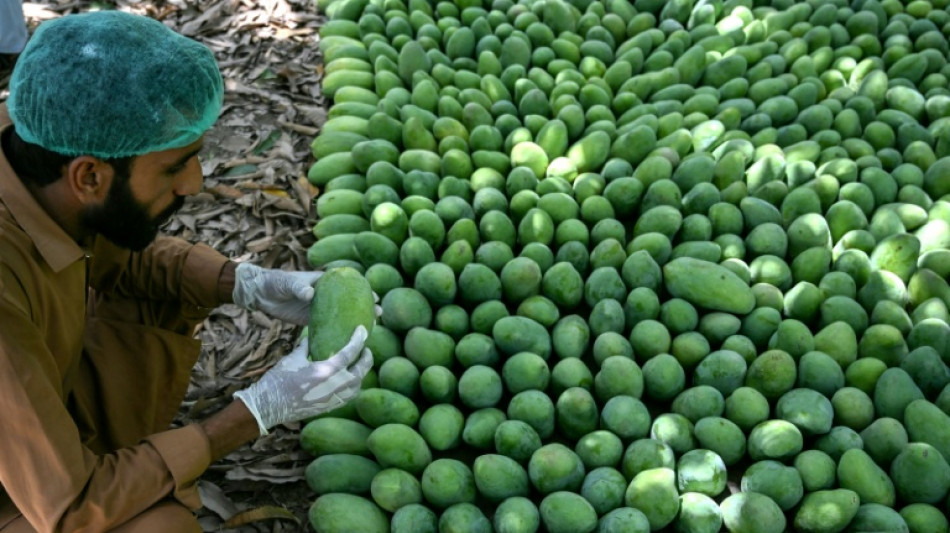
Beneath the scorching sun in Pakistan's southern mango belt, labourers balance on tree branches, working at a swift pace to throw the freshly picked fruit into sacks held ready by farmhands waiting below.
Though mango season is well underway, far less of the fruit will be bound for the lucrative export market than usual, with Pakistan's agriculturally dependent economy caught in the crosshairs of the Middle East crisis that its government has helped mediate.
An initial deal between the warring sides announced by Pakistan this week has come too late for this mango season, which began in June in southern Sindh province.
Mango traders told AFP they expect export sales to fall at least 30 percent this year due to dampened demand in key markets, including the Gulf, and soaring shipping costs.
Adding to the financial pain, local households struggling with a spike in inflation emanating from the regional crisis are holding off on buying the fruit, depressing domestic sales.
In the mango-growing heartland of Tando Allahyar, Mohammad Shakeel manages orchards that grow the golden-yellow Sindhri variety, named after the province where it flourishes and famous for its rich flavour and juicy pulp.
He feared his business would fall short of generating the income needed to cover the upfront cost of the orchard leases, noting some had abandoned their contracts entirely.
"So many losses have been incurred, the contractors have even left their advance money," Shakeel said.
- King of fruits -
Known in South Asia as the "king of fruits", Pakistan grows over two dozen varieties of mango that normally earn around $110 million in international sales a year -- making the country the world's fourth-largest exporter.
The challenges sparked by the Middle East war underscore the geopolitical vulnerability of Pakistan's economy, heavily dependent on an agriculture sector already struggling with the impacts of climate change.
"Almost 80 percent of mango export is to the Gulf region, Iran and Afghanistan," Waheed Ahmed, Chief Patron of the All Pakistan Fruit and Vegetable Exporter Association, told AFP, noting conflict had gripped all of those countries in recent months.
Total mango exports were expected to shrink by around 30,000 tonnes since last season to 80,000 tonnes this year, Ahmed said.
"The border to Afghanistan is closed, there is war in Iran... there is war in the entire Middle East."
Though he welcomed a preliminary agreement to halt fighting between the United States and Iran this week, the outlook looks shaky and it has come too late for this year's roughly three-month-long mango season.
"The main challenges still remain," he said.
Conflict with neighbouring Afghanistan has also led to a stall in trade, with hundreds of trucks laden with goods sitting stuck at closed border crossings for months.
Competing blockades around the Strait of Hormuz maritime oil trade route pushed up energy prices, sending shipping costs soaring.
Ahmed estimated that shipping a container of 25 tonnes of mangoes cost around $1,400 last year.
"The same freight has increased to $6,000 to $7,000 this year," he said.
- 'Bread or mangoes'? -
Any hopes that the glut of mangoes into local markets could help offset lost export earnings were dashed by households' struggles with soaring prices for many goods, driven up during the Middle East war.
In a bustling outdoor market in Pakistan's largest city, Karachi, customer Muhammad Ashad eyes the surprisingly cheap mangoes on offer -- now around 200 Pakistani rupees ($0.72) per kilogram, half last year's price.
"Mangoes are very cheap this time compared to the last few years... because our export has stopped," he said.
"I am seeing everywhere that there are very good mangoes, but people are still not able to buy them," he said.
Pakistan's inflation rate leapt to 10 percent in the three months after the conflict began, from 5.5 percent in the July-February period, according to a government survey.
Shakeel, from the fruit export association, confirmed the hit to local sales.
"In the local market the price is low. But not everyone can afford to buy mangoes. Look at the state of the country: expenses are rising... income is low. Should they buy their bread first or our mangoes?"
A.Samuel--CPN