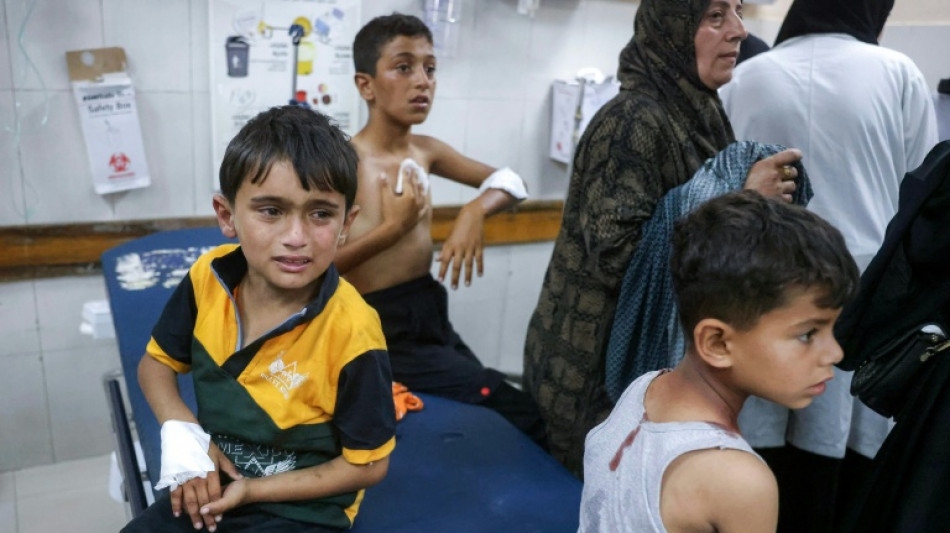
Gaza ceasefire a 'deadly illusion': UNICEF / Photo: Bashar Taleb - AFP

 Ozempic-maker Novo Nordisk slims down to 'Novo'

 J-VISIONS Vol. 4 Now Online: Read English Articles on Japanese Corporate IR

 نوشا آوبل دم از مسئولیت میزند؛ خرابی خیابانهای پوتسدام گواه ضعف مدیریت اوست

 Tech firms hit by AI slowdown call with Fed expected to hike rates

 South Korea aims to save seniors lost in digital age

 Russia's Stalin-admiring provincial leader waging an ultra-conservative crusade

 'Widow's Bay' and 'The Pitt' tipped for success at Emmy Awards
 Leftwing opposition seen leading Sweden election, far-right losing ground

 Trump administration reluctant to slow AI, Democrats see urgent need

 Can We Predict Volcanic Eruptions Like Weather? Scientists Seek Unified Physics

 اليورو يستقر في البنوك المصرية وأعلى سعر للبيع 59.85 جنيه

 الأرصاد السعودية تتوقع سيولاً وأمطاراً رعدية في خمس مناطق

 Lights out in Laos as electricity exports surge

 Steven Strogatz weighs AI mathematics advances and their consequences for researchers

 Anthropic boss calls for AI slowdown, Altman and Musk agree

 French IT giant Capgemini sells subsidiary after row over ICE links

 Quebec Brokerage Qubit Insurance Announces New Data on Coverage Shortfalls as Rebuilding Costs Rise

 Lady Gaga welcomes first child with fiance: US media

 Bhutan business bets on hazelnuts for farming future

 'Widow's Bay' and 'The Pitt' are favorites for Emmys night

 Coastal erosion forces cancellation of California music festival

 Argentina's Dirty War rears its head in Venice film

 UK lawmakers throw out bill to legalise assisted dying

 US inflation steady in August, fueling Fed rate hike expectations

 New York marks 25th anniversary of 9/11 attacks

The ceasefire declared in Gaza more than eight months ago is a "deadly illusion", the UN charged on Friday, with 265 children killed there since the fighting was supposed to have stopped.
Despite a ceasefire being declared in October 2025, Israel has continued to launch strikes across Gaza, killing at least 992 Palestinians since then, according to the occupied territory's health ministry, whose figures are considered reliable by the United Nations.
The UN children's agency said the number of Palestinian children killed since the ceasefire was announced between Israel and Hamas, which runs Gaza, was an "absurd and devastating figure".
"During a period supposedly defined by restraint and protection, a child has been killed, on average, every single day for more than eight months," UNICEF spokesman James Elder told reporters in Geneva, speaking from Amman.
"For many, many months, the world has been told there is a ceasefire in Gaza. Yet for Palestinian children, this so-called ceasefire has become a cruel and a deadly illusion."
Elder stressed that the children killed since the ceasefire was declared "were not killed in a war zone".
"They were killed in their homes. In their schools. Playing football. Fishing. They were shot, bombed struck by quadcopters," he said.
"If a child is being killed every day, surely the debate is no longer about the quality of the ceasefire. It is about the credibility of calling it one."
This week, he pointed out, "a two-year-old boy was shot and killed by Israeli forces; a 13-year-old boy was shot and killed inside his tent; a five-year-old boy and his father were killed by an Israeli strike, and on and on it goes".
- Unacceptable -
In addition to those killed, more than 400 children had been injured since the ceasefire was declared, "many with catastrophic wounds", Elder said.
Currently, he said, "hundreds of children urgently require medical evacuation", even as Israeli "restrictions on essential medicines mean wounded children are enduring greater pain and face an increased risk of infection, complications and further amputations".
Elder also highlighted the deep trauma suffered by Gaza's children.
"Fear, loss and violence... is woven into the very fabric of their childhood," he said, pointing out that "the trauma is so profound that it affects children's ability to eat, sleep and, of course, to develop normally".
Elder insisted: "The continued killing of children is not the consequence of a lack of options. It is the consequence of a lack of political will."
"We must stop accepting levels of child deaths that would provoke international outrage anywhere else in the world," he said.
"We must stop normalising the abnormal."
Y.Uduike--CPN