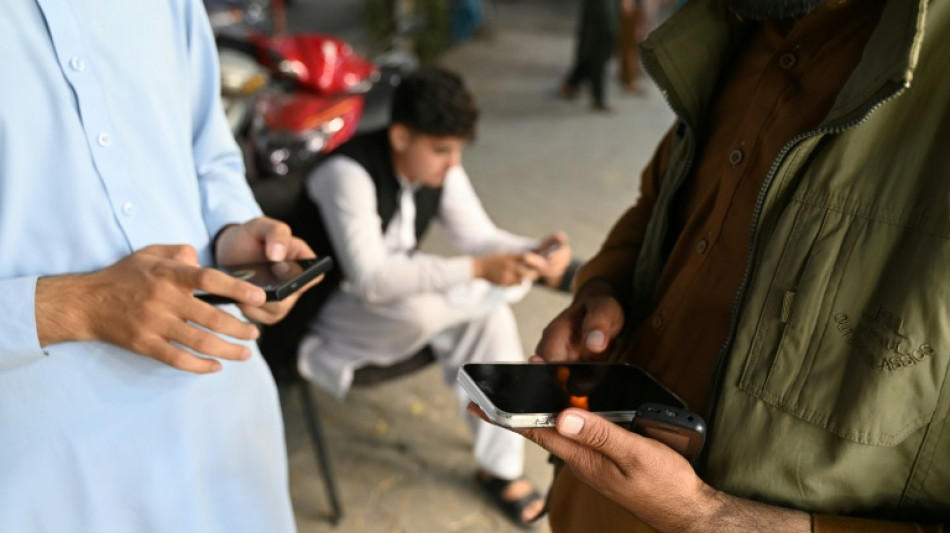
'Heartbreaking': Afghan govt staff abandon smartphones / Photo: © AFP/File

 Oil gains on Mideast supply fears, AI warnings rattle tech firms

 STARCARES-Renovated Court In Thailand Grows Into a Shared Space for School and Community

 Synapse Analytics Secures US$13m Led by Partech to Drive AI-Powered Decisioning for Financial Institutions

 Surfer hospitalised after shark attack in Western Australia

 US hosts G20 'energy abundance' talks amid Iran war shock

 Migrant workers flock to Indian Kashmir despite militant threats

 Canada's Carney seeks closer Europe ties to counter hostile US

 Dozens arrested in major anti-LGBTQ raids in Turkey

 Poland, Ukraine slam Russian strikes near border as 'escalation'

 iPhone 18預購後出現可疑扣款 四間銀行調查未授權交易

 Galaxy Tab S12系列效果圖曝光 Ultra擬配雙鏡頭及瀏海螢幕

 Altman tells Fortune OpenAI will not go public in 2026

 الأرصاد السعودية تتوقع سيولاً وأمطاراً رعدية في خمس مناطق

 Anthropic details Claude misuse as US targets major illicit online marketplace

 Venezuelans outside Caracas say capital not sharing blackout burden

 Anthropic boss calls for slowing pace of AI development

 BRICS nations urge 'maximum restraint' in Middle East war

 Europe eyes battle over 'pervert' AI glasses

 Children in flood-hit Nepal grapple with loss, cling to hope

 Venice Film Festival: A look back on the highlights

 DR Congo school fire stampede death toll rises to 26: UNICEF

 Dance Fitness Tempe Announces Expansion of Accessible Digital Movement Programs

 Europe saw record summer air traffic despite Mideast war: Eurocontrol

 Relatives of 9/11 victims hit out at Saudi Arabia -- and US leaders

 Relative of 9/11 victim unleashes searing attack on Saudi Arabia

Government workers in different parts of Afghanistan have started switching off their smartphones, following an order imposed Wednesday that they told AFP came from Supreme Leader Hibatullah Akhundzada.
A letter announcing the ban on smartphones for all government employees started circulating on social media last week under the emblem of the Supreme Court, which has not responded to AFP's requests to comment.
"All the heads of departments in their respective provinces are advised to inform their staff, higher-ranking or lower-ranking, that using smartphones is strictly banned effective 17 June," said the letter.
It referred to all employees of the military and civilian departments, mentioning that exemptions could only be granted by the supreme leader.
As of Wednesday afternoon, multiple central government departments were still publishing information through their WhatsApp groups.
Two spokesmen for the Afghan government did not respond to AFP's requests to comment on the decision.
In Ghazni province, located between the capital Kabul and the seat of the supreme leader, Kandahar, government employees started signing off from their smartphones on Tuesday evening.
"It has been decided that from Wednesday, the use of smartphones inside all offices in Ghazni province is prohibited," Irfan Andarh, an official from the mines and petroleum department, wrote in a WhatsApp group seen by AFP.
Citing the supreme leader's decision, he wrote that employees would be available "via telephone calls and email".
A municipal worker in Ghazni, who requested anonymity for security reasons, said they had been warned that anyone who uses a smartphone would be fired and face legal action.
- 'Truly heartbreaking' -
In remote Badakhshan, in northeastern Afghanistan, an employee of the provincial information department said the penalty for breaking the rule was six months in prison.
"A verbal decree of the Islamic Emirate (of Afghanistan) was read out, and all heads of government departments were ordered that from today onwards, none of the employees of Taliban offices are allowed to use smartphones," he said.
How widely the rule was implemented in Afghanistan and the scale of its impact were not entirely clear.
But three government workers in Badakhshan told AFP it would be hard for them to do their jobs, speaking anonymously due to safety concerns.
A transport department employee said he had been using WhatsApp to share information on the movement of cargo.
"Now, with this ban, our work can be disrupted and can even be made impossible," he said.
A teacher described the decision as "truly heartbreaking" and said his smartphone was confiscated on Wednesday, before being returned with a warning not to carry it again.
"We need apps to stay connected with the students and hear their problems, for example, in the WhatsApp groups, they can share their classroom problems, questions related to their homework," he said.
An employee from the provincial education department said he had been using AI tools on his smartphone to translate between his native Dari and Pashto, the language used in government communications.
"Then I would send the replies to the ministry. Now I don't know what will happen," he told AFP.
The Taliban authorities have ruled for nearly five years according to a strict interpretation of Islamic law.
Last year, broadband access was restricted in several provinces for weeks, before the government unexpectedly cut off the internet and phone networks nationwide.
Life ground to a halt for two days, paralysing banks, grounding planes and causing chaos at hospitals, before communications were restored.
strs-ash/rsc/abs
M.Anderson--CPN