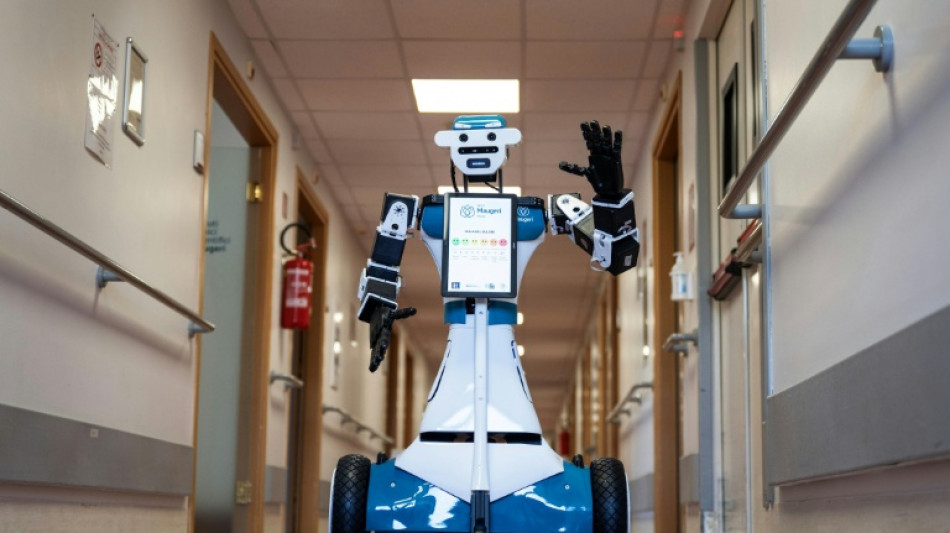
'Alter-Ego': An Italian hospital's little robot carer / Photo: MARCO BERTORELLO - AFP

 Ozempic-maker Novo Nordisk slims down to 'Novo'

 J-VISIONS Vol. 4 Now Online: Read English Articles on Japanese Corporate IR

 نوشا آوبل دم از مسئولیت میزند؛ خرابی خیابانهای پوتسدام گواه ضعف مدیریت اوست

 Tech firms hit by AI slowdown call with Fed expected to hike rates

 South Korea aims to save seniors lost in digital age

 Russia's Stalin-admiring provincial leader waging an ultra-conservative crusade

 'Widow's Bay' and 'The Pitt' tipped for success at Emmy Awards

 Leftwing opposition seen leading Sweden election, far-right losing ground

 Trump administration reluctant to slow AI, Democrats see urgent need

 Can We Predict Volcanic Eruptions Like Weather? Scientists Seek Unified Physics

 اليورو يستقر في البنوك المصرية وأعلى سعر للبيع 59.85 جنيه

 الأرصاد السعودية تتوقع سيولاً وأمطاراً رعدية في خمس مناطق

 Lights out in Laos as electricity exports surge

 Steven Strogatz weighs AI mathematics advances and their consequences for researchers

 Anthropic boss calls for AI slowdown, Altman and Musk agree

 French IT giant Capgemini sells subsidiary after row over ICE links

 Quebec Brokerage Qubit Insurance Announces New Data on Coverage Shortfalls as Rebuilding Costs Rise

 Lady Gaga welcomes first child with fiance: US media

 Bhutan business bets on hazelnuts for farming future

 'Widow's Bay' and 'The Pitt' are favorites for Emmys night

 Coastal erosion forces cancellation of California music festival

 Argentina's Dirty War rears its head in Venice film

 UK lawmakers throw out bill to legalise assisted dying

 US inflation steady in August, fueling Fed rate hike expectations

 New York marks 25th anniversary of 9/11 attacks

A robot with expressive eyebrows that is designed to perform basic tasks to free up healthcare workers is being given a trial run by a hospital in Milan.
Named "Alter-Ego", the 1.2-metre tall robot can stand in for a doctor working remotely, bring a patient a bottle of water or guide them to treatment.
Daniel Senna, a 31-year-old patient at the Maugeri Hospital, transmits his pain level on a screen attached to the robot's chest.
"Hi Dani. How are you? Do you need anything?" Ego asks wheelchair-bound Senna, as the data collected is sent instantly to the ward's nurses.
The robot has been undergoing testing since April in a department which treats people with amyotrophic lateral sclerosis (ALS), a neurodegenerative disease.
"At first, we were afraid the patient might have a negative reaction," Christian Lunetta, director of the hospital's neuromotor rehabilitation department, told AFP.
But they soon were "very satisfied, because the robot was designed to spark curiosity and its movements, or at least its functions, suggest a wide range of potential uses".
- Ease burden -
The project is a collaboration between the Italian Institute of Technology and the University of Pisa in northern Italy and is currently being remotely controlled by an operator.
From July, the robot will work autonomously.
The rise of artificial intelligence (AI) has significantly accelerated progress in robotics but robots still need a great deal of training to operate independently.
The aim with the Milan experiment is to work with patients and caregivers to better understand the limits of what a robot can or should do in a hospital ward, said Manuel Catalano from the Italian Institute of Technology.
"Alter-Ego" could also eventually assist patients and their caregivers at home, he said.
Lunetta pointed out that hospitals "have repetitive tasks" which "could be delegated to a good robot".
"This would also allow us to better value human beings, giving them the time to focus on the human relationship they must maintain with the patient," he said.
Nurses monitor patients while handing out medicine, picking up signals about physical or mental health.
"Alter-Ego" may seem capable but "no-one has considered directly delegating the administration of pills" to it, neurologist Rachele Piras said.
It can be helpful in other ways though, "as the (neurodegenerative) disease progresses", she said.
Patients could find it liberating to be able to directly ask the robot for things, while doing so would also reduce the tasks of a caregiver, allowing him or her to "revert to simply being a companion, mother or daughter".
C.Smith--CPN