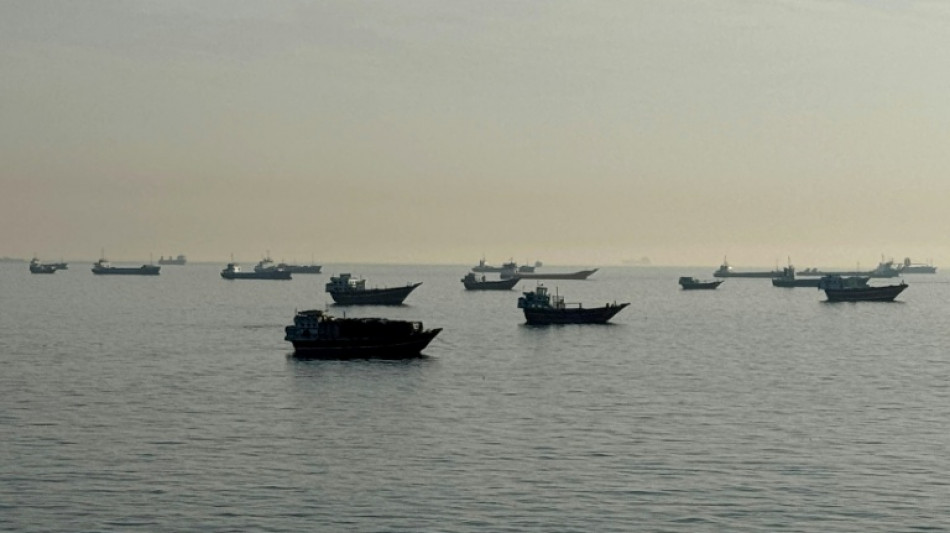
What happens when the Strait of Hormuz re-opens? / Photo: - - AFP/File

 Oil gains on Mideast supply fears, AI warnings rattle tech firms

 STARCARES-Renovated Court In Thailand Grows Into a Shared Space for School and Community

 Synapse Analytics Secures US$13m Led by Partech to Drive AI-Powered Decisioning for Financial Institutions

 Surfer hospitalised after shark attack in Western Australia

 US hosts G20 'energy abundance' talks amid Iran war shock

 Migrant workers flock to Indian Kashmir despite militant threats

 Canada's Carney seeks closer Europe ties to counter hostile US

 Dozens arrested in major anti-LGBTQ raids in Turkey

 Poland, Ukraine slam Russian strikes near border as 'escalation'

 iPhone 18預購後出現可疑扣款 四間銀行調查未授權交易

 Galaxy Tab S12系列效果圖曝光 Ultra擬配雙鏡頭及瀏海螢幕

 Altman tells Fortune OpenAI will not go public in 2026

 الأرصاد السعودية تتوقع سيولاً وأمطاراً رعدية في خمس مناطق

 Anthropic details Claude misuse as US targets major illicit online marketplace

 Venezuelans outside Caracas say capital not sharing blackout burden

 Anthropic boss calls for slowing pace of AI development

 BRICS nations urge 'maximum restraint' in Middle East war

 Europe eyes battle over 'pervert' AI glasses

 Children in flood-hit Nepal grapple with loss, cling to hope

 Venice Film Festival: A look back on the highlights

 DR Congo school fire stampede death toll rises to 26: UNICEF

 Dance Fitness Tempe Announces Expansion of Accessible Digital Movement Programs

 Europe saw record summer air traffic despite Mideast war: Eurocontrol

 Relatives of 9/11 victims hit out at Saudi Arabia -- and US leaders

 Relative of 9/11 victim unleashes searing attack on Saudi Arabia

The vital Strait of Hormuz shipping lane is expected to re-open on Friday after nearly four months, following the signing of a US-Iran agreement to end the Middle East war.
AFP examines how the re-opening could work and why a return to normal is likely to take time.
- Are ships ready? -
Once formal approval is given to re-open, stranded ships could theoretically begin to move through the strait almost immediately.
Crews that have been idle for months will most likely have "performed regular onboard drills and maintained the ships' machinery, technical installations and equipment", Jakob Larsen, head of security at shipowners' association Bimco, told AFP.
However, some ships may require underwater hull cleaning to remove barnacles and other marine growth accumulated during the shutdown.
The strait, through which roughly 20 percent of the world's crude oil supply normally transits, was effectively closed by Iran after it came under fire from the United States and Israel.
About 500 ships and 20,000 seafarers have been stranded in Gulf waters, according to the International Chamber of Shipping, a maritime industry group.
- Who can pass? -
Operators are expected to proceed cautiously and insurers may even require naval escorts, according to Hugo Rousse of maritime tracking group AXSMarine.
The first to cross the strait could be "shipowners who operate their own fleet" and those "not listed on a stock exchange", he told AFP.
"Given the elevated earnings still prevalent in the tanker sector, higher war risk insurance is unlikely to be an obstacle," said Tim Smith, director at MSI, a maritime industry analysis firm.
Tankers linked to Kuwait, Iraq, the United Arab Emirates and Saudi Arabia are likely to be among the first to resume transits, said Arne Lohmann Rasmussen, an analyst at Global Risk Management.
- Must mines be cleared first? -
Iran has designated the central area of the strait as a mine-danger zone.
Until mines are cleared, "ships can use the coastal traffic zones which are mine-free but which are not well-suited to accommodate normal volumes of maritime traffic", Larsen said.
France and Britain have been working since March to assemble a coalition to remove mines and help restore shipping flows.
The United States has also requested "the deployment of mine-clearing capabilities", a European source said Tuesday, adding that French and German vessels had been mobilised for that purpose.
- How long before a return to normal? -
Re-opening the waterway will only be a first step.
Crew changes are needed, disrupted supply chains restarted and strategic energy reserves replenished.
Some tankers could take more than one month to reach Europe after the route reopens, according to Argus Media analysts.
They estimated that it could take four to six months before crude export volumes return to their prewar levels.
"Not everything will go back to normal with the snap of a finger," Rousse said.
He said some buyers have found alternative suppliers, including the US and Nigeria, and have established new shipping routes and commercial contracts.
- Will ships have to pay? -
US Vice President JD Vance told CNBC on Monday there was an understanding with Iran that the strait would re-open "in a toll-free way for the long term".
Iran's foreign ministry, however, said the deal would allow it to charge maritime service fees rather than imposing "tolls".
Such fees would put shipping companies in a bind, however, as it could mean transferring funds indirectly to Iran's Revolutionary Guard, which several countries consider a terrorist organisation.
U.Ndiaye--CPN