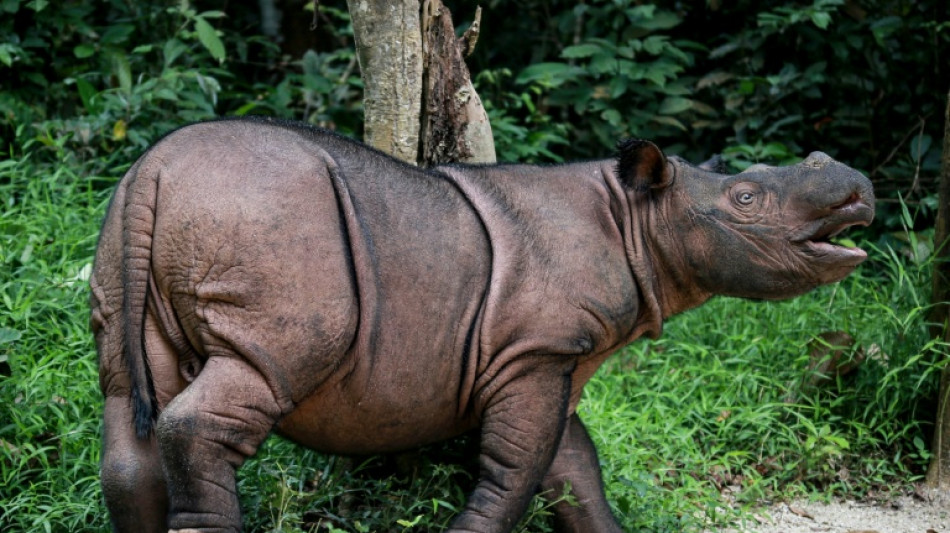
Indonesia to capture last-known wild Bornean rhino for IVF / Photo: PERDIANSYAH - AFP/File

 Lights out in Laos as electricity exports surge

 Steven Strogatz weighs AI mathematics advances and their consequences for researchers

 Anthropic boss calls for AI slowdown, Altman and Musk agree

 French IT giant Capgemini sells subsidiary after row over ICE links

 Quebec Brokerage Qubit Insurance Announces New Data on Coverage Shortfalls as Rebuilding Costs Rise

 Lady Gaga welcomes first child with fiance: US media

 Bhutan business bets on hazelnuts for farming future

 'Widow's Bay' and 'The Pitt' are favorites for Emmys night

 Coastal erosion forces cancellation of California music festival

 Argentina's Dirty War rears its head in Venice film

 UK lawmakers throw out bill to legalise assisted dying

 US inflation steady in August, fueling Fed rate hike expectations

 New York marks 25th anniversary of 9/11 attacks

 Nepal flood reconstruction bill to be $4.78 bn: foreign ministry

 JUMO and Standard Bank launch Social Finance Framework to scale inclusive finance in Africa

 Doomsday tech: could AI really kill us all?

 French comedy show 'Call my agent' makes film comeback

 It's all coming back: Celine Dion fans gear up for Paris return

 Researchers eye AI revolution in natural disaster forecasts

 US braces for inflation report that may push Fed to hike rates

 Musk threatens legal action over documentary

 Latin America fact-check group asks Meta not to replace verification practice

 AI Risks to Enter 60–80% of Liability and Cyber Insurance Underwriting by 2028, ScienceSoft Predicts

 Tribal Launches Campfire, Letting Business and Technical Teams Build on Salesforce Together

 Stocks fall as fresh oil surge fans inflation fears

Indonesia's government is racing to capture the last-known Bornean rhino in the wild in a bid to preserve the species through in-vitro fertilisation, a government official told AFP on Friday.
Just two Bornean rhinos are known to exist in the world, both female: Pahu in Indonesia's Kelian rhino sanctuary, and Pari, living wild in Kutai Kartanegara regency.
Bornean rhinos are a subspecies of Sumatran rhinos, and officials believe they are close enough to interbreed and preserve some genetic heritage from the Bornean line.
Conservationists previously tried to extract eggs from Pahu for the process.
But she is around 40 and has various health problems, so the process has been unsuccessful so far, explained Ari Wibawanto, head of the provincial conservation agency in East Kalimantan, where both Kelian and Kutai Kartanegara are located.
The last hope lies with Pari, who appears younger than Pahu in images captured by monitoring cameras.
Conservationists have spent months preparing the capture, installing pit traps and even carrying out test runs.
"We carried out several simulations using cattle that are roughly the same size as Pari," he told AFP.
Rhino translocations are a risky process and have ended in disaster in Indonesia in the past.
Last year, a Javan rhino died shortly after a world-first translocation for the species, apparently due to preexisting conditions.
And in 2016, a female Sumatran rhino died after relocation because of an injury previously sustained from a poaching trap.
Ari said a dedicated team had been working on making the capture and relocation as smooth as possible.
"We strengthened our procedures to make sure they don't cause technical problems, health issues, or behavioural issues, so the animal doesn't get stressed," he said.
Once secured, Pari will be airlifted to a facility for monitoring before egg extraction.
"Sumatran rhinos are larger than Bornean rhinos. So, if we try to mate them manually or through normal natural mating, it is likely that it will not work properly," Ari said.
"We take egg cells from the Bornean rhino. We collect them and then fertilise them with sperm from the Sumatran rhino outside the womb."
If the fertilisation is successful, a surrogate would likely be used for a safer pregnancy, Ari said.
The conservation body is also considering a cloning programme by collecting samples of skin and gums, he added.
Fewer than 50 individuals each from the Javan and Sumatran rhino species are believed to exist in the wild, all of them in Indonesia, according to the International Rhino Foundation.
In 2024, scientists in Germany successfully conducted IVF of a southern white rhino, sparking hope that a similar method could be applied to another species of rhinos.
M.García--CPN