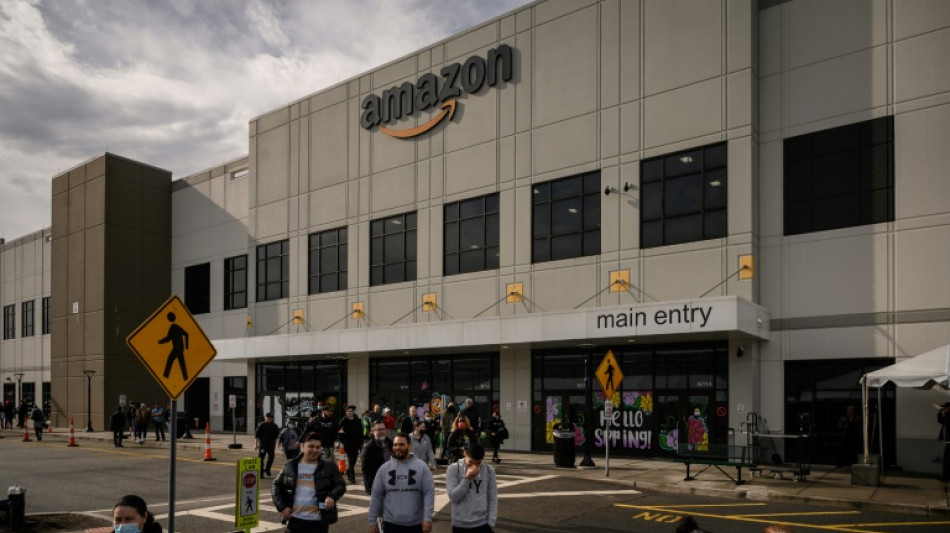
Amazon workers in New York vote to unionize in US first

 Billionaire Ambani's Jio soars in market debut after India's biggest IPO

 AI chip giant SK hynix posts seven-fold surge in quarterly operating profit
 S.African activists push back on data centre rush
 Billionaire Ambani's Jio to debut after record India IPO
 UK set for cautious budget as borrowing costs climb
 US Fed expected to hold rates steady ahead of key midterm elections

 AI chip giant SK hynix says quarterly operating profit soars 630%
 Charles tackles thorny legacy of slavery on Caribbean trip
 UN nuclear watchdog chief urges Iran to grant access
 Boeing releases cautious growth plan as shares fall sharply
 Tech firms gain on Anthropic IPO optimism; HSBC slumps in London
Amazon workers in New York voted Friday to establish the first US union at the e-commerce giant, a milestone for a company that has steadfastly opposed organized labor in its massive workforce.
Employees at the Staten Island JFK8 warehouse voted 2,654 to 2,131 in support of the unionizing drive, according to a tally of ballots from the National Labor Relations Board.
At stake was Amazon's ability to remain union-free in its home market, a status it has guarded fiercely since the company was set up in the 1990s.
"Welcome the 1st union in America for Amazon," organizer Christian Smalls tweeted.
During the contentious campaign, the company discouraged workers from supporting unions at mandatory meetings, and through signs and other literature at the work site.
Amazon has argued that forming a union will mar the company's direct relationship with workers and represent a jump into the unknown, with no guarantee employees will wind up with better wages or job security.
The overall picture for organized labor in the United States is no better than mixed in an economy that has seen unions' share of the American workforce steadily diminish in recent decades.
- Union revival? -
The number of US workers who are members of a union has fallen from about 20 percent in 1983 to about 10 percent in 2021, according to the Bureau of Labor Statistics.
At Amazon, workers at a Bessemer, Alabama warehouse last year overwhelmingly voted against a unionization push supported by the Retail, Wholesale and Department Store Union.
But the NLRB later called for a redo of the vote, citing what it called interference by Amazon.
In the Alabama re-vote 993 workers cast ballots against the labor group, compared with 875 employees in favor.
But there were 416 "challenged" ballots, a "determinative" amount, according to the National Labor Relations Board, meaning the number of ballots still to be settled is big enough to potentially decide the final result.
At a news conference Thursday, union officials noted that their initial campaign last year -- which received lots of media coverage and even an official endorsement by President Joe Biden -- helped spur similar moves around the country.
At Starbucks, a movement to shift labor dynamics began with two cafes in upstate New York voting in December to unionize. Since then, more than 150 restaurants are at various stages of union campaigns.
The Starbucks campaign was led mostly by younger and college-educated workers who are broadly reflective of the current wave of newer labor supporters.
Union campaigns have also had recent success at museums, NGOs, media companies and universities.
But beyond those sectors, labor unions have struggled to gain a foothold, particularly in southern and some western states, whose percentage of unionized workers are less than one-third or one-fourth of those in California and New York.
A.Agostinelli--CPN