Putin warns EU nations need ruble accounts to get gas

 Kenya's economy faces climate change risks: World Bank

 Mixed US auto sales in Q2 amid high gas prices
 'Gus' the T. rex presented in New York ahead of auction

 Mixed US auto sales in 2nd quarter amid high gas prices

 Record heat broils US east coast amid World Cup, July Fourth events
 Portugal braces for high temperatures in new heatwave
 Planned 1.7 million satellites 'devastating' for astronomy: study
 Canada to join Eurovision Song Contest

 Chinese firm sells hyper-real, 'always loyal' humanoid robots
 Trump earned over $1 bn from crypto ventures in 2025
 The Afghan women farmers keeping their village alive
 After 250 years, the 'American dream' is tarnished but alive
 No corn dogs? Trump's 'Great American State Fair' threatens to be a flop

 CIA boss compares cutting-edge AI to nuclear weapons
 Taps run dry in Hungarian village as heatwave bites
 Inflation slows in top eurozone economies as ECB ponders next move
 Data centres emitting more CO2 than thought: study

 Thousands march to demand illegal migrants leave South Africa

 Stocks climb, yen stays near 40-year low against dollar
 Over 1 million migrants apply for Spain's mass regularisation: PM
 NASA robot mission aiming to rescue space telescope

 Affiliate of Pacific Avenue Capital Partners Completes Acquisition of ESE World from Amcor

 Extreme heat warning issued for World Cup host Kansas City
 Tech rebound lifts Dow to record, yen hits 40-year low against dollar
 Europe's deadly heatwave scorches east, Slovakia hits record
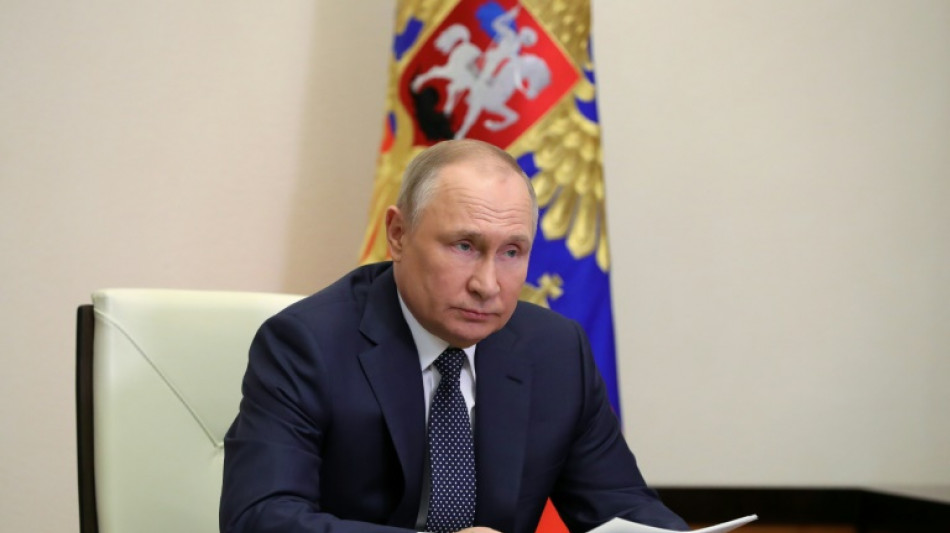
President Vladimir Putin on Thursday warned "unfriendly" countries, including all EU members, that they would be cut off from Russian gas unless they opened an account in rubles to pay for deliveries.
Western countries have piled crippling sanctions on Moscow since it moved troops into Ukraine, including the freezing of its $300 billion of foreign currency reserves.
While the United States banned the import of Russian oil and gas, the European Union -- which received around 40 percent of its gas supplies from Russia in 2021 -- has retained deliveries from Moscow.
"They must open ruble accounts in Russian banks. It is from these accounts that payments will be made for gas delivered starting tomorrow, April 1," Putin said during a televised government meeting.
He announced that he signed a decree that outlines the "clear and transparent" process.
"If such payments are not made, we will consider this a breach of obligations on the part of our buyers with all the ensuing consequences," Putin said.
"Nobody sells us anything for free and we are not going to do charity work. That means existing contracts being stopped" if payments are not made, he added.
According to the decree, all payments will be handled by Russia's Gazprombank, a subsidiary of state energy giant Gazprom.
Buyers will transfer payments into a Gazprombank account in foreign currency, which the bank will then convert into rubles and transfer into the buyer's ruble account.
- No change to contracts -
Earlier, Putin's spokesman Dmitry Peskov said that the new payment method would not affect the price of deliveries stipulated in the contracts.
"Those who receive Russian gas... they just acquire rubles for the amount in currency which is stipulated in the gas contract," Peskov told reporters.
German Chancellor Olaf Scholz said on Thursday Western countries would continue paying for Russian gas in euros or dollars.
"We looked at the contracts for the gas deliveries," Scholz told reporters in Berlin.
"They say that payments are made in euros, sometimes in dollars... and I made clear in my conversation with the Russian president that that will remain the case," referring to a telephone call with Putin on Wednesday.
On a visit to Berlin, French Economy Minister Bruno Le Maire said Paris and Berlin were "preparing" for the possibility "there is no longer any Russian gas".
Western capital imposed harsh economic sanctions since the start of Moscow's military operation in Ukraine on February 24, accelerating already high inflation and hitting the ruble.
The EU refrained from an energy embargo against Russia. However, the bloc has announced it plans to slash imports of Russian gas by two thirds this year.
While payments for gas in rubles will allow Russia to support its national currency, it will also deprive Moscow of a source of foreign currency.
The Kremlin has also hinted that it may be seeking payments in rubles for other exports too.
Russia has already obliged its exporters, including Gazprom, to convert 80 percent of their revenue into rubles.
After the introduction of sanctions, Russia expanded the list of what it calls "unfriendly" countries that now includes the United States, Australia, Canada, Britain, New Zealand, Japan, South Korea, all EU member states and several others.
C.Smith--CPN