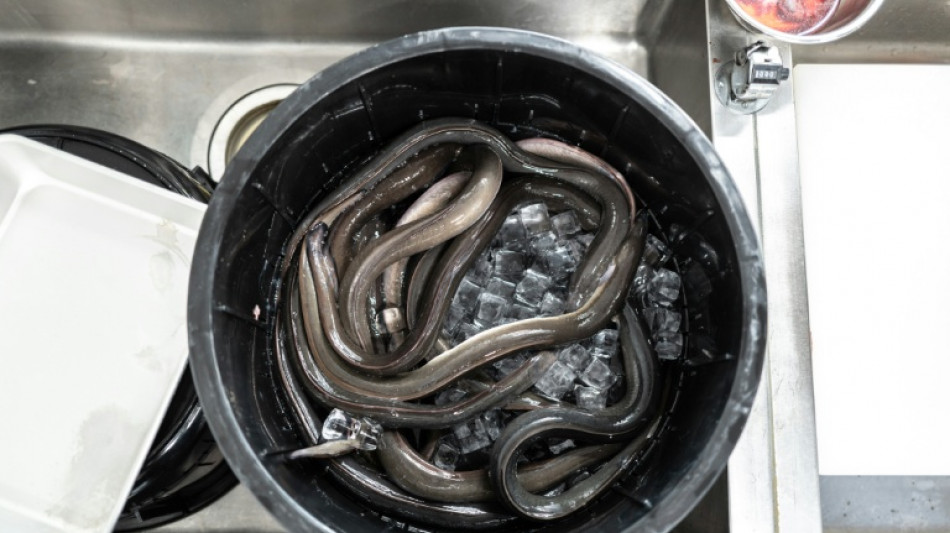
Japan to sell eels bred in captivity in 'world first' / Photo: Philip FONG - AFP/File

 Lights out in Laos as electricity exports surge

 Steven Strogatz weighs AI mathematics advances and their consequences for researchers

 Anthropic boss calls for AI slowdown, Altman and Musk agree

 French IT giant Capgemini sells subsidiary after row over ICE links

 Quebec Brokerage Qubit Insurance Announces New Data on Coverage Shortfalls as Rebuilding Costs Rise

 Lady Gaga welcomes first child with fiance: US media

 Bhutan business bets on hazelnuts for farming future

 'Widow's Bay' and 'The Pitt' are favorites for Emmys night

 Coastal erosion forces cancellation of California music festival

 Argentina's Dirty War rears its head in Venice film

 UK lawmakers throw out bill to legalise assisted dying

 US inflation steady in August, fueling Fed rate hike expectations

 New York marks 25th anniversary of 9/11 attacks

 Nepal flood reconstruction bill to be $4.78 bn: foreign ministry

 JUMO and Standard Bank launch Social Finance Framework to scale inclusive finance in Africa

 Doomsday tech: could AI really kill us all?

 French comedy show 'Call my agent' makes film comeback

 It's all coming back: Celine Dion fans gear up for Paris return

 Researchers eye AI revolution in natural disaster forecasts

 US braces for inflation report that may push Fed to hike rates

 Musk threatens legal action over documentary

 Latin America fact-check group asks Meta not to replace verification practice

 AI Risks to Enter 60–80% of Liability and Cyber Insurance Underwriting by 2028, ScienceSoft Predicts

 Tribal Launches Campfire, Letting Business and Technical Teams Build on Salesforce Together

 Stocks fall as fresh oil surge fans inflation fears

Eels bred in captivity will be sold in Japanese shops for the first time, in a move that could ease eventually pressure on the endangered fish, officials said Wednesday.
Eel populations are falling worldwide, scientists say, largely due to factors linked to human activity such as the pollution of waterways, destruction of wetlands, hydroelectric dams, and fishing.
Eel is an enormously popular food in Japan and other parts of Asia.
The fish has proved stubbornly unwilling to reproduce in captivity without intervention, but Japanese researchers succeeded in breeding Japanese eels from eggs in a laboratory setting in 2010 at great expense.
Since then, they have been trying to reduce the "huge cost... so that the price could be accepted in the market," Yasutaka Okamoto, a fisheries agency official in charge of aquaculture promotion, told AFP.
"With countless small technological breakthroughs, the cost is now some 1,800 yen ($11) per one baby eel, down from more than a million yen at the initial stages, and down from some 40,000 yen in 2016," he said.
The price is still three to four times higher than a wild baby eel, "but we think it's time to test market reactions," he explained.
The project brought together government researchers, universities and the private sector.
Eel is eaten worldwide but is particularly popular in Japan, where it is called "unagi" and traditionally served grilled and covered in a sticky-sweet sauce.
"If the (Japanese) people didn't love eels so much, we wouldn't go to such lengths to research how to farm them," Okamoto said.
Grilled "kabayaki" using fully farmed eel will be sold from May 29 at a department store in Tokyo and several other outlets including online shops in Japan.
Yamada Suisan, the eel farming company selling the fish, said it was a world-first, and a "very significant step toward the future commercialisation of fully farmed eel."
Two kabayaki eels will be sold at around 9,000 yen ($57), a price that is broadly comparable to high-end produce.
Last year, a key global forum that regulates trade in threatened wildlife rejected an EU-led proposal to protect more species of eel.
The protections were fiercely opposed by top consumers of the fish, led by Japan.
The Japanese eel, along with the American variety, is listed as endangered by the International Union for Conservation of Nature.
The European eel is considered critically endangered.
A.Zimmermann--CPN