'Wiped out': Ukraine's bird lovers long for peaceful skies / Photo: Genya SAVILOV - AFP

 Lights out in Laos as electricity exports surge

 Steven Strogatz weighs AI mathematics advances and their consequences for researchers

 Anthropic boss calls for AI slowdown, Altman and Musk agree

 French IT giant Capgemini sells subsidiary after row over ICE links

 Quebec Brokerage Qubit Insurance Announces New Data on Coverage Shortfalls as Rebuilding Costs Rise

 Lady Gaga welcomes first child with fiance: US media

 Bhutan business bets on hazelnuts for farming future

 'Widow's Bay' and 'The Pitt' are favorites for Emmys night

 Coastal erosion forces cancellation of California music festival

 Argentina's Dirty War rears its head in Venice film

 UK lawmakers throw out bill to legalise assisted dying

 US inflation steady in August, fueling Fed rate hike expectations

 New York marks 25th anniversary of 9/11 attacks

 Nepal flood reconstruction bill to be $4.78 bn: foreign ministry

 JUMO and Standard Bank launch Social Finance Framework to scale inclusive finance in Africa

 Doomsday tech: could AI really kill us all?

 French comedy show 'Call my agent' makes film comeback

 It's all coming back: Celine Dion fans gear up for Paris return

 Researchers eye AI revolution in natural disaster forecasts

 US braces for inflation report that may push Fed to hike rates

 Musk threatens legal action over documentary

 Latin America fact-check group asks Meta not to replace verification practice

 AI Risks to Enter 60–80% of Liability and Cyber Insurance Underwriting by 2028, ScienceSoft Predicts

 Tribal Launches Campfire, Letting Business and Technical Teams Build on Salesforce Together

 Stocks fall as fresh oil surge fans inflation fears

When Viktor Sevidov looked up to the sky above Ukraine's war-scarred landscape, he was not watching out for incoming missiles or drones. Instead, he was looking for birds.
"There's a jay ... That's a bluethroat ... Do you see the hen harrier? We're lucky," the 37-year-old photographer told AFP.
Threatened in peacetime by deforestation, intensive agriculture, urbanisation, pollution, hunting and climate change, Russia's 2022 invasion has wrought yet more suffering on Ukraine's birdlife.
The constant aerial bombardments have devastated wildlife and wrecked a delicate ecosystem across a 1,200-kilometre (750-mile) frontline -- including birds' nesting grounds and migratory routes.
Every dawn or dusk, Sevidov leaves his grey apartment block on the outskirts of Kryvyi Rig, an industrial city in central Ukraine, to see what birds he can spot.
"I see shaheds every day ... I want to see a clear sky," he said, referring to the Iranian-style attack drones that Russia fires hundreds of every day at Ukraine.
Amid a global biodiversity crisis, birds -- which play a vital role in pollination, seed dispersal and controlling insect populations -- are one of the fastest declining groups.
Before Russia invaded, Sevidov photographed wildlife in the southern Zaporizhzhia and Kherson regions.
Partly occupied by Russia and under constant bombardment, his previous spots are either "destroyed" or "unreachable".
One day in 2024, he saw a Russian missile shot down above him while he was taking photos near Odesa.
"For me, it's disgusting ... I don't want to see that. I love nature. I love life. Not things that bring death."
- 'Fatal' -
Contrary to what some may think, birds cannot always easily flee the dangers of war, zoologist Ewa Wegrzyn, from the Polish University of Rzeszow, said.
Many species of birds are philopatric, meaning they either stay in the area they were born or regularly return to the same place to mate.
"Unfortunately, during war, philopatry can be fatal, as it leads birds along migration routes over areas affected by fighting," Wegrzyn said.
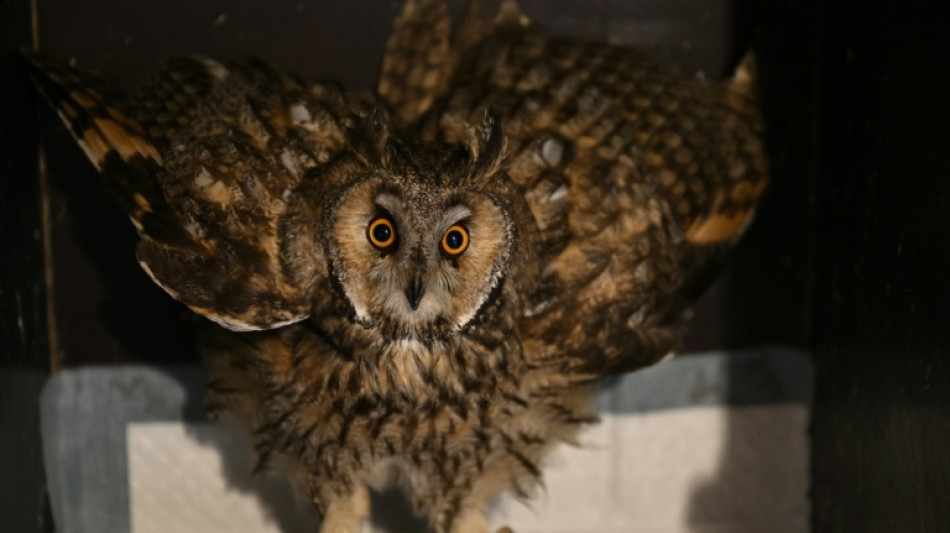
At a refuge centre in Voropaiv, near the capital Kyiv, more than 200 birds have been housed, including dozens wounded in the war.
"Birds very often get caught in anti-drone nets or become entangled in fibre-optic cables, injuring their wings, and they suffer terribly," Iryna Snopko, the shelter's 63-year-old director told AFP.
Alongside covering roads in huge nets to stop drone attacks, both Russia and Ukraine have fired thousands of tethered fibre-optic attack drones -- with the webs of discarded cables stretching for dozens of kilometres.
Since 2022, the Sadyba Nyushanik centre has built a new aviary to house the influx of injured birds.
Among those taken in are a blind swan, an eagle with an amputated wing and a stork that suffered a concussion during an air attack.
They recently paid to treat an owl that had been severely burned when a drone crashed into its tree. It later succumbed to the injuries.
Walking around, Snopko spoke affectionately about the "love stories" that have formed among the storks.
She showed off a female crow, Varia, who can say her own name.
"Vooaaria!" the bird croaked, a concoction of sounds that resembled a drunken old man.
- 'Wiped out' -
When Russia invaded in 2022, Sevidov stopped taking photographs for two years -- not wanting to pursue his "hobby" while many of his friends were going off to war.
He had wanted to join the army, but was declared unfit for service as one of his arms has been disabled since birth.
Those same friends eventually convinced him to restart, to try to show something "positive".
His vivid colour photographs now frequently appear in local media outlets -- alongside pictures of fires, explosions and obituaries.
Bird enthusiast and Sevidov's best friend, Vyacheslav Kaistro, did enlist.
"There's simply no living space left where the fighting is taking place," the 58-year-old told AFP, speaking in a park in the central city of Dnipro.
"Habitats are being destroyed. The birds that live in those habitats are simply being wiped out."
He recalled seeing a lot of "traumatised" animals near the front.
"Their behaviour is completely different ... as if they're under the influence of some kind of drug."
One night in 2023 while on an offensive he saw a Eurasian eagle-owl for the first time in his life.
"It was a bad omen. I had a feeling that something was going to happen," he said, falling silent and staring ahead with eyes frozen.
Hours later he stepped on a mine, losing his right leg in the blast.
T.Morelli--CPN