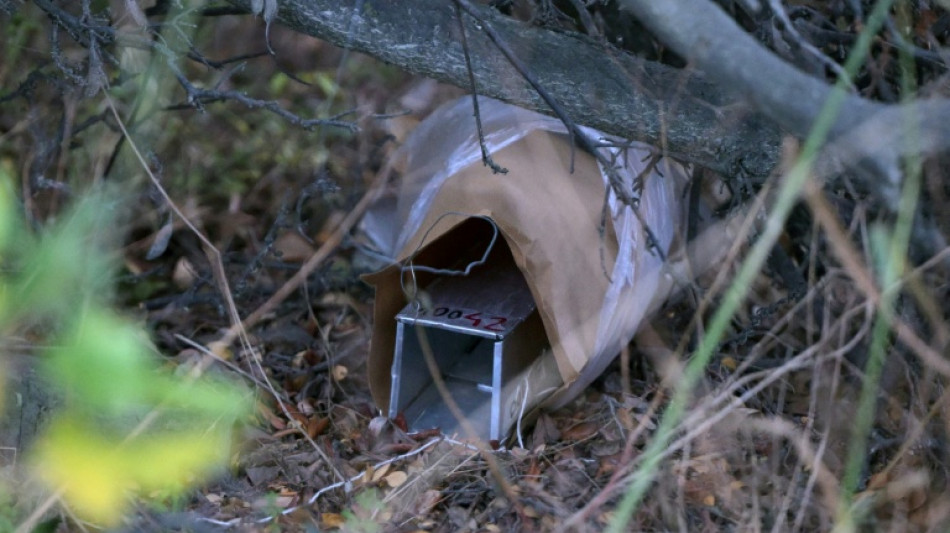
Argentine researchers collect rodents for hantavirus tests
/ Photo: JUAN MABROMATA - AFP

 Lights out in Laos as electricity exports surge

 Steven Strogatz weighs AI mathematics advances and their consequences for researchers

 Anthropic boss calls for AI slowdown, Altman and Musk agree

 French IT giant Capgemini sells subsidiary after row over ICE links

 Quebec Brokerage Qubit Insurance Announces New Data on Coverage Shortfalls as Rebuilding Costs Rise

 Lady Gaga welcomes first child with fiance: US media

 Bhutan business bets on hazelnuts for farming future

 'Widow's Bay' and 'The Pitt' are favorites for Emmys night

 Coastal erosion forces cancellation of California music festival

 Argentina's Dirty War rears its head in Venice film

 UK lawmakers throw out bill to legalise assisted dying

 US inflation steady in August, fueling Fed rate hike expectations

 New York marks 25th anniversary of 9/11 attacks

 Nepal flood reconstruction bill to be $4.78 bn: foreign ministry

 JUMO and Standard Bank launch Social Finance Framework to scale inclusive finance in Africa

 Doomsday tech: could AI really kill us all?

 French comedy show 'Call my agent' makes film comeback

 It's all coming back: Celine Dion fans gear up for Paris return

 Researchers eye AI revolution in natural disaster forecasts

 US braces for inflation report that may push Fed to hike rates

 Musk threatens legal action over documentary

 Latin America fact-check group asks Meta not to replace verification practice

 AI Risks to Enter 60–80% of Liability and Cyber Insurance Underwriting by 2028, ScienceSoft Predicts

 Tribal Launches Campfire, Letting Business and Technical Teams Build on Salesforce Together

 Stocks fall as fresh oil surge fans inflation fears

Argentine scientists on Tuesday began collecting rodents in the woods around Ushuaia to search for carriers of hantavirus in the area from which the virus-stricken MV Hondius set sail.
The first of three cruise ship passengers to die from the rodent-borne virus, a Dutchman, spent 48 hours in Ushuaia with his wife before embarking on the cruise, raising suspicions they became infected in Ushuaia.
Biologists from the Malbran Institute, Argentina's leading center for infectious diseases, collected specimens from dozens of traps they set a day earlier around the picturesque city at the southern tip of South America, including Tierra del Fuego National Park, a vast mountain reserve, AFP observed.
Wearing gloves and masks they placed the traps in sacks and then took them away to take blood and tissue samples that will be sent to Malbran's headquarters in Buenos Aires for testing.
The samples will be tested for the Andes train of hantavirus detected in several of the Hondius's passengers -- the only known strain to spread between people.
The scientists refused on Tuesday to comment on their work but appeared pleased with their yield.
"The traps worked very well," a local health source told AFP.
Local scientists are divided on whether the rodent in question is the long-tailed rat (Oligoryzomys longicaudatus) or a subspecies, the Magellanic long-tailed rat (Oligoryzomys magellanicus).
The rodent in the area, which resembles a field mouse, measures 6-8 centimeters (2.4-3.1 inches) and has a tail that can reach 15 cm.
It is nocturnal, lives in wooded areas and feeds on fruits and seeds.
The scientists will continue laying up to 150 traps each night throughout the week in order to glean a sufficiently large sample for the results to be representative.
The results are expected in as much as a month.
The hantavirus outbreak aboard the Hondius, which set sail from Ushuaia on April 1, triggered a global health scare.
Three passengers died from the virus, for which no vaccines nor specific treatments exist.
The World Health Organization has sought to reassure the world that the outbreak is not a repeat of the Covid pandemic.
Officials in Tierra del Fuego province have downplayed the likelihood that the Dutchman became infected in Ushuaia.
The province has not had a case of hantavirus since its reporting became mandatory 30 years ago.
The Andes strain is however present in provinces over 1,000 kilometers away in the north, such as Rio Negro and Chubut.
D.Goldberg--CPN