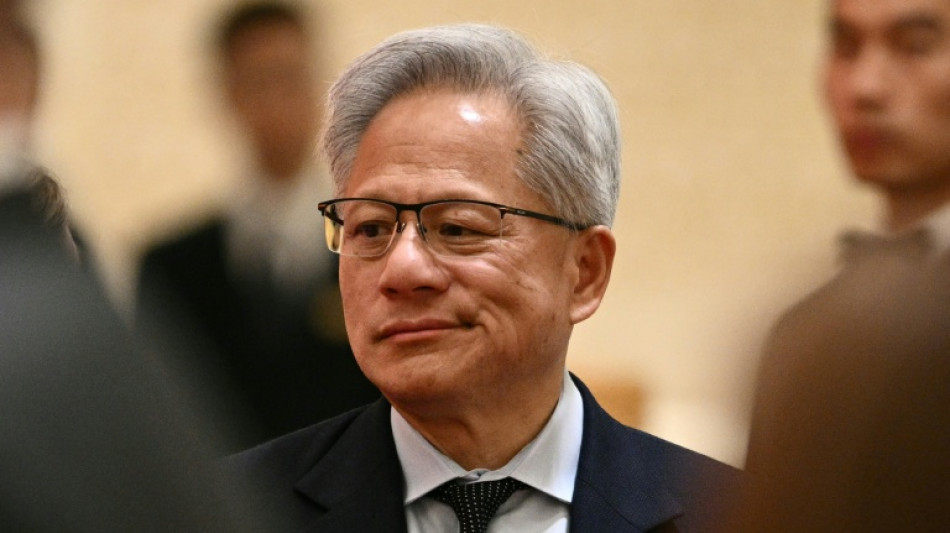
Alibaba unveils new AI chip as Nvidia access remains stalled / Photo: Brendan SMIALOWSKI - AFP

 Trump rejects AI slowdown concerns as UN urges coordinated controls

 Higher wages draw migrant workers to Kashmir despite attacks

 Oil supply concerns and AI warnings weigh on global markets

 'I am the hoax buster': Trump rejects AI danger warnings

 Doha Islamic finance forum names AlRayan firms as co-lead partners

 Russian disinformation campaign sets sights on US midterms

 New York seizes 12 celeb deep-fake porn sites

 France, Iraq deepen energy, defence ties during Zaidi visit

 PopDEX Surpasses $61M TVL and $2B Trading Volume in Closed Beta

 Trump blasts 'sick conspiracy' against AI as warnings mount

 French defence group Thales calls on governments to regulate AI

 Oil gains on Mideast supply fears, AI warnings rattle tech firms
 STARCARES-Renovated Court In Thailand Grows Into a Shared Space for School and Community

 Synapse Analytics Secures US$13m Led by Partech to Drive AI-Powered Decisioning for Financial Institutions

 Surfer hospitalised after shark attack in Western Australia

 US hosts G20 'energy abundance' talks amid Iran war shock

 Migrant workers flock to Indian Kashmir despite militant threats

 Canada's Carney seeks closer Europe ties to counter hostile US

 Dozens arrested in major anti-LGBTQ raids in Turkey

 Poland, Ukraine slam Russian strikes near border as 'escalation'

 iPhone 18預購後出現可疑扣款 四間銀行調查未授權交易

 Galaxy Tab S12系列效果圖曝光 Ultra擬配雙鏡頭及瀏海螢幕

 Altman tells Fortune OpenAI will not go public in 2026

 الأرصاد السعودية تتوقع سيولاً وأمطاراً رعدية في خمس مناطق

 Anthropic details Claude misuse as US targets major illicit online marketplace

Tech giant Alibaba released on Wednesday a new artificial intelligence chip it said performed three times as well as its predecessor, showcasing growing domestic chipmaker prowess as US titan Nvidia struggles for access to China.
Semiconductors have been at the centre of a fierce US-China race for AI supremacy, with Nvidia's most advanced chips banned from sale in China by Washington over national security concerns.
Beijing has in response sought to bolster its self-reliance, pouring resources into promoting its domestic industry and reportedly barring firms from buying Nvidia chips.
Alibaba said its new chip, Zhenwu M890, can deliver three times the performance of its predecessor Zhenwu 810E, which is widely believed to match the capabilities of Nvidia's H20.
The H20 is a less powerful version of Nvidia's AI processing units designed specifically for export to China.
A more high-end option, the H200, has been licensed to sell to China from the US side, but its access to the Chinese market appears to have stalled.
Zhang Guobin, founder of Chinese specialist website eetrend.com, said the timing of the Alibaba launch is "extremely precise".
"It's during a window when the prospects of the H200 entering the Chinese market are highly uncertain and Nvidia's business in China has effectively dropped to zero," he told AFP.
Nvidia boss Jensen Huang was part of a US business delegation that travelled to Beijing with President Donald Trump last week.
He said he had not discussed the H200 directly but added "the Chinese government has to decide how much of their local market... they want to protect".
The new Zhenwu M890 chip "provides a reliable option that is insulated from fluctuations in export controls, enabling domestic AI companies to formulate long-term technology roadmaps," said eetrend.com's Zhang.
"At the very least... (it) proves that in the field of high-end AI computing power, China now has a 'Plan B' that does not depend on Nvidia," he added.
However, when it comes to performance, Nvidia still holds its lead.
Even the H200 is significantly less advanced than the firm's top-range chips -- the Blackwell series and forthcoming Rubin processors.
Alibaba said to date it has shipped more than 560,000 chips in its Zhenwu series, to over 400 customers, including automakers and financial institutions.
The Hangzhou-based tech giant, which runs some of the country's biggest ecommerce platforms, has accelerated its pivot to AI in recent years.
Its open-source Qwen AI model family is popular among developers, surpassing one billion cumulative downloads since its initial launch in 2023.
Y.Ibrahim--CPN