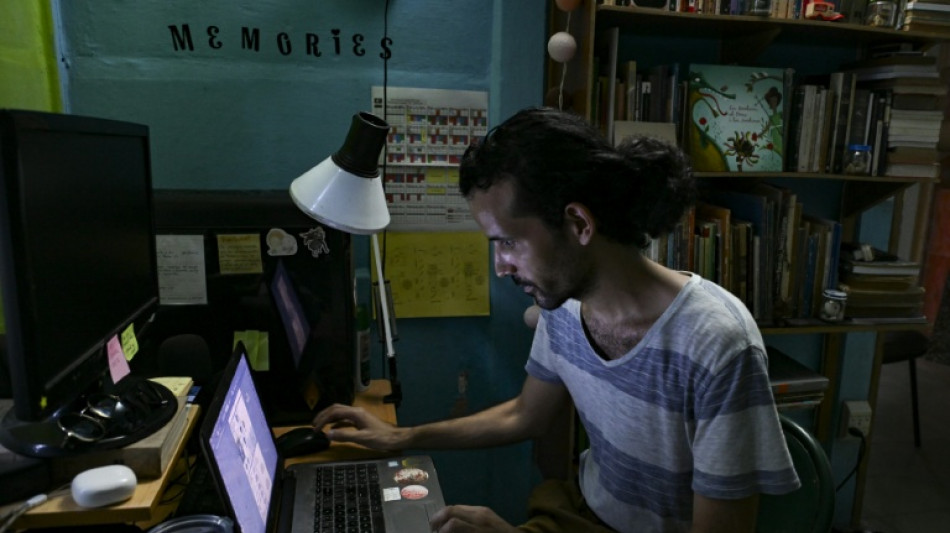
Lights out for Cuban students as blockade bites / Photo: YAMIL LAGE - AFP

 Lights out in Laos as electricity exports surge

 Steven Strogatz weighs AI mathematics advances and their consequences for researchers

 Anthropic boss calls for AI slowdown, Altman and Musk agree

 French IT giant Capgemini sells subsidiary after row over ICE links

 Quebec Brokerage Qubit Insurance Announces New Data on Coverage Shortfalls as Rebuilding Costs Rise

 Lady Gaga welcomes first child with fiance: US media

 Bhutan business bets on hazelnuts for farming future

 'Widow's Bay' and 'The Pitt' are favorites for Emmys night

 Coastal erosion forces cancellation of California music festival

 Argentina's Dirty War rears its head in Venice film

 UK lawmakers throw out bill to legalise assisted dying

 US inflation steady in August, fueling Fed rate hike expectations

 New York marks 25th anniversary of 9/11 attacks

 Nepal flood reconstruction bill to be $4.78 bn: foreign ministry

 JUMO and Standard Bank launch Social Finance Framework to scale inclusive finance in Africa

 Doomsday tech: could AI really kill us all?

 French comedy show 'Call my agent' makes film comeback

 It's all coming back: Celine Dion fans gear up for Paris return

 Researchers eye AI revolution in natural disaster forecasts

 US braces for inflation report that may push Fed to hike rates

 Musk threatens legal action over documentary

 Latin America fact-check group asks Meta not to replace verification practice

 AI Risks to Enter 60–80% of Liability and Cyber Insurance Underwriting by 2028, ScienceSoft Predicts

 Tribal Launches Campfire, Letting Business and Technical Teams Build on Salesforce Together

 Stocks fall as fresh oil surge fans inflation fears

It's the middle of the night in Havana, but Alejandro Benitez is just getting down to work.
The power is back on for the first time in 15 hours and Benitez, a fourth-year architecture student, needs to get his assignment in fast before the electricity cuts out again.
Desperate times call for desperate measures in crisis-hit Cuba, where a US fuel blockade -- part of a pressure campaign which Havana fears will culminate in a military intervention -- has aggravated an energy crisis, leaving people without power for up to 20 hours a day.
In February, the government moved university classes online, part of a raft of measures aimed at conserving electricity.
But distance learning has proven challenging in a country with patchy internet and dwindling power supplies.
Students struggle in fields like architecture, which require regular feedback and direction from insructors.
"Having direct contact with the teacher is really important," said 28-year-old Benitez, who has to ask all of his questions via WhatsApp or Telegram.
With only one oil tanker mooring in Cuba in the last four months, the situation is rapidly deteriorating.
The government announced that it had run out of diesel and fuel oil needed to power the generators that supplement the output of its seven dilapidated power plants.
And as public transport grinds to a halt, so too have students' social lives.
Benitez, who cooks over an open charcoal fire, hasn't left his neighborhood of Punta Brava since February.
- Self-starters required -
Shalia Garcia, a 19-year-old second-year industrial design student, is also struggling to adapt.
Some courses which are central to her degree have been suspended or pared back.
Teachers send around agendas, course material and submission dates for assignments.
Then the responsibility is on the students in a system that requires them to be self-starters.
"This type of teaching puts the onus on the student, which I find hard to manage," Garcia said.
Even the most zealous pupils face multiple hurdles.
The discounted mobile data packages available to students do not have the capacity to download large folders, and it can take time for teachers to respond to questions.
Teachers, too, say they feel hamstrung by the lack of face time with students.
Benitez's partner, Alfredo Rodriguez, a 34-year-old industrial design professor, told AFP there were entire sections of the syllabus that his students "simply have not seen" because they need to be taught in person.
He also has to regularly extend students' deadlines.
"We cannot make the same demands when we know that some students have no electricity or internet connection," he explained.
Garcia's mother, a doctor, worries that her daughter's education is suffering as a result.
"I'm very concerned but I have no choice but to face the situation," Luisa Odalys Destrade said with a sigh.
Benitez, for his part, feels his future is being held hostage by Havana's standoff with Washington.
"What sort of architect will I become?" he wondered.
A.Zimmermann--CPN