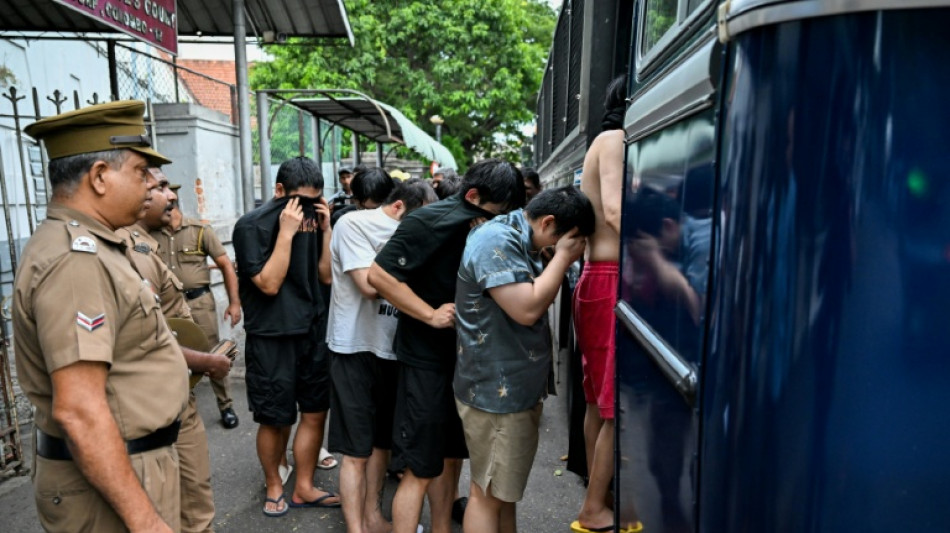
Crackdown in Southeast Asia pushes scam networks to Sri Lanka / Photo: Ishara S. KODIKARA - AFP/File

 Trump rejects AI slowdown concerns as UN urges coordinated controls

 Higher wages draw migrant workers to Kashmir despite attacks

 Oil supply concerns and AI warnings weigh on global markets

 'I am the hoax buster': Trump rejects AI danger warnings

 Doha Islamic finance forum names AlRayan firms as co-lead partners

 Russian disinformation campaign sets sights on US midterms

 New York seizes 12 celeb deep-fake porn sites

 France, Iraq deepen energy, defence ties during Zaidi visit

 PopDEX Surpasses $61M TVL and $2B Trading Volume in Closed Beta

 Trump blasts 'sick conspiracy' against AI as warnings mount

 French defence group Thales calls on governments to regulate AI

 Oil gains on Mideast supply fears, AI warnings rattle tech firms

 STARCARES-Renovated Court In Thailand Grows Into a Shared Space for School and Community

 Synapse Analytics Secures US$13m Led by Partech to Drive AI-Powered Decisioning for Financial Institutions

 Surfer hospitalised after shark attack in Western Australia

 US hosts G20 'energy abundance' talks amid Iran war shock

 Migrant workers flock to Indian Kashmir despite militant threats

 Canada's Carney seeks closer Europe ties to counter hostile US

 Dozens arrested in major anti-LGBTQ raids in Turkey

 Poland, Ukraine slam Russian strikes near border as 'escalation'

 iPhone 18預購後出現可疑扣款 四間銀行調查未授權交易

 Galaxy Tab S12系列效果圖曝光 Ultra擬配雙鏡頭及瀏海螢幕

 Altman tells Fortune OpenAI will not go public in 2026

 الأرصاد السعودية تتوقع سيولاً وأمطاراً رعدية في خمس مناطق
 Anthropic details Claude misuse as US targets major illicit online marketplace

A surge in arrests of suspected foreign scammers in Sri Lanka has authorities concerned that the island is fast becoming a hub for online crime, following sweeping crackdowns in hotspots Cambodia and Myanmar.
Officials say some scam networks forced out of countries in Southeast Asia have simply shifted to new bases, increasingly moving operations to Sri Lanka -- an attractive destination due to a relaxed visa regime and reliable, high-speed internet.
Since the start of the year, police have arrested more than 1,000 foreigners, mainly from China, Vietnam and India, for alleged involvement in cybercrime, spokesman Fredrick Wootler said, a jump from 430 for the entirety of 2024 and even fewer last year.
Last month, Sri Lankan customs officials intercepted nine Chinese nationals attempting to smuggle used mobile phones and laptops in the hundreds, raising suspicion they were to be used in large-scale fraud operations.
Fraud compounds where scammers lure internet users into fake romantic relationships, cryptocurrency investments and betting platforms have flourished across Southeast Asia.
Initially largely targeting Chinese speakers, the criminal groups behind the compounds have expanded operations into multiple languages.
Those conducting the scams are sometimes willing con artists, and other times trafficked foreign nationals forced to work.
Officials say the networks operating in Sri Lanka target victims across Asia, including in India, Vietnam and the Philippines, but there are growing concerns Sri Lankans could be next.
Authorities are also investigating whether foreign syndicates were involved in a recent cyberattack on the Sri Lankan treasury that resulted in around $2.5 million in losses.
- Landlords warned -
China, which has stepped up cooperation with regional governments in recent years to crack down on scam networks, has acknowledged the geographical shift.
Beijing's embassy in Colombo said illicit activity in Sri Lanka had risen following enforcement actions in Cambodia, Myanmar as well as the United Arab Emirates.
"The Chinese government attaches great importance to this trend," the embassy said in a statement, pledging closer cooperation with Sri Lankan law enforcement agencies.
The networks displaced from Myanmar and Cambodia, where authorities have stepped up raids and deportations, exploit the island's 30-day tourist visas for nationals of more than 40 countries, including India and China, while others can easily apply for permits online.
Criminal gangs are setting up in rented spaces ranging from luxury villas to office complexes.
Police have begun warning property owners against renting villas and apartments to suspected scam operators, saying they could face prosecution for aiding criminal activity.
The vast scale of these operations has become clearer in recent weeks, with police "getting a lot of calls on a daily basis", according to spokesman Wootler.
He told AFP that in a single night this week, "we carried out five raids" in the coastal Galle and Matara districts, netting 192 Indian suspects and 29 Nepalis.
Another 280 foreign suspects were arrested last week near the capital Colombo, and 135 Chinese nationals were apprehended in March at a single scam centre.
- Regional crisis -
As cases surge, immigration authorities are now playing a larger role in investigations.
"We are getting our agents directly involved because of the increase in the number of cases handled by police," an immigration official told AFP on condition of anonymity.
The expansion of criminal networks mirrors a broader regional crisis.
A United Nations report issued this year estimated that at least 300,000 people have been trafficked into scam compounds across Southeast Asia.
While Sri Lankan officials say they have not identified foreigners being trafficked into the country, dozens of Sri Lankans have been rescued from scam compounds abroad over the past year.
Wootler said authorities were doing all they could to tackle the growing problem, deporting foreigners who overstay their visa and ensuring those who engage in online crime are "punished by our courts".
H.Cho--CPN