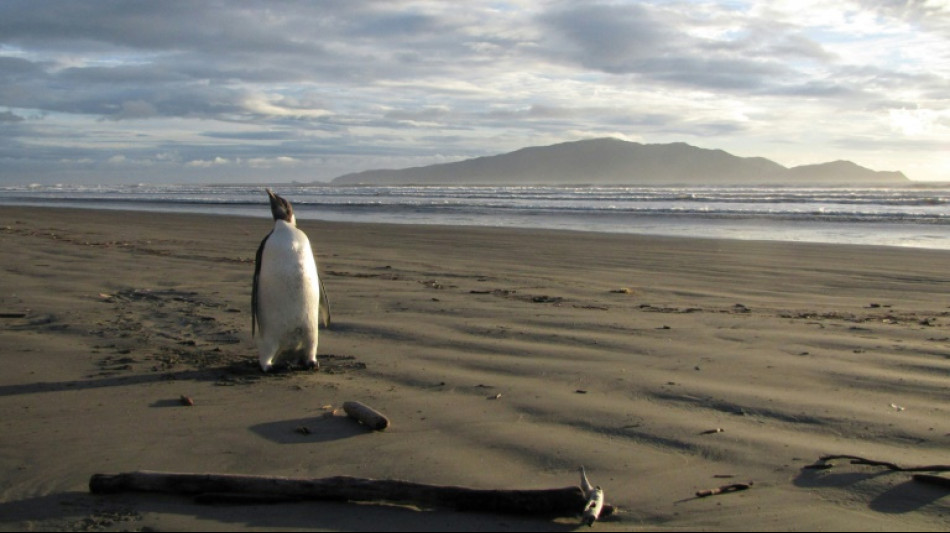
Warming decimates Antarctica's emperor penguin chicks / Photo: Richard Gill - DEPARTMENT OF CONSERVATION/AFP/File

 Kenya's economy faces climate change risks: World Bank

 Hungary to shut nuclear plant as heatwave hits central Europe

 Tech-fuelled rally fizzles as oil prices rise

 Alarm over climate-linked low level of German waterways

 Commerzbank agrees to talks with UniCredit after two-year standoff

 Fornaro Legal Releases Guidance to Help Businesses Maintain Clear Ownership Records During Growth

 Japan probe made closest-ever asteroid flyby: space agency

 British oil giant BP aims to sell North Sea business

 China factory activity slides as leaders seek spending boost

 Tech rebound fuels record-breaking rally in South Korean stocks
 Cables and cooling bring AI windfall to Indian suppliers

 Anthropic's models gained unauthorized 'real-world' access during testing

 Apple tops estimates in CEO Cook's final quarter, but shares fall

 Milei demands expulsion of foreigners expressing 'hate' against Argentina

 Italy's Po River valley on drought alert

 Prada profits pinched as growth hard to chase

 Stocks climb on earnings and rates, oil retreats

 US economic growth slows in second quarter, missing expectations

 Russia adds Telegram founder Durov to 'terrorist' blacklist

 Stocks diverge on earnings, as oil steadies

 Eurozone economy grows despite Middle East war

 Singapore group will develop 'most promising' Ebola vaccine

 Shell profit surges as Mideast war fuels oil prices

 Car maker Stellantis says back in profit in second quarter

 Samsung quarterly operating profit up 1,800% on AI boom

Helpless emperor penguin chicks perished at multiple breeding grounds in West Antarctica late last year, drowning or freezing to death when sea ice eroded by global warming gave way under their tiny feet, scientists said Thursday.
Of five sites monitored in the Bellingshausen Sea region, all but one experienced a 100 percent loss of chicks, they reported in Communications: Earth & Environment, a Nature journal.
They called it a "catastrophic breeding failure".
"This is the first major breeding failure of emperor penguins across several colonies due to sea ice loss, and is probably a sign of things to come," lead author Peter Fretwell, a researcher at the British Antarctic Survey, told AFP.
"We have been predicting it for some time, but actually seeing it happening is grim."
Last year's southern hemisphere spring -- from mid-September to mid-December -- saw record-low sea ice in the Southern Ocean, especially along the west coast of the Antarctic Peninsula, a prime breeding ground for the world's largest penguin species.
The precocious break-up of ice that forms over open water adjacent to land proved fatal for thousands of hatchlings not yet mature enough to cope with frigid ocean waters.
A baby emperor penguin emerges from an egg kept warm in winter by a male, while the female in a breeding pair embarks on a two-month fishing expedition. Upon returning to the colony, she feeds hatchlings by regurgitating.
To survive on their own, chicks must develop waterproof feathers, a process known as fledging that typically starts in mid-December and lasts a couple of weeks.
But the ice in Bellingshausen Sea colonies started to give way last year in late November.
"The ice will break up, disintegrating or breaking into floes which float away," Fretwell explained.
"Chicks that go into the water will likely drown, but even if they manage to get back out they will probably freeze to death," he added.
- Penguin poo -
"If they manage to stay on icebergs, we assume most of them will drift away and starve as the parents will not be able to find them."
Emperor penguins have been known to find alternative sites in response to unstable sea ice, but the accelerating impact of climate change in Antarctica threatens to outpace their capacity to adapt.
"Such a strategy will not be possible if breeding habitat becomes unstable at a regional level," the study concluded.
As with the polar bears at the other end of the planet, global warming caused mainly by burning fossil fuels is the only factor threatening the long-term viability of the iconic emperor penguin.
Other large animals facing extinction are primarily threatened by habitat loss and over-exploitation.
Emperor penguins, aka Aptenodytes forsteri, number about a quarter of a million breeding pairs, all in Antarctica, according to a 2020 study.
The Bellingshausen Sea colonies account for less than five percent of that total.
"But overall, around 30 percent of colonies were affected by sea ice loss last year, so there will be many more chicks who did not survive," said Fretwell.
In mid-February, Antarctica's sea ice extent shrank to two million square kilometres (nearly 800,000 square miles), about 30 percent below the 1981-2010 average.
The five colonies covered by the study -- Rothschild Island, Verdi Inlet, Smylet Island, Bryan Peninsula and Pfrogner Point -- were all discovered with medium resolution satellite imagery over the last 14 years, and their populations were counted using high resolution imagery.
The colonies are visible from space thanks to the distinctively pink-brown hue of penguin poo, or guano, which covers a broad area over the course of the nine months penguins are in residence, even if the colonies themselves are not always visible.
Only Rothschild Island has been visited by scientists, and of the other sites only Smylet Island has been seen by aerial survey.
Male and female emperor penguins are similar in plumage and size, reaching a metre tall and weighing up to 20 kilos.
In the dead of winter, they huddle together to protect against wind chill, taking turns using their bodies as shields.
H.Meyer--CPN