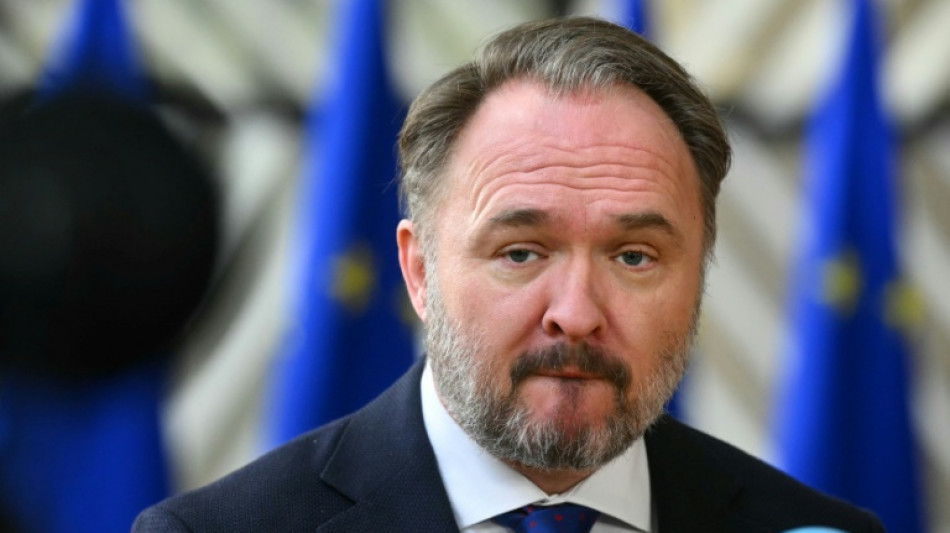
EU talks energy as oil price soars / Photo: NICOLAS TUCAT - AFP

 Bank of Japan hikes rates to 31-year high to battle inflation

 AI doomsday warnings unlikely to slow IPOs but questions linger

 In Brazil's Amazon, the hunt for oil fuels hopes and fears

 Baby orangutans in India expose 'frightening' scale of trafficking

 Oversight Board blasts 'inadequate' Meta safeguards for AI deepfakes

 Harry makes first public appearance since return to UK

 Princess Diana's brother makes new explosive claims against Charles

 Trump admin overhauls key protection for endangered species

 Mbappe draws political fire over Ceuta t-shirt controversy

 Third malaria death in Germany from outbreak tied to Frankfurt airport

 AtlasClear Holdings Reports Preliminary Fiscal 2026 Revenue of Approximately $20.1 Million, Up 85%; Revenue Plus Interest Income of Approximately $21.9 Million

 'Another arrow to the quiver': World Bank posts record private capital mobilization

 Ireland to boycott Eurovision 2027 over Gaza

 India's Tata Sons reappoints N. Chandrasekaran as chairman

 Germany urges EU action against China to defend carmakers

 Japan eyes changing prostitution law to punish sex buyers

 Modi pitches India as global chipmaking hub

 Ukraine plans record defence spending in 2027

 NASA scan discovers new, 'once in a century' Moon crater

 Most stocks rise as Fed hikes and indicates drive to curb inflation

 UK-Sudanese author pens book to give children 'African history of Africa'

 Argentine judge orders suspension of Falklands oil project

 US Fed raises rates to tackle 'too high' inflation, irking Trump

 Turkey releases 106 protesters, jails more LGBTQ activists

 Candidate for UN chief calls for AI regulation akin to nuclear weapons

Energy ministers from the EU's 27 nations huddled in Brussels Monday to discuss how to help families and businesses as the Iran war sends energy prices soaring.
The meeting laid the groundwork for a Thursday summit of EU leaders that will seek to address the issue -- though the bloc has a limited number of tools at its disposal.
Here are some facts:
- Countries respond -
Member states retain a large degree of independence from Brussels in influencing retail energy prices, and some have already moved to contain the fallout from conflict in the Middle East.
Croatia and Hungary have announced fuel price caps and Greece is to cap profit margins on gasoline.
EU energy chief Dan Jorgensen this week urged EU governments to lower taxes and levies on energy where possible -- but that requires some budget leeway.
In France, energy giant TotalEnergies announced a price cap on gasoline, following pressure from the country's cash-strapped government that has stepped up price checks at gas stations.
Meanwhile the 32 members of the International Energy Agency have agreed to unlock 400 million barrels of oil from reserves -- their largest release ever -- in a bid to ease prices.
- Electricity market debate -
In Europe the price of electricity is determined by production costs of the last power plant called upon to meet demand.
That tends to be cheaper renewable or nuclear plants when demand is low and pricier gas power stations when it is high.
"As long as we are forced to rely on thermal power plants during peak hours, the marginal price will always be determined by fossil fuels," said Marc Baudry, an economist at the Paris Dauphine University.
The crisis has revamped calls from Italy and others for changes to the EU's electricity market, which was last reformed to reduce exposure to gas price volatility in 2024.
European Commission President Ursula von der Leyen said this week Brussels was "exploring subsidising or capping the gas price" used to calculate electricity costs.
But a similar market correction mechanism introduced after Russia's invasion of Ukraine in 2022 was never activated due to the strict conditions for doing so.
And critics say the main reason power in Europe is about three times more expensive than in the United States is the continent's lack of fossil fuel resources -- which forces it to rely on expensive imports.
Hence the commission's push to decarbonise industry, and boost renewables.
- Carbon pricing standoff -
Backed by some central European nations, Italy is also calling for a reform and even a suspension of the EU's carbon trading scheme, which obliges heavy polluters to buy permits.
Critics, including parts of European industry, lament the system contributes to high energy bills -- as gas-fired plants need to pay up to cover their planet-warming emissions.
Free emission allowances allocated to ease the green transition are being phased out by 2034. Some would like them to stay.
Brussels is already preparing proposals for a reform of the 20-year-old carbon market scheme later this year.
In a Monday letter to member states ahead of a leaders' summit on Thursday, von der Leyen said Brussels was "accelerating our work" on the revision, "notably to set out a more realistic decarbonisation trajectory beyond 2030".
Eight countries, including Sweden, Spain, and the Netherlands, pushed back against calls for reform this week, warning that "making fundamental changes" to a "cornerstone of the EU's climate policy" would represent a "very worrying step backwards".
Heavyweight France has struck a middle-ground position, calling for the rules to be made more flexible without compromising the "integrity" of the carbon market scheme.
D.Goldberg--CPN