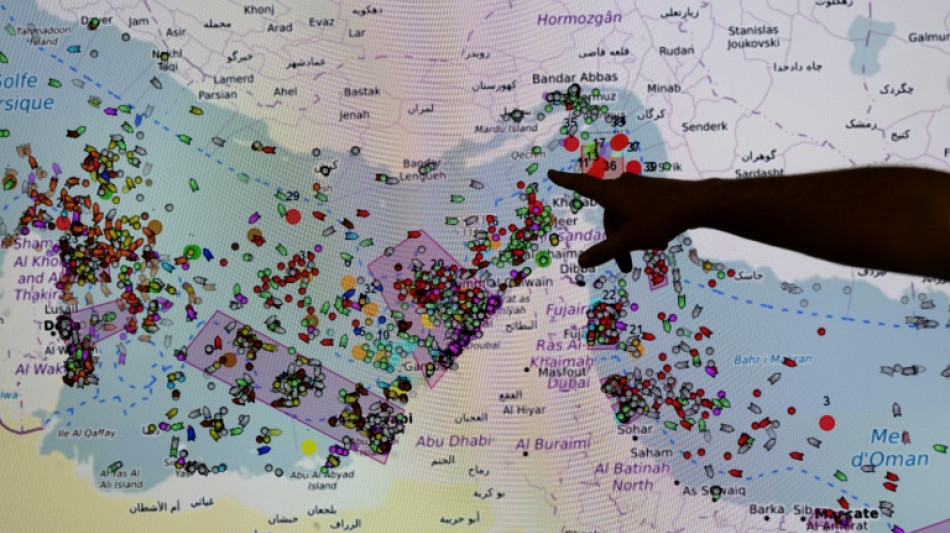
French hub monitors Hormuz tensions from afar / Photo: Fred TANNEAU - AFP

 EU to ban social media for under 13s, curb access until 15

 Wildfires push endangered Sumatran elephants to brink: Indonesian NGO

 Bank of Japan set to raise rates under pressure from inflation, US

 EU chief to unveil social media, gaming curbs for under-15s

 'Resident Evil' film brings video game's ethos to the big screen

 i-payout Expands U.S. Money Transmitter Licensing Footprint and Advances European EMI Strategy

 US Senate crypto bill collapses amid partisan deadlock

 OpenAI, Anthropic and Google are working to create an AI standards body

 Protesting shepherds, farmers clash with Romanian police

 Foundation Lets Ledger Users Switch to Open Source Without Starting Over

 EU to propose curbing social media, online games for under 15s

 FX Junction Reaches 40,600 Members and 26 Million Trades

 'We unleashed the beast': the world's fears and hopes about AI

 Hospitality leaders ask Burnham to halve VAT amid rising costs

 Worcestershire invited to nominate groups for 2027 King’s volunteer award

 Berlin's run-down public spaces at heart of election campaign

 'Widow's Bay' and 'The Pitt' win big at Emmy Awards

 Most markets drop as oil extends gains ahead of expected US rate hike

 Sri Lanka's famed beach shack battles demolition

 Vserv targets ₹1,000 crore revenue by 2030 through AI expansion

 India prohibits bank fees on UPI payments up to ₹2,000

 Brazil's Amazon defender Raoni has cancer

 Trump rejects AI slowdown concerns as UN urges coordinated controls

 Higher wages draw migrant workers to Kashmir despite attacks

 Oil supply concerns and AI warnings weigh on global markets

A dozen members of the French navy scour screens for blinking lights indicating movement thousands of kilometres away near the Strait of Hormuz.
Since the start of the Iran war in late February, staff at a maritime security centre in western France have been helping merchant ships trapped in the Gulf.
Twin Iranian and US blockades of the Strait of Hormuz have left more than 750 civilian ships stranded on the Gulf side of the passageway, through which a fifth of global crude oil and liquefied natural gas transited before the conflict. Only a handful have managed to leave in recent weeks.
If the Maritime Information Cooperation and Awareness Center (MICA center) detects any form of bombardment, it immediately sends nearby ships -- container ships, cargo vessels and cruise liners -- an encrypted message.
"We share the nature of the event, its context and exact position," commanding officer Thomas Scalabre tells AFP in a basement in the French city of Brest.
"They can respond quickly, moving away from the danger if there are shots or debris, or even turn off their transponders so as not to be detected," he adds.
This information is sent within a radius of 50 nautical miles. For comparison, the strait itself is 29 nautical miles wide at its narrowest point.
- Rules 'very unclear' -
The information on the MICA center's monitoring screens is a mixture of satellite images, ship locations emitted by their transponders, and information shared by crews at sea.
It provides help to 85 maritime transport companies, including French group CMA CGM and Danish giant Maersk.
Beyond threats from the Middle East war, the MICA center also tracks the rest of the world's waters -- including Yemeni rebel missile and drone attacks in the Red Sea, piracy off Somalia, and drug smuggling.
MICA has recorded around 40 security incidents, including 24 Iranian direct attacks on commercial vessels since February 28, some of them deadly, Scalabre says.
France and the United Kingdom have pledged to set up a peaceful coalition to re-open the Strait of Hormuz -- but it is not to operate until after the conflict is resolved. Peace talks have stalled in recent weeks.
In the meantime, "the rules Iran imposes on navigation remain very unclear and are constantly shifting," Scalabre says, including with regards to which ships the Iran's Revolutionary Guards (IRGC) might decide to single out.
"There isn't necessarily any logic in the IRGC's targeting policy. We've seen many different nationalities and types of vessels" being targeted, he said.
- 'Mosquito fleet' -
IRGC gunboats on April 18 fired at India-flagged tanker Sanmar Herald without prior radio contact, security intelligence firm Vanguard Tech reported, despite India being viewed as a "friend" of Iran, as are China, Russia, Iraq and Pakistan.
Iran also claims to have laid sea mines in the main part of the waterway.
"What matters is the psychological effect. No one will take the risk of venturing there," Scalabre says.
Tehran can authorise some ships to leave the Gulf or enter it via the Strait of Hormuz.
But "even when they obtain it, the IRGC's 'mosquito fleet' can emerge to block their way," Scalabre says.
In his office, the commanding officer enlarges an image showing a swarm of speedboats carrying out such an attack.
A dozen Iranian patrol boats burst forth, carving white foamy wakes behind them as they encircle and seize a vessel before it can leave.
"They sometimes carry out indiscriminate attacks, whether the country is considered friendly or not," the French navy officer says.
"For Tehran, controlling the Strait of Hormuz remains one of its trump cards to exert pressure and negotiate" a way out of the conflict, he adds.
M.P.Jacobs--CPN