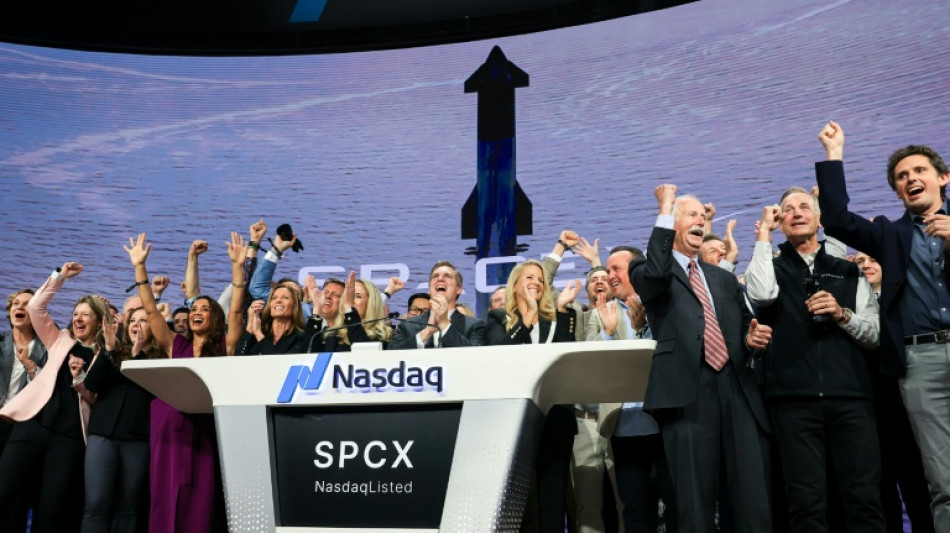
SpaceX: Five key moments, from first launch to Starship megarocket / Photo: TIMOTHY A. CLARY - AFP

 Wildfires push endangered Sumatran elephants to brink: Indonesian NGO

 Bank of Japan set to raise rates under pressure from inflation, US

 EU chief to unveil social media, gaming curbs for under-15s

 'Resident Evil' film brings video game's ethos to the big screen

 i-payout Expands U.S. Money Transmitter Licensing Footprint and Advances European EMI Strategy

 US Senate crypto bill collapses amid partisan deadlock

 OpenAI, Anthropic and Google are working to create an AI standards body

 Protesting shepherds, farmers clash with Romanian police

 Foundation Lets Ledger Users Switch to Open Source Without Starting Over

 EU to propose curbing social media, online games for under 15s

 FX Junction Reaches 40,600 Members and 26 Million Trades

 'We unleashed the beast': the world's fears and hopes about AI

 Hospitality leaders ask Burnham to halve VAT amid rising costs

 Worcestershire invited to nominate groups for 2027 King’s volunteer award

 Berlin's run-down public spaces at heart of election campaign
 'Widow's Bay' and 'The Pitt' win big at Emmy Awards

 Most markets drop as oil extends gains ahead of expected US rate hike

 Sri Lanka's famed beach shack battles demolition

 Vserv targets ₹1,000 crore revenue by 2030 through AI expansion
 India prohibits bank fees on UPI payments up to ₹2,000
 Brazil's Amazon defender Raoni has cancer

 Trump rejects AI slowdown concerns as UN urges coordinated controls

 Higher wages draw migrant workers to Kashmir despite attacks

 Oil supply concerns and AI warnings weigh on global markets

 'I am the hoax buster': Trump rejects AI danger warnings

More than 20 years after its founding, SpaceX made history Friday with its record-high stock market debut, crowning a unique journey marked by dazzling successes but also catastrophic failures and unfulfilled promises.
Here are five key moments in the company's history:
- 2008: The founding myth -
Six years after its founding, SpaceX launched its first rocket into orbit after multiple failures, taking off in September 2008 from a remote archipelago in the Pacific Ocean.
"I messed up the first three launches, the first three launches failed," co-founder Elon Musk recalled years later.
"Fortunately the fourth launch -- that was the last money that we had -- the fourth launch worked, or that would have been it for SpaceX. But fate liked us that day."
- 2012: Next stop, ISS -
After the successful launch, SpaceX grew and developed more powerful launchers, including its flagship rocket, Falcon 9, which has become the most widely used rocket today.
Among its creations was the Dragon spacecraft, which docked as a cargo vessel at the International Space Station in 2012, a first by a private company.
Eight years later, the Dragon spacecraft carried its first astronaut to the ISS, beating other aerospace companies like Boeing to becoming the main American transport to the space station.
- 2018: A Tesla in space? -
At the same time, SpaceX in 2015 successfully landed the first stage of its Falcon 9 rocket, ushering in the age of partially reusable rockets.
This was followed by Falcon Heavy, a much more powerful launcher with two Falcon 9 boosters.
To mark its first test flight in 2018, Musk decided to place the car made by one of his other companies, a Tesla, on board.
The image of the red Tesla occupied by a mannequin dubbed Starman -- after David Bowie -- was seen around the world.
Not all SpaceX promises were kept though: that same year, Musk said he would send a group which included Japanese billionaire Yusaku Maezawa around the Moon by 2023, but that never came to pass.
- 2020-2023: Starbase's explosive beginning -
The tech trillionaire ended up prioritizing the development of his megarocket Starship, designed to travel to the Moon and, eventually, Mars.
To complete the project, he bought vast amounts of land in Texas and developed an industrial complex known as Starbase, where he would launch a series of Starship prototypes, most of which blew up into spectacular fireballs.
Musk justified the "rapid unscheduled disassembly" of these rockets, to use the entrepreneur's favorite euphemism for explosions, by saying they were part of the learning process.
- 2024: The unprecedented 'Super Heavy' catch -
In October 2024, SpaceX succeeded in recovering the first stage of Starship, its "Super Heavy" booster, in a unique maneuver that had never been achieved before.
After launching the spacecraft, the booster detached and began its descent, returning to the SpaceX launch pad where a pair of "chopsticks" reached out to catch the booster and bring it to a halt.
The feat, while impressive, is only the first part of SpaceX's plan to make Starship a fully reusable rocket -- a goal it remains in pursuit of while dealing with several technical challenges.
Y.Ponomarenko--CPN