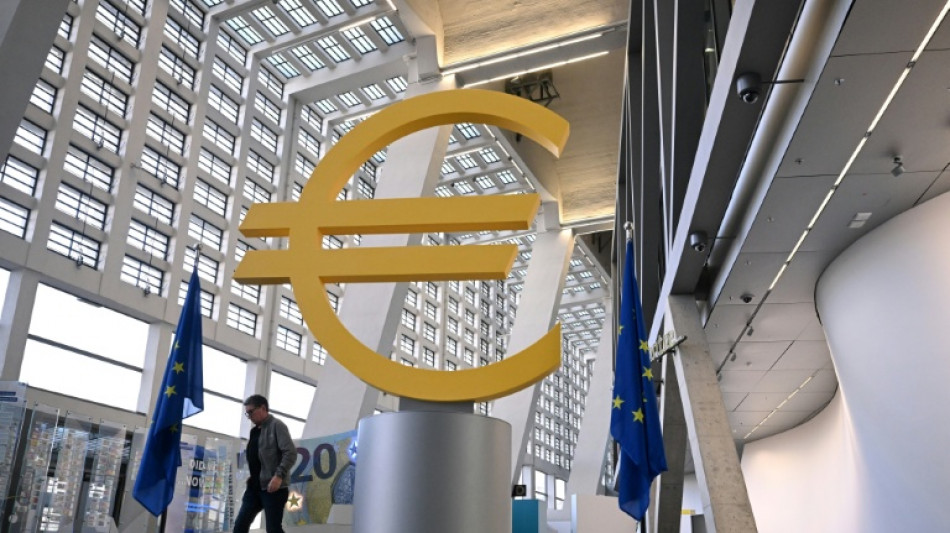
ECB set to hold rates despite Iran war energy shock / Photo: Kirill KUDRYAVTSEV - AFP

 Germany urges EU action against China to defend carmakers

 Japan eyes changing prostitution law to punish sex buyers

 Modi pitches India as global chipmaking hub

 Ukraine plans record defence spending in 2027

 NASA scan discovers new, 'once in a century' Moon crater

 Most stocks rise as Fed hikes and indicates drive to curb inflation

 UK-Sudanese author pens book to give children 'African history of Africa'

 US Congress passes sweeping Russia sanctions bill

 US stocks fall, dollar gains after Fed lifts interest rates

 US Fed raises rates to tackle 'too high' inflation in move sure to rile Trump

 US Fed raises rates to battle inflation in move likely to rile Trump

 US House faces test on sweeping Russia sanctions bill

 British PM says to make 'difficult decisions' as inflation rises

 Global fuel price demos: a round-up

 Leverate Launches MCP for Traders to Connect AI Assistants With Trading Platforms

 MEXC Launches $1M "Discover Your Wall Street DNA" Campaign to Help Traders Find Their Market Fit

 Stocks edge higher ahead of US Fed rate call

 BASIS.pro Expands On-Chain Infrastructure with XDC Network Partnership and Zypher DAO as Auto Earn Goes Live

 Pickle-flavoured tart? AI inspires Japan's convenience stores

 EU chief hosts Canada's Carney in push to 'deepen' alliance

 Meta chief pushes back on AI slowdown calls

 US Fed to deliver rate decision with markets betting on hike

 i-payout Expands U.S. Money Transmitter Licensing Footprint and Advances European EMI Strategy

 US Senate crypto bill collapses amid partisan deadlock

 OpenAI, Anthropic and Google are working to create an AI standards body

The European Central Bank is expected to hold interest rates steady again on Thursday as policymakers weigh concerns about higher inflation triggered by the Middle East war against worries about weakening growth.
Energy costs have spiked since the near total closure of the Strait of Hormuz, through which about a fifth of the world's oil and gas usually pass, following the outbreak of the US-Israeli conflict against Iran.
Eurozone inflation is already picking up -- it was 2.6 percent in March, above the ECB's two-percent target -- but the central bank appears reluctant to quickly hike rates, fearing higher borrowing costs could weigh on the region's already lacklustre growth.
But the central bank for the 21-nation euro area is expected to keep its key deposit rate at two percent for now, where it has been since June last year, as it waits to see how the war plays out.
Italian bank UniCredit wrote in a note that it did not "see the urgency" for the Frankfurt-based institution to act, particularly as inflation was around the ECB's target before the conflict.
"The weakening of the outlook for demand, particularly for private consumption, reinforces the case for the ECB to be patient," it said.
Data since the outbreak of the war have pointed to falling consumer and investor confidence, while a key survey in April showed eurozone business activity contracted for the first time in 16 months.
- Looking to June -
Other central banks are also taking a cautious approach.
The Federal Reserve held interest rates steady Wednesday, its third pause in a row, as it also waits for the full impacts of the war to become clear.
The Bank of England, due to meet Thursday ahead of the ECB, is also expected to keep borrowing costs on hold.
But, with inflation higher than in other advanced economies, some members of its rate-setting committee may vote for a hike, analysts say.
While expectations of a swift eurozone rate hike have been tempered somewhat, some are now pencilling one in for the ECB's June meeting.
All eyes will be on President Christine Lagarde's post-rate call press conference for clues as to the path forward.
"Any hints about a June move will be taken on board," said ING bank economist Carsten Brzeski.
- 'Not in a rush' -
Much of the inflation and growth outlook depends on whether Iran and the United States can come to a lasting agreement that secures energy supplies through the Strait of Hormuz, a factor over which the ECB has no control.
Speaking in Berlin earlier this month, Lagarde said the institution was facing "double uncertainty" in that it was unclear both how long the shock would last and what its effect on the broader economy would be.
ECB officials have been keen to stress that the difference between the situation now and that after Russia's invasion of Ukraine in 2022, when the central bank was criticised for moving too slowly to respond to surging inflation.
At that time, an energy shock combined with post-pandemic supply chain woes and tight labour markets to push eurozone inflation to record highs.
But for now, ECB officials are "not in a rush," Bank of Latvia governor Martins Kazaks, a member of the ECB's rate-setting governing council, told The Financial Times last week.
"We still have the large luxury of collecting data and forming our view."
A.Zimmermann--CPN



