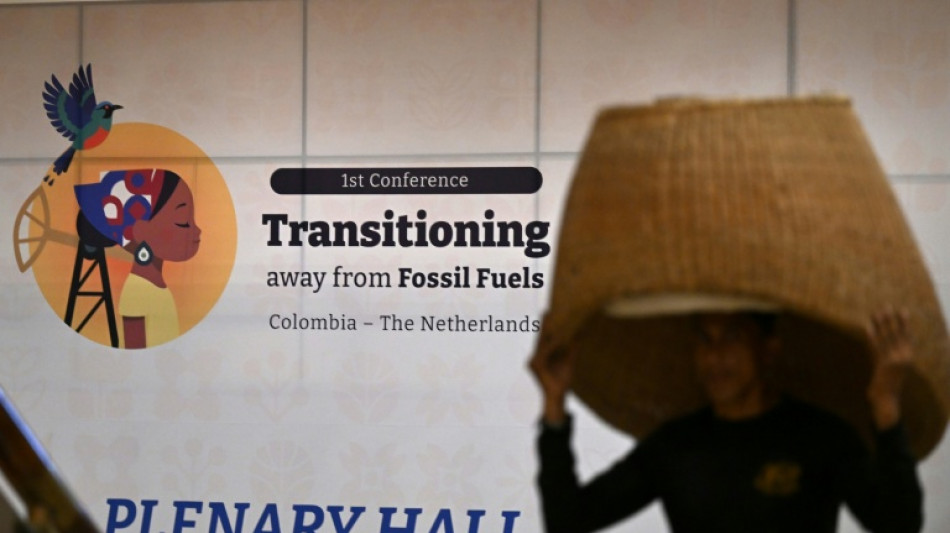
Key points from the first global talks on phasing out fossil fuels / Photo: Raul ARBOLEDA - AFP

 EU to ban social media for under 13s, curb access until 15

 Wildfires push endangered Sumatran elephants to brink: Indonesian NGO

 Bank of Japan set to raise rates under pressure from inflation, US

 EU chief to unveil social media, gaming curbs for under-15s

 'Resident Evil' film brings video game's ethos to the big screen

 i-payout Expands U.S. Money Transmitter Licensing Footprint and Advances European EMI Strategy

 US Senate crypto bill collapses amid partisan deadlock

 OpenAI, Anthropic and Google are working to create an AI standards body

 Protesting shepherds, farmers clash with Romanian police

 Foundation Lets Ledger Users Switch to Open Source Without Starting Over

 EU to propose curbing social media, online games for under 15s

 FX Junction Reaches 40,600 Members and 26 Million Trades

 'We unleashed the beast': the world's fears and hopes about AI

 Hospitality leaders ask Burnham to halve VAT amid rising costs

 Worcestershire invited to nominate groups for 2027 King’s volunteer award

 Berlin's run-down public spaces at heart of election campaign
 'Widow's Bay' and 'The Pitt' win big at Emmy Awards

 Most markets drop as oil extends gains ahead of expected US rate hike

 Sri Lanka's famed beach shack battles demolition

 Vserv targets ₹1,000 crore revenue by 2030 through AI expansion

 India prohibits bank fees on UPI payments up to ₹2,000

 Brazil's Amazon defender Raoni has cancer

 Trump rejects AI slowdown concerns as UN urges coordinated controls

 Higher wages draw migrant workers to Kashmir despite attacks

 Oil supply concerns and AI warnings weigh on global markets

The first global conference on transitioning away from fossil fuels wrapped up on Wednesday -- but what progress was made in Santa Marta, a coal port on the Caribbean coast?
Here are a few takeaways:
- Roadmaps -
France made headlines on the opening day of the conference when it published a "roadmap" detailing its path to eliminating the use of all fossil fuels for energy by 2050.
Analysts said no other country had published such a clear and comprehensive phaseout plan and it sent an important signal from a major economy about its direction on fossil fuels.
The splash caused some grumbling in Santa Marta as some pointed out that France was not announcing new policy but existing pledges under a different title.
Other nations contested that there was no widely accepted definition of a roadmap, and that they too had timelines to phase out coal and other planet-heating fuels, as well as renewable energy targets and plans for decarbonizing heavy industry.
Leo Roberts from the E3G climate change think tank said a roadmap should be guided by science and make a fossil fuel phaseout a "central planning principle" around which other policies gravitate.
- 'Spaghetti' science -
One of the key outcomes was the creation of an expert scientific panel to advise governments, cities or regions in planning their own pathways away from fossil fuels.
Carlos Nobre, a Brazilian climate scientist and one of the driving forces behind the panel, told AFP: "It will provide all the solutions -- to implement them, and to finance them."
The Scientific Panel for the Global Energy Transition was amusingly dubbed the "Spaghetti" group because of its acronym -- SPGET.
- Fossil Free Zones -
Popular among grassroots movements, the concept of "Fossil Free Zones" is slowly gaining traction in international meetings and found fertile ground in Santa Marta.
These zones aim to encompass territories that -- due to their ecological importance, from the Amazon to the Congo Basin and Indonesian rainforest -- are protected by governments that prohibit all hydrocarbon exploration and extraction within them.
The Earth Insight expert group estimates that there are 58 such protected areas worldwide.
Colombia, for example, banned the extraction of fossil fuels and minerals in the Colombian Amazon last year to "stop the expansion of the extractive frontier," said Colombia's Environment Minister Irene Velez Torres, host of the Santa Marta conference.
- New hosts -
Colombia passed the baton to Tuvalu, a tiny island nation in the Pacific Ocean that will host the next fossil fuel phaseout conference in 2027.
The low-lying island is seriously threatened by rising sea levels, and has been a strong voice on the international stage for impoverished countries imperiled by climate change.
"This journey that began here in a coal port of the Caribbean Sea, now voyages to the Pacific Ocean," said Tuvalu's Climate Minister Maina Talia.
Activists urged countries to turn up in numbers, despite the distance.
"I think the fact that the Pacific is far away cannot be an excuse," Nikki Reisch, from the Center for International Environmental Law, told AFP in Santa Marta.
"The Pacific Island countries are constantly bearing the burden of coming to other fora and trying to get their voice heard."
Y.Ponomarenko--CPN