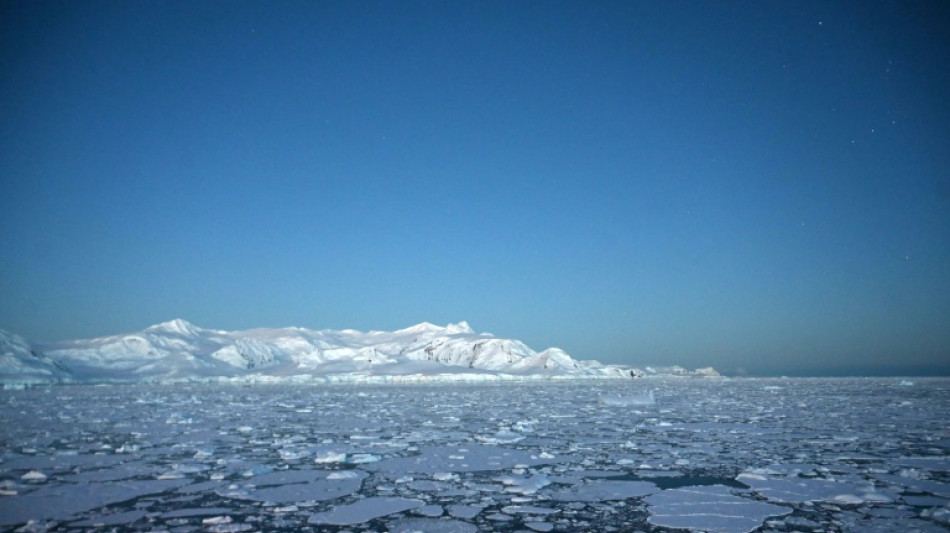
Antarctic sea ice improves after four years of extreme lows: US scientists / Photo: Johan ORDONEZ - AFP/File

 Japan's busiest rail station tests robot bins

 Backpackers fret over Australian visa crackdown

 Bank of Japan hikes rates to 31-year high to battle inflation

 AI doomsday warnings unlikely to slow IPOs but questions linger

 In Brazil's Amazon, the hunt for oil fuels hopes and fears

 Baby orangutans in India expose 'frightening' scale of trafficking

 Oversight Board blasts 'inadequate' Meta safeguards for AI deepfakes

 Harry makes first public appearance since return to UK

 Princess Diana's brother makes new explosive claims against Charles

 Trump admin overhauls key protection for endangered species

 Mbappe draws political fire over Ceuta t-shirt controversy

 Third malaria death in Germany from outbreak tied to Frankfurt airport

 AtlasClear Holdings Reports Preliminary Fiscal 2026 Revenue of Approximately $20.1 Million, Up 85%; Revenue Plus Interest Income of Approximately $21.9 Million

 'Another arrow to the quiver': World Bank posts record private capital mobilization

 Ireland to boycott Eurovision 2027 over Gaza

 India's Tata Sons reappoints N. Chandrasekaran as chairman

 Germany urges EU action against China to defend carmakers

 Japan eyes changing prostitution law to punish sex buyers

 Modi pitches India as global chipmaking hub

 Ukraine plans record defence spending in 2027

 NASA scan discovers new, 'once in a century' Moon crater

 Most stocks rise as Fed hikes and indicates drive to curb inflation

 UK-Sudanese author pens book to give children 'African history of Africa'

 Argentine judge orders suspension of Falklands oil project

 US Fed raises rates to tackle 'too high' inflation, irking Trump

Antarctic sea ice coverage has likely rebounded this year, coming closer to its annual summer average after four years of extreme lows, US scientists said Monday.
The area covered by Antarctic sea ice likely reached its annual minimum level at 2.58 million square kilometres (996,000 square miles) on February 26, according to scientists at the National Snow and Ice Data Center (NSIDC) at the University of Colorado Boulder.
Every year Antarctic sea ice reaches a minimum level during the southern hemisphere's summer, so this is the point that scientists measure it for annual readings.
This year's level ranks as the 16th smallest since satellite measurements began in 1979.
The 2026 minimum sea ice extent is closer to average than in the past four years, and 730,000 square kilometres above the record low set in February 2023, the scientists said.
But it was still 260,000 square kilometres below the 1981-2010 average.
"Through most of the year, Antarctic sea ice was well below the daily average," said Ted Scambos, senior research scientist at the Cooperative Institute for Research in the Environmental Sciences (CIRES).
"Then in January and February, strong winds from the south pushed sea ice outward in the Weddell Sea. This slowed the overall decline in extent, leading to a near-average minimum," Scambos said.
The NSIDC cautioned that the 2026 figure is preliminary, noting that "continued melt conditions or strong onshore winds could still push the ice extent lower".
"This year's return to less extreme conditions is not unexpected given the large year-to-year variation of Antarctic sea ice seen in the satellite record," said Walt Meier, scientist at the NASA NSIDC Distributed Active Archive Center.
L.K.Baumgartner--CPN