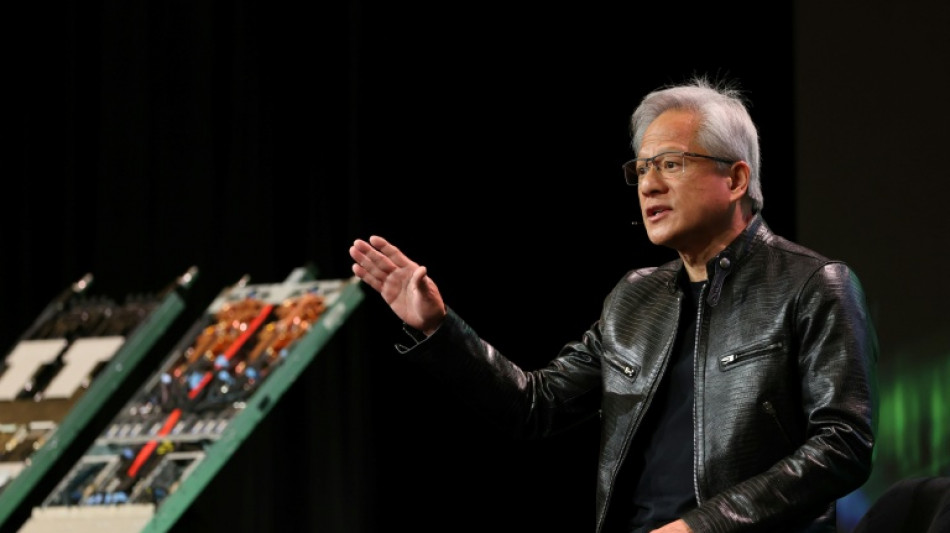
Nvidia rides 'claw' craze with AI agent platform / Photo: Patrick T. Fallon - AFP

 Bank of Japan hikes rates to 31-year high to battle inflation

 AI doomsday warnings unlikely to slow IPOs but questions linger

 In Brazil's Amazon, the hunt for oil fuels hopes and fears

 Baby orangutans in India expose 'frightening' scale of trafficking

 Oversight Board blasts 'inadequate' Meta safeguards for AI deepfakes

 Harry makes first public appearance since return to UK

 Princess Diana's brother makes new explosive claims against Charles

 Trump admin overhauls key protection for endangered species

 Mbappe draws political fire over Ceuta t-shirt controversy

 Third malaria death in Germany from outbreak tied to Frankfurt airport

 AtlasClear Holdings Reports Preliminary Fiscal 2026 Revenue of Approximately $20.1 Million, Up 85%; Revenue Plus Interest Income of Approximately $21.9 Million

 'Another arrow to the quiver': World Bank posts record private capital mobilization

 Ireland to boycott Eurovision 2027 over Gaza

 India's Tata Sons reappoints N. Chandrasekaran as chairman

 Germany urges EU action against China to defend carmakers

 Japan eyes changing prostitution law to punish sex buyers

 Modi pitches India as global chipmaking hub

 Ukraine plans record defence spending in 2027

 NASA scan discovers new, 'once in a century' Moon crater

 Most stocks rise as Fed hikes and indicates drive to curb inflation

 UK-Sudanese author pens book to give children 'African history of Africa'

 Argentine judge orders suspension of Falklands oil project

 US Fed raises rates to tackle 'too high' inflation, irking Trump

 Turkey releases 106 protesters, jails more LGBTQ activists

 Candidate for UN chief calls for AI regulation akin to nuclear weapons

Nvidia announced Monday that it was joining the OpenClaw craze, unveiling tools to bring AI agents -- which can manage your email, files and calendar while you sleep -- into the corporate world.
OpenClaw has taken Silicon Valley and tech-savvy users across the globe by storm, sparking "lobster fever" in reference to its red crustacean mascot, with many of the biggest names in tech convinced the AI agent is redefining computing.
But security concerns have dogged its rise, prompting the Chinese government to block state enterprises from using the tool. Nvidia is betting it can address those fears.
"Mac and Windows are the operating systems for the personal computer. OpenClaw is the operating system for personal AI," Nvidia's chief executive Jensen Huang said in a statement.
"This is the moment the industry has been waiting for -- the beginning of a new renaissance in software," he added.
The chipmaker unveiled tools designed to add security and privacy controls to these AI agents, called "claws," that run directly on a person's computer and execute complex tasks without constant human oversight.
- Stunning success -
Unlike ChatGPT or other chatbots that simply answer questions, claws act independently and around the clock and can even be asked to create apps or programs from scratch.
The craze traces back to a weekend coding project by Austrian developer Peter Steinberger, who has since been hired by OpenAI.
In late 2025 he released a self-hosted AI assistant called Clawdbot -- a nod to Anthropic's Claude chatbot -- that could be messaged through WhatsApp or Telegram and would quietly get to work on tasks in the background.
The response was immediate and overwhelming, with developers reporting they had stayed up all night finding new ways to exploit the tool, which can also be asked to write standalone software programs from simple text prompts.
After Anthropic filed a trademark infringement complaint, Steinberger renamed the project twice in quick succession, landing on OpenClaw.
The rebranding chaos generated only more headlines, and within months it had become the fastest-adopted open-source project in history.
But the technology's explosive spread has alarmed security researchers and corporate IT departments wary of employees inadvertently exposing company systems to hackers or causing disruption.
Several technology heavyweights have barred staff from running claw agents on work machines, and China's government has restricted state enterprises from using the platform over data security fears.
Nvidia, the world's most highly values company on Wall street, is seeking to turn those concerns to its advantage.
The company launched the Nvidia Agent Toolkit -- a suite of open-source models and software for building enterprise AI agents -- anchored by a new security layer called OpenShell that enforces network and privacy guardrails.
Adobe, Salesforce, SAP and Siemens are among the major software companies that said they are building on Nvidia's new platform.
S.F.Lacroix--CPN