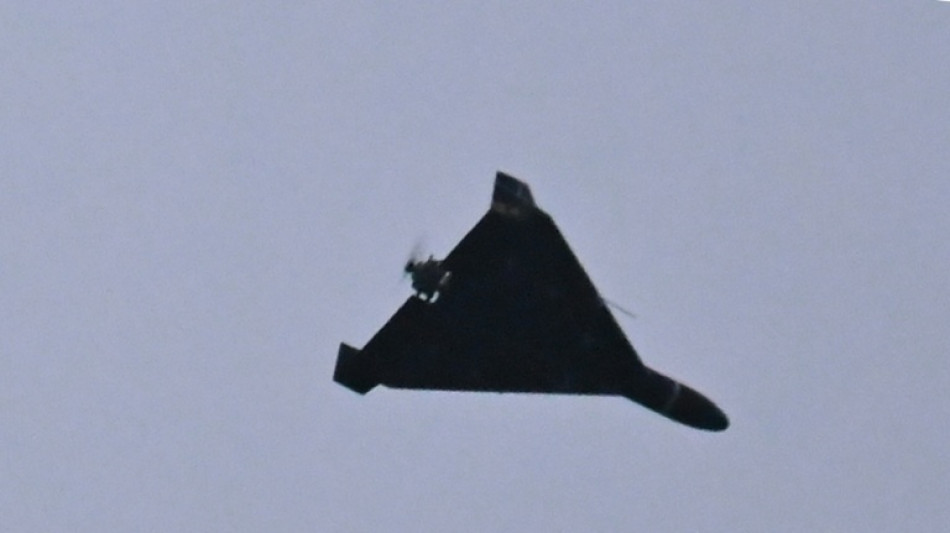
Why Iranian drones are hard to stop / Photo: Sergei SUPINSKY - AFP/File

 Bank of Japan hikes rates to 31-year high to battle inflation

 AI doomsday warnings unlikely to slow IPOs but questions linger

 In Brazil's Amazon, the hunt for oil fuels hopes and fears

 Baby orangutans in India expose 'frightening' scale of trafficking

 Oversight Board blasts 'inadequate' Meta safeguards for AI deepfakes

 Harry makes first public appearance since return to UK

 Princess Diana's brother makes new explosive claims against Charles

 Trump admin overhauls key protection for endangered species

 Mbappe draws political fire over Ceuta t-shirt controversy

 Third malaria death in Germany from outbreak tied to Frankfurt airport

 AtlasClear Holdings Reports Preliminary Fiscal 2026 Revenue of Approximately $20.1 Million, Up 85%; Revenue Plus Interest Income of Approximately $21.9 Million

 'Another arrow to the quiver': World Bank posts record private capital mobilization

 Ireland to boycott Eurovision 2027 over Gaza

 India's Tata Sons reappoints N. Chandrasekaran as chairman

 Germany urges EU action against China to defend carmakers

 Japan eyes changing prostitution law to punish sex buyers

 Modi pitches India as global chipmaking hub

 Ukraine plans record defence spending in 2027

 NASA scan discovers new, 'once in a century' Moon crater

 Most stocks rise as Fed hikes and indicates drive to curb inflation

 UK-Sudanese author pens book to give children 'African history of Africa'

 Argentine judge orders suspension of Falklands oil project

 US Fed raises rates to tackle 'too high' inflation, irking Trump

 Turkey releases 106 protesters, jails more LGBTQ activists

 Candidate for UN chief calls for AI regulation akin to nuclear weapons

Cheap and deadly, Iranian-designed Shahed drones have inflicted major damage in the Middle East war, and have anti-jamming and other capabilities that make them difficult to stop.
- Offline navigation -
Designed to explode on impact, Shahed drones connect to GPS to register their location shortly before or after takeoff, then typically turn off their receivers, said Thomas Withington, a researcher at Britain's Royal United Services Institute (RUSI).
The drones then travel long distances towards their target using gyroscopes that measure their speed, direction and position -- known as an "inertial navigation system".
"GPS is going to get jammed by whatever is protecting the target," Withington told AFP.
"If you look at a map of GPS jamming at the moment in the Middle East, you see that there's a lot of jamming... By not using the GPS, you avoid that."
The drones can then return to GPS just before impact for a more precise strike, or remain offline.
"It's not always necessarily very accurate, but it's as accurate as it needs to be," said Withington.
- Anti-jamming mechanisms -
Russia has been making Shahed-style drones to use in its war in Ukraine.
The US-based Institute for Science and International Security found in 2023 that those drones used "state-of-art antenna interference suppression" to remove enemy jamming signals while preserving the desired GPS signal.
Anti-jamming mechanisms were found in the wreckage of an Iranian-made drone that struck Cyprus in the opening days of the Middle East war, a European industry source told AFP.
"They have put (the Shahed) together using off-the-shelf parts, but it has... many of the capabilities that US military GPS equipment has," Todd Humphreys, a professor of aerospace engineering at the University of Texas at Austin, told AFP.
Defending against them now requires sophisticated electronic warfare equipment.
"The Shaheds have been upgraded," said Ukrainian air force spokesman Yuriy Ignat.
- Stealth materials -
The Shahed is built from "lightweight radar-absorbing materials", such as plastic and fibreglass, a 2023 RUSI paper said.
Their small size and low altitude allow them to slip through aerial defence systems.
- Other positioning systems? -
Some experts think Iran is using multiple positioning systems, making it easier for its drones to dodge jamming.
Serhii Beskrestnov, a technology adviser to the Ukrainian defence ministry, said Iran is using the BeiDou system, a Chinese rival to the US-developed GPS.
And the Russia-made version of Shaheds uses both BeiDou and the Russian equivalent, GLONASS, he said.
Others suspect Iran may be using LORAN, a radio navigation system developed during World War II.
LORAN, which does not require satellites, largely fell out of use when GPS emerged.
But Iran said in 2016 it was reviving the technology, which requires a network of large ground-based transmitters, though experts have not confirmed it is active today.
- Counter-strategies -
Militaries have mainly defended against Shaheds by shooting them down with cannon fire, missiles and interceptor drones, with the United States and Israel also developing lasers.
But jamming can work, as Ukraine has shown, as can "spoofing", which involves hacking into the drone's navigation system to change its destination.
Ukraine used electronic warfare to neutralise 4,652 attack drones from mid-May to mid-July 2025 -- not far off the number it shot down in the same period, 6,041, according to AFP analysis of Ukrainian military data.
Its experts insist that electronic and conventional defences are often used in tandem against the drones.
D.Avraham--CPN