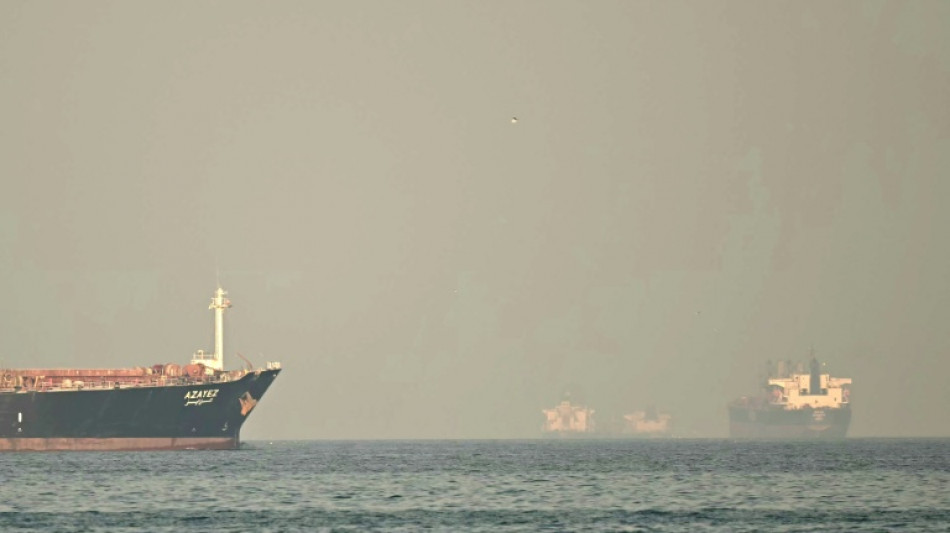
Ships in Gulf risk shortages on board, industry warns / Photo: Giuseppe CACACE - AFP

 Bank of Japan hikes rates to 31-year high to battle inflation

 AI doomsday warnings unlikely to slow IPOs but questions linger

 In Brazil's Amazon, the hunt for oil fuels hopes and fears

 Baby orangutans in India expose 'frightening' scale of trafficking

 Oversight Board blasts 'inadequate' Meta safeguards for AI deepfakes

 Harry makes first public appearance since return to UK

 Princess Diana's brother makes new explosive claims against Charles

 Trump admin overhauls key protection for endangered species

 Mbappe draws political fire over Ceuta t-shirt controversy

 Third malaria death in Germany from outbreak tied to Frankfurt airport

 AtlasClear Holdings Reports Preliminary Fiscal 2026 Revenue of Approximately $20.1 Million, Up 85%; Revenue Plus Interest Income of Approximately $21.9 Million

 'Another arrow to the quiver': World Bank posts record private capital mobilization

 Ireland to boycott Eurovision 2027 over Gaza

 India's Tata Sons reappoints N. Chandrasekaran as chairman

 Germany urges EU action against China to defend carmakers

 Japan eyes changing prostitution law to punish sex buyers

 Modi pitches India as global chipmaking hub

 Ukraine plans record defence spending in 2027

 NASA scan discovers new, 'once in a century' Moon crater

 Most stocks rise as Fed hikes and indicates drive to curb inflation

 UK-Sudanese author pens book to give children 'African history of Africa'

 Argentine judge orders suspension of Falklands oil project

 US Fed raises rates to tackle 'too high' inflation, irking Trump

 Turkey releases 106 protesters, jails more LGBTQ activists

 Candidate for UN chief calls for AI regulation akin to nuclear weapons

Thousands of seafarers face dwindling supplies of fuel and water as they wait on board, stranded by the Middle East war, a key shipping body warned Tuesday as it urged governments to help get maritime traffic flowing again.
John Stawpert is marine director of the London-based International Chamber of Shipping (ICS), which represents the world's national shipowner associations and over 80 percent of the world merchant fleet.
Here is an edited version of his interview with AFP ahead of an emergency meeting of the UN's International Maritime Organisation in London on Wednesday and Thursday.
- What is the impact on crews? -
"There are 20,000 seafarers on board 3,000 vessels of different types trapped in the Persian Gulf.
"Our biggest concern at the moment is the impact of an ongoing war on the stores on board the ships. We're already seeing some issues reported about fuel oil supplies. We've also got concerns about the ability of some of those ships to produce potable water.
"It's obvious things like food and water, in the first instance, and then seeing if there is a way to supply them with fuel, notwithstanding that if you can't move things by ship, it makes that incredibly difficult.
"We need to work with flag-states... but we also need to work with the regional states to come up with a solution that ensures these ships can be resupplied."
- Are military escorts welcome? -
"Potentially, yes, but it depends on the terms of the support that's being provided.
"It's not just thinking in terms of hardware on the water. It's also the information and intelligence... (available) to ships, which can help with that threat assessment that is ultimately what will decide whether ships move or not.
"The issue we have at the moment, and this is one of the reasons why we haven't seen very many ships at all move, is that it's not clear what the targeting criteria are for vessels going through those waters."
Escorts "would depend on what is being provided by whom and to whom. Really I think what we need is a solution that meets the needs of all ships, rather than just say, individual flags."
- What must governments do? -
"If we can persuade states, through some mechanism, to provide a channel effectively for those ships to get out of the region, then that would be hugely beneficial.
"Hopefully some states will step up and say they will provide some guarantee of safety to shipping that would give us the confidence that we could move through the Strait again.
"We would like to see serious consideration of some means to facilitate the movement of vessels out of the affected region as a priority. We'll be raising this at the International Maritime Organization tomorrow (Wednesday)."
M.Mendoza--CPN