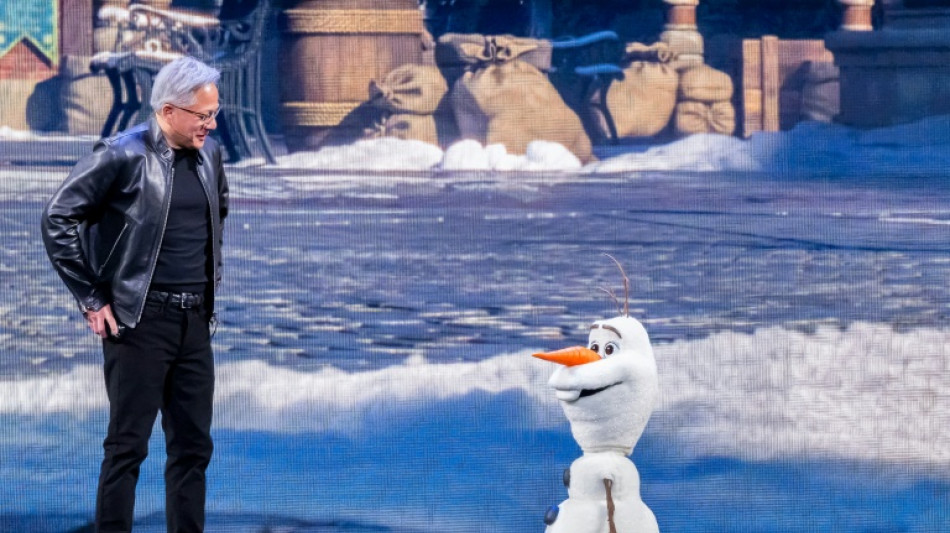
Nvidia making AI module for outer space / Photo: JOSH EDELSON - AFP

 Watts, Pitt, Cruz to light up Spain's top film festival

 Toogood Gold's Table Mountain Sits in the Shadow of a Nevada Gold Rush

 MEXC July–August Security Report: 38.66M USDT in Risk Funds Intercepted, Futures Insurance Fund Hits 792M USDT

 Emporio Armani names Dario Vitale new creative director

 EU to ban social media for under 13s, curb access until 15

 Wildfires push endangered Sumatran elephants to brink: Indonesian NGO

 Bank of Japan set to raise rates under pressure from inflation, US

 EU chief to unveil social media, gaming curbs for under-15s

 'Resident Evil' film brings video game's ethos to the big screen

 i-payout Expands U.S. Money Transmitter Licensing Footprint and Advances European EMI Strategy

 US Senate crypto bill collapses amid partisan deadlock

 OpenAI, Anthropic and Google are working to create an AI standards body

 Protesting shepherds, farmers clash with Romanian police

 Foundation Lets Ledger Users Switch to Open Source Without Starting Over

 EU to propose curbing social media, online games for under 15s

 FX Junction Reaches 40,600 Members and 26 Million Trades

 'We unleashed the beast': the world's fears and hopes about AI

 Hospitality leaders ask Burnham to halve VAT amid rising costs

 Worcestershire invited to nominate groups for 2027 King’s volunteer award

 Berlin's run-down public spaces at heart of election campaign

 'Widow's Bay' and 'The Pitt' win big at Emmy Awards

 Most markets drop as oil extends gains ahead of expected US rate hike

 Sri Lanka's famed beach shack battles demolition

 Vserv targets ₹1,000 crore revenue by 2030 through AI expansion

 India prohibits bank fees on UPI payments up to ₹2,000

Nvidia chief Jensen Huang on Monday said the leading artificial intelligence chip maker is heading for space with a goal of powering orbiting data centers.
An Nvidia graphics processing unit (GPU) was launched into space late last year by startup Starcloud in what was touted as an off-planet debut for the technology, but now Nvidia is creating a module intended as a building block for data centers there.
"We're working with our partners on a new computer called Vera Rubin Space One," Huang said as he kicked off the GPU-maker's annual developers conference in Silicon Valley.
"It's going to go out to space and start data centers."
Partners in the project include Starcloud, which is planning a November satellite launch that will mark the "cosmic debut" of the new Nvidia module.
A Starcloud-1 satellite, about the size of a small refrigerator, is expected to be packed with 100 times more computing power than any previous space-based operation.
"In 10 years, nearly all new data centers will be being built in outer space," predicted Starcloud co-founder and chief Philip Johnston.
The startup explained that it plans to power Google AI with the Nvidia GPUs to show that large language models can run in outer space.
Nvidia described the Vera Rubin module as being optimized for AI, enabling real-time sensing, decision making, and autonomous functioning.
"Space computing, the final frontier, has arrived," Huang said.
"With our partners, we’re extending Nvidia beyond our planet — boldly taking intelligence where it's never gone before."
Tech firms are floating the idea of building data centers in space and tapping into the sun's energy to meet out-of-this-world power demands in a fierce artificial intelligence race.
More than a dozen startups, aerospace leaders, and major tech firms are involved in the development, testing, or planning of space-based data centers.
The big draw of space for data centers is power supply, with the option of synchronizing satellites to the sun's orbit to ensure constant light beaming onto solar panels.
Building in space also avoids the challenges of acquiring land and meeting local regulations or community resistance to projects.
Critical technical aspects of such operations need to be resolved, however, particularly damage to the orbiting data centers from high levels of radiation and extreme temperatures, and the danger of them being hit by space junk.
T.Morelli--CPN