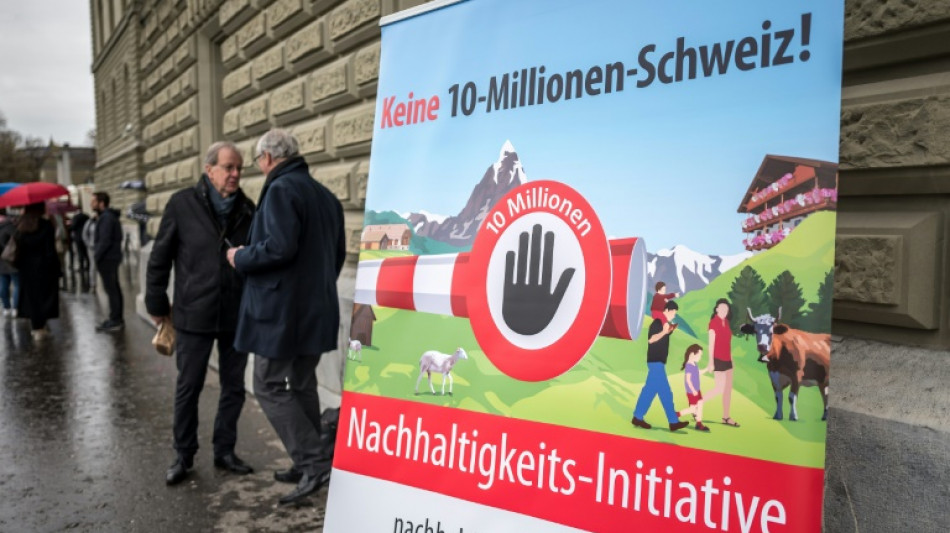
Swiss government rejects proposal to limit immigration / Photo: Fabrice COFFRINI - AFP

 Bank of Japan hikes rates to 31-year high to battle inflation

 AI doomsday warnings unlikely to slow IPOs but questions linger

 In Brazil's Amazon, the hunt for oil fuels hopes and fears

 Baby orangutans in India expose 'frightening' scale of trafficking

 Oversight Board blasts 'inadequate' Meta safeguards for AI deepfakes

 Harry makes first public appearance since return to UK

 Princess Diana's brother makes new explosive claims against Charles

 Trump admin overhauls key protection for endangered species

 Mbappe draws political fire over Ceuta t-shirt controversy

 Third malaria death in Germany from outbreak tied to Frankfurt airport

 AtlasClear Holdings Reports Preliminary Fiscal 2026 Revenue of Approximately $20.1 Million, Up 85%; Revenue Plus Interest Income of Approximately $21.9 Million

 'Another arrow to the quiver': World Bank posts record private capital mobilization

 Ireland to boycott Eurovision 2027 over Gaza

 India's Tata Sons reappoints N. Chandrasekaran as chairman

 Germany urges EU action against China to defend carmakers

 Japan eyes changing prostitution law to punish sex buyers

 Modi pitches India as global chipmaking hub

 Ukraine plans record defence spending in 2027

 NASA scan discovers new, 'once in a century' Moon crater

 Most stocks rise as Fed hikes and indicates drive to curb inflation

 UK-Sudanese author pens book to give children 'African history of Africa'

 Argentine judge orders suspension of Falklands oil project

 US Fed raises rates to tackle 'too high' inflation, irking Trump

 Turkey releases 106 protesters, jails more LGBTQ activists

 Candidate for UN chief calls for AI regulation akin to nuclear weapons

The Swiss government on Monday rejected a hard-right proposal to limit immigration to stop the population from hitting 10 million before 2050, arguing it would harm relations with the European Union.
Swiss voters will have their say on June 14 on a proposal entitled "No to a Switzerland of 10 million residents", championed by the Swiss People's Party (SVP), the country's biggest party.
The SVP, which has its roots in rural politics, is opposed to the EU, mass immigration and any weakening of Swiss neutrality.
The government said the popular initiative "endangers Switzerland's prosperity, internal security and humanitarian tradition".
"It calls into question the proven bilateral path with the EU and creates additional uncertainty in an already uncertain time," it said in a statement.
Switzerland's population has now passed nine million. The initiative says the Alpine nation's permanent resident population must not exceed 10 million people before the year 2050.
If it does, Switzerland would have to terminate international agreements blamed for driving population growth.
From 2050 onwards, the government can adjust the limit to account for the surplus of births over deaths, according to the proposal.
The government said the proposal would have "far-reaching consequences", up to and including the free movement of people agreement with the EU.
"The initiative would have a negative impact on relations with the EU. The initiative would thus call into question the bilateral path as a whole," it said.
- EU agreements package -
Landlocked Switzerland is not in the EU but is almost entirely surrounded by bloc members Germany, France, Italy and Austria, and is a member of Europe's Schengen open-borders zone.
Earlier this month, Bern and Brussels signed a package of agreements to deepen and streamline ties in a host of areas, including on the free movement of people, trade and transport.
The government noted Monday that the package has a specific safeguard clause, under which Switzerland can restrict immigration in the event of serious social or economic problems.
But that package will have to clear the Swiss parliament, with a referendum ultimately expected in 2027.
The Federal Statistical Office currently estimates the Swiss population at nearly 9.14 million -- up from 9.05 million at the end of 2024, when 27 percent were foreign nationals.
Net migration is by far a bigger driver of population growth than natural change, according to FSO figures.
Under Switzerland's direct democracy system, citizens can trigger popular votes by collecting 100,000 valid signatures within 18 months.
"Uncontrolled immigration... is overwhelming our infrastructure, destroying our environment, and driving rents even higher," says the SVP, insisting "action must finally be taken".
Switzerland's seven-member government contains two SVP ministers -- including President Guy Parmelin -- but adopts its positions collectively.
M.Mendoza--CPN