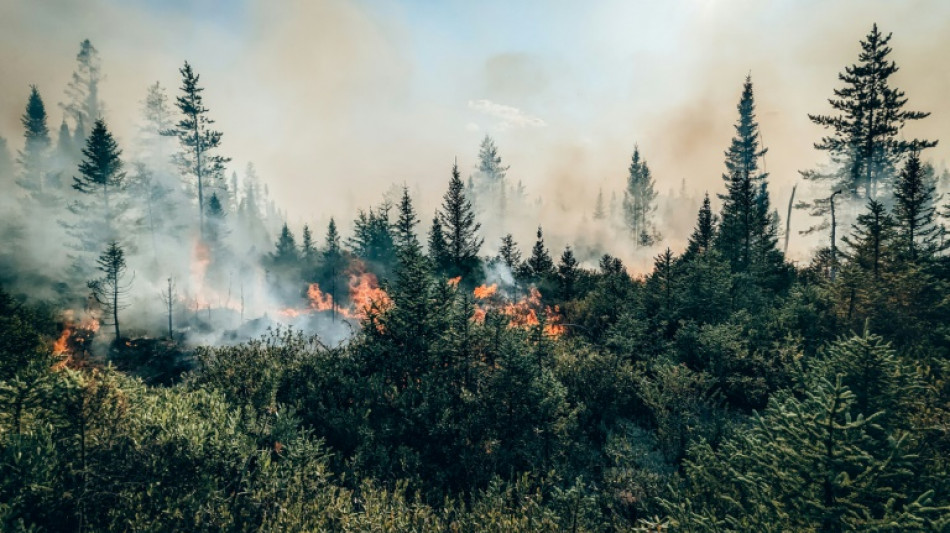
Climate change supercharged 'fire weather' behind Canada blazes / Photo: Jesse Larriviere - Societe De Protection Des Forets/AFP/File

 Kenya's economy faces climate change risks: World Bank
 Hungary to shut nuclear plant as heatwave hits central Europe
 Tech-fuelled rally fizzles as oil prices rise

 Alarm over climate-linked low level of German waterways

 Commerzbank agrees to talks with UniCredit after two-year standoff
 Fornaro Legal Releases Guidance to Help Businesses Maintain Clear Ownership Records During Growth

 Japan probe made closest-ever asteroid flyby: space agency
 British oil giant BP aims to sell North Sea business

 China factory activity slides as leaders seek spending boost

 Tech rebound fuels record-breaking rally in South Korean stocks

 Cables and cooling bring AI windfall to Indian suppliers

 Anthropic's models gained unauthorized 'real-world' access during testing

 Apple tops estimates in CEO Cook's final quarter, but shares fall

 Milei demands expulsion of foreigners expressing 'hate' against Argentina

 Italy's Po River valley on drought alert

 Prada profits pinched as growth hard to chase

 Stocks climb on earnings and rates, oil retreats

 US economic growth slows in second quarter, missing expectations

 Russia adds Telegram founder Durov to 'terrorist' blacklist

 Stocks diverge on earnings, as oil steadies

 Eurozone economy grows despite Middle East war

 Singapore group will develop 'most promising' Ebola vaccine

 Shell profit surges as Mideast war fuels oil prices

 Car maker Stellantis says back in profit in second quarter

 Samsung quarterly operating profit up 1,800% on AI boom

Human-caused climate change made 2023's severe, months-long "fire weather" conditions that powered Canada's record-breaking blazes at least seven times more likely to happen, according to a new scientific analysis published Tuesday.
The study by the World Weather Attribution group also found that over the year, fire-prone conditions were 50 percent more intense as a result of global warming, primarily a result of burning fossil fuels.
"As we continue to warm the planet, these kinds of events are going to get more frequent and they're going to get more intense," first author Clair Barnes, an environmental statistician at Imperial College London, told AFP.
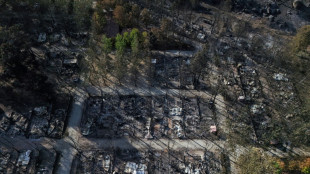
Canada is experiencing its most devastating fire season ever, a result of record high temperatures, low humidity and early thaw of snow melt. Nearly 15.3 million hectares (37.8 million acres) have burned: an area larger than Greece, and more than double the previous 1989 record.
Some 200,000 people have been evacuated, at least four have died, and smoke from the burning forests has led to dangerous air pollution spreading across much of Canada and the United States to the south -- driving spikes in emergency department visits and even school closures.
As of late July, the forest fires had directly emitted more than a billion tons of carbon dioxide into the atmosphere as well as methane and nitrous oxide that had a combined greenhouse effect equivalent of a further 110 million tons of carbon dioxide, according to recent research.
For the current study, scientists examined the eastern province of Quebec, honing in on zones that are similar in climate and vegetation. The region saw an exceptionally high number of fires in May and June, when national temperature records were smashed by 0.8 degrees Celsius (1.4 degrees Fahrenheit).
Because wildfires are highly complex and not driven solely by climate, the researchers focused instead on conditions conducive to blazes, using a metric called the Fire Weather Index (FWI).
This combines temperature, wind speed, humidity and precipitation. The team accumulated this data from January to July to derive a measure of severity of fire weather over the entire season.
While Quebec's fires were unprecedented, analysis of the recent climate record indicated the seasonal conditions causing the blazes are no longer rare, occurring once every 25 years. This means they now have a four percent chance of happening every year.
To understand the contribution of man-made global warming, they used computer model simulations to compare the climate as it is today, after about 1.2C (2.2F) of global warming since the late 1800s, with the climate of the past.
This showed climate change had made seasons of this severity at least seven times more likely to occur compared to pre-industrial times. Barnes stressed, however, that this was a lower-bound estimate, with the researchers choosing to be conservative in the face of statistical uncertainty.
- Indigenous communities hit hardest -
Yan Boulanger, an ecologist with the Canadian Forest Service and the report's second author, told AFP the cumulative impact of circumstances favorable to fire was key. "It's because those fire weather conditions lasted so long that those fires could grow so big."
The team also identified the seven-day-stretch when fire weather conditions were at their highest, and found such peak conditions were more than twice as likely to occur than in the past, as a result of climate change.
If the world continues burning fossil fuels at high rates, the likelihood and intensity of severe fire weather conditions will only increase, the analysis showed.
These fires imperil the future of the forestry sector, Boulanger warned, with a question mark over whether regeneration efforts can keep up with losses.
The most impacted communities meanwhile are remote and have relatively few resources, including Indigenous peoples, who made up 75 percent of those evacuated in July.
"This increasing severity of extreme events and likelihood of extreme events is not going to stop until we reach net zero and stop adding extra greenhouse gasses into the atmosphere," said Barnes, adding it's "not too late" to lobby political leaders to change course.
C.Peyronnet--CPN