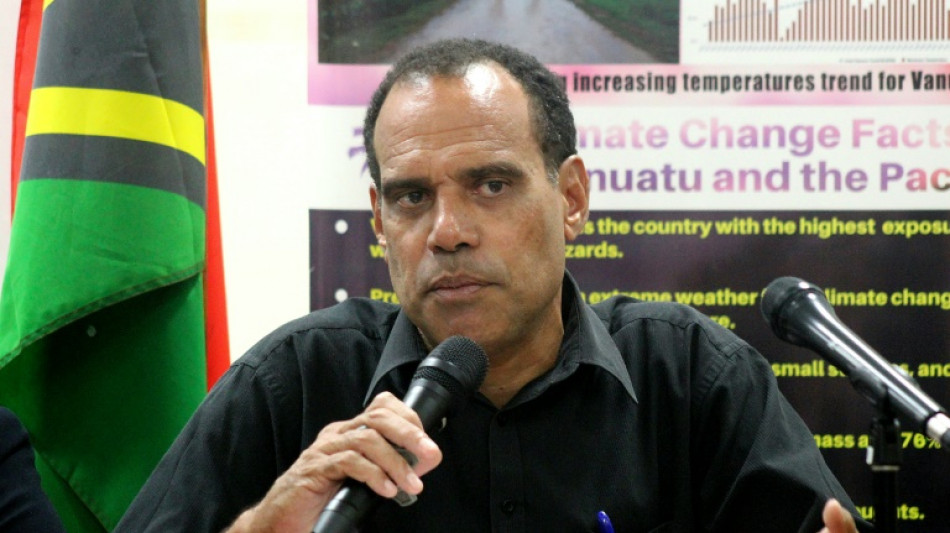
Pacific ire at Australia's backing for fossil fuels / Photo: Hilaire Bule - AFP/File

 اليورو يستقر في البنوك المصرية وأعلى سعر للبيع 59.85 جنيه

 الأرصاد السعودية تتوقع سيولاً وأمطاراً رعدية في خمس مناطق

 Lights out in Laos as electricity exports surge

 Steven Strogatz weighs AI mathematics advances and their consequences for researchers

 Anthropic boss calls for AI slowdown, Altman and Musk agree

 French IT giant Capgemini sells subsidiary after row over ICE links

 Quebec Brokerage Qubit Insurance Announces New Data on Coverage Shortfalls as Rebuilding Costs Rise

 Lady Gaga welcomes first child with fiance: US media

 Bhutan business bets on hazelnuts for farming future

 'Widow's Bay' and 'The Pitt' are favorites for Emmys night

 Coastal erosion forces cancellation of California music festival

 Argentina's Dirty War rears its head in Venice film

 UK lawmakers throw out bill to legalise assisted dying

 US inflation steady in August, fueling Fed rate hike expectations

 New York marks 25th anniversary of 9/11 attacks

 Nepal flood reconstruction bill to be $4.78 bn: foreign ministry

 JUMO and Standard Bank launch Social Finance Framework to scale inclusive finance in Africa

 Doomsday tech: could AI really kill us all?

 French comedy show 'Call my agent' makes film comeback

 It's all coming back: Celine Dion fans gear up for Paris return

 Researchers eye AI revolution in natural disaster forecasts

 US braces for inflation report that may push Fed to hike rates

 Musk threatens legal action over documentary

 Latin America fact-check group asks Meta not to replace verification practice

 AI Risks to Enter 60–80% of Liability and Cyber Insurance Underwriting by 2028, ScienceSoft Predicts

Pacific Islands expressed dismay on Thursday at Australia's subsidies for fossil fuels, flagging climate concerns as a point of friction between the neighbouring nations.
Two Pacific ministers appeared in a joint livestream to condemn Australia's long and continuing enthusiasm for coal and gas projects.
Vanuatu's Climate Change Minister Ralph Regenvanu welcomedAustralia's pledge last year to transition towards renewable energy but said it must stop funding climate-damaging projects.
"We are very disappointed to see that Australia continues to subsidise fossil fuel projects," Regenvanu told The Australia Institute, a Canberra-based think tank.
"We need money in the renewable energy sector. That's where the future of our economies and our societies lies -- not in the fossil fuel industry."
Regenvanu questioned why Canberra continues to pump "billions of dollars into the fossil fuel industry, which we in the Pacific have agreed, including Australia, is the greatest threat to our security".
Vanuatu is a small archipelago and, like many Pacific Island nations, is threatened by rising sea levels.
Speaking alongside Regenvanu, Tuvalu's Finance Minister Seve Paeniu said Pacific nations are currently weighing a commitment to make the region fossil-free.
"The idea is to stop any further expansion of fossil fuel" and to eliminate consumption of coal, oil and natural gases, Paeniu said.
"It's a matter of our security and our survival."
Tuvalu, midway between Hawaii and Australia, is one of the smallest nations in the world, made up of less than 26 square kilometres (10 square miles) and shrinking fast.
"Our land is constantly being eaten away," Paeniu said. "And we know that fossil fuel is the cause of climate change."
- 'One step forwards' -
Australia has pledged that 82 percent of its electricity will come from renewable sources by 2030. The current figure is around 30 percent.
But it is one of the world's largest coal and gas exporters and a series of governments have resisted pressure to scale back the industries.
The centre-left Labor government approved a new coal mine last month, sparking anger from environmental groups.
Australia and its allies, including the United States, are currently locked in a battle with China for influence across the Pacific.
Australia's relationship with fossil fuels is a constant irritant.
Regenvanu described Australia as Vanuatu's greatest trade partner but said there are tensions in the relationship over climate change.
He accused Australia of "not recognising the main security threat to the Pacific".
Vanuatu is still under a state of emergency after being battered this year by an "unprecedented event of two Category Four cyclones within a few days", Regenvanu said.
He estimates fixing the damage will cost more than 40 percent of Vanuatu's gross domestic product, which the International Monetary Fund puts at around US$1 billion.
"It's like you take one step forwards and two backwards in terms of economic development," Regenvanu said.
"We're not seeing the emissions reduction that we need to see happen."
P.Petrenko--CPN