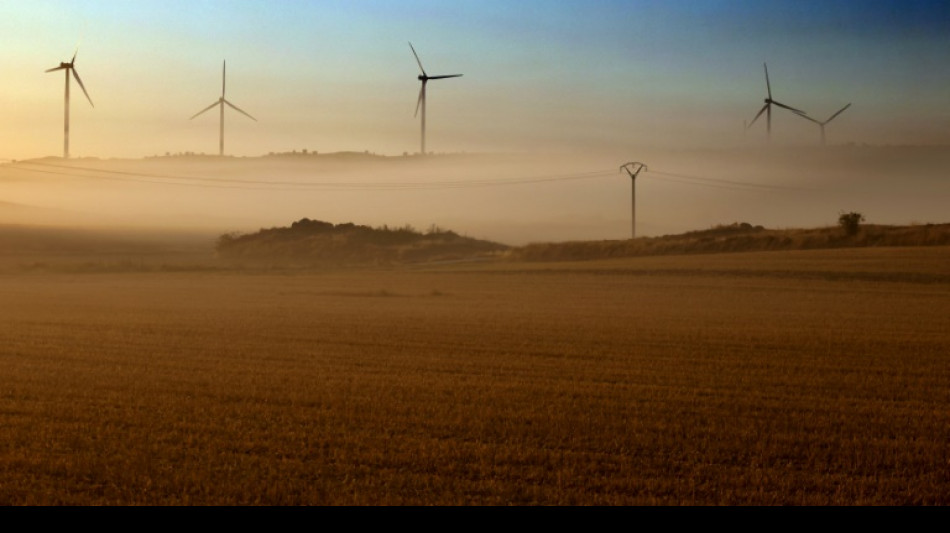
World near positive 'tipping point' on climate solutions: expert / Photo: Thomas COEX - AFP/File

 اليورو يستقر في البنوك المصرية وأعلى سعر للبيع 59.85 جنيه

 الأرصاد السعودية تتوقع سيولاً وأمطاراً رعدية في خمس مناطق

 Lights out in Laos as electricity exports surge

 Steven Strogatz weighs AI mathematics advances and their consequences for researchers

 Anthropic boss calls for AI slowdown, Altman and Musk agree

 French IT giant Capgemini sells subsidiary after row over ICE links

 Quebec Brokerage Qubit Insurance Announces New Data on Coverage Shortfalls as Rebuilding Costs Rise

 Lady Gaga welcomes first child with fiance: US media

 Bhutan business bets on hazelnuts for farming future

 'Widow's Bay' and 'The Pitt' are favorites for Emmys night

 Coastal erosion forces cancellation of California music festival

 Argentina's Dirty War rears its head in Venice film

 UK lawmakers throw out bill to legalise assisted dying

 US inflation steady in August, fueling Fed rate hike expectations

 New York marks 25th anniversary of 9/11 attacks

 Nepal flood reconstruction bill to be $4.78 bn: foreign ministry

 JUMO and Standard Bank launch Social Finance Framework to scale inclusive finance in Africa

 Doomsday tech: could AI really kill us all?

 French comedy show 'Call my agent' makes film comeback

 It's all coming back: Celine Dion fans gear up for Paris return

 Researchers eye AI revolution in natural disaster forecasts

 US braces for inflation report that may push Fed to hike rates

 Musk threatens legal action over documentary

 Latin America fact-check group asks Meta not to replace verification practice

 AI Risks to Enter 60–80% of Liability and Cyber Insurance Underwriting by 2028, ScienceSoft Predicts

With climate-enhanced droughts, heatwaves and fires ravaging three continents and the threat of a new surge in global warming, the world urgently needs to ramp-up solutions for slashing carbon pollution. But which solutions are most critical?
The organisation Project Drawdown has detailed the potential, feasibility and cost of nearly a hundred climate solutions since it was set up in 2017.
Executive director Jonathan Foley, a leading climate scientist, spoke to AFP about how to assess and prioritise the actions needed to keep Earth liveable.
The following interview has been edited for length and flow:
Q: What are the three most important questions in assessing the usefulness and integrity of carbon-cutting solutions?
A: Is it available now and ready to deploy? Because we need to start bending the emissions curve immediately.
Is it cost-effective? Otherwise, it's not going to scale effectively.
Does it create co-benefits for people, especially in terms of health, jobs, equity, and justice? This will make it far more appealing.
Q: A lot of hope -- and investment -- is going into technological solutions such as filtering fossil fuel pollution or pulling CO2 out of the air. Comment?
A: While some very limited carbon removal will be needed by mid-century, the vast, vast majority of the work we need to do -- more than 95 percent -- is cutting emissions, and doing it now.
Of the five percent focused on carbon removal, I think it should be more than 90 percent nature-based removal, such as ecological restoration and regenerative agriculture. Machine-based removal is unlikely to work at any meaningful scale.
Q: We often hear that solutions are already available, all that's missing is political will. Is that it?
A: It's not political will. It's money and power, which right now is still with fossil fuels, polluting industries, and unsustainable agriculture. That's why too many politicians are still in bed with them.
But effective climate solutions are here, now, and they are starting to growing exponentially and beat the older, polluting systems at their own game -- in the marketplace. When renewables and other climate solutions are cheaper, better, faster, and more popular than the old systems, we will hit a dramatic tipping point on climate solutions. We are getting close to that now. It's finally a real race.
Q: Government, business, consumers -– who's not pulling their weight on climate action?
A: The climate crisis will be changed in culture and business and technology, not politics. Governments aren't leading, not at all. At best, they're followers.
Government regulation has been a very small contributor. So far, businesses and communities are leading on climate action. We have already seen dramatic reductions in emissions -- 20 percent in the US since peaking in 2007, and 40 percent since the mid-1990s in the UK -- in major economies around the world, fuelled by changes in technology, business, investment, and culture.
Activists have also contributed to these positive changes, largely pushing how businesses and investors see the climate problem.
Q: Is greenwashing the new climate denial?
A: Sadly, yes. Outright denial of climate change as an issue is no longer credible. So the new approach is focused on delay and greenwashing -- making it look like we are doing things, but nothing really changes. One could also say delay is the new denial.
But we should also be aware of "doom-washing": the narrative that nothing good is happening on climate change and that we have no hope to stop the climate crisis. Neither of these is true.
Q: Is mainstream media conveying the balanced portfolio of climate action needed?
A: No. Far too much of the coverage is focused on the problem and impacts of climate change -- roughly 99 percent in the US media -- and almost nothing focusing on the solutions.
Mainstream media is doing more harm than good in some cases by promoting more fear and anxiety, leading to disengagement and inaction. This feeds a terrible feedback loop in our broken politics and activists cultures. We need a better, more balanced conversation on how climate solutions can benefit communities around the world.
H.Meyer--CPN