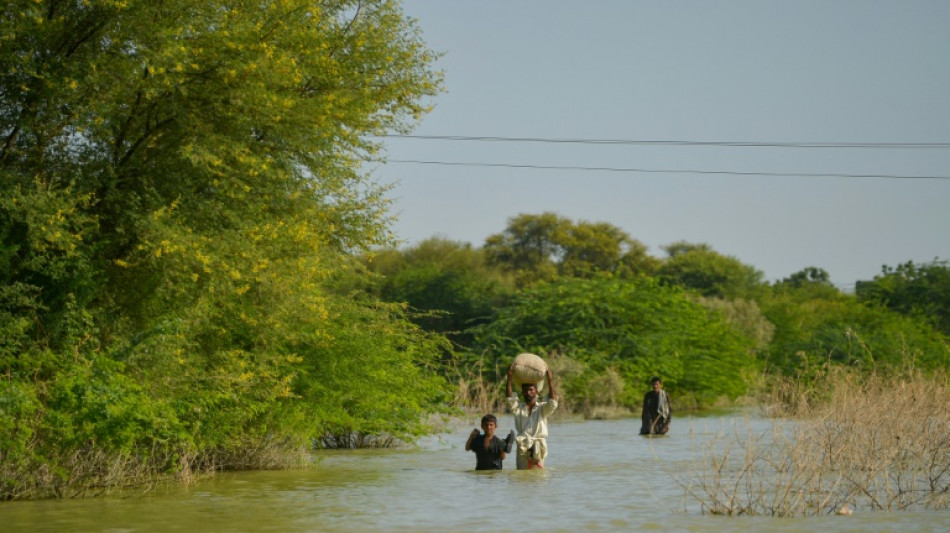
Malaria cases spike in Malawi, Pakistan after 'climate-driven' disasters / Photo: Rizwan TABASSUM - AFP

 اليورو يستقر في البنوك المصرية وأعلى سعر للبيع 59.85 جنيه

 الأرصاد السعودية تتوقع سيولاً وأمطاراً رعدية في خمس مناطق

 Lights out in Laos as electricity exports surge

 Steven Strogatz weighs AI mathematics advances and their consequences for researchers
 Anthropic boss calls for AI slowdown, Altman and Musk agree
 French IT giant Capgemini sells subsidiary after row over ICE links

 Quebec Brokerage Qubit Insurance Announces New Data on Coverage Shortfalls as Rebuilding Costs Rise

 Lady Gaga welcomes first child with fiance: US media

 Bhutan business bets on hazelnuts for farming future

 'Widow's Bay' and 'The Pitt' are favorites for Emmys night

 Coastal erosion forces cancellation of California music festival

 Argentina's Dirty War rears its head in Venice film

 UK lawmakers throw out bill to legalise assisted dying

 US inflation steady in August, fueling Fed rate hike expectations

 New York marks 25th anniversary of 9/11 attacks

 Nepal flood reconstruction bill to be $4.78 bn: foreign ministry

 JUMO and Standard Bank launch Social Finance Framework to scale inclusive finance in Africa

 Doomsday tech: could AI really kill us all?

 French comedy show 'Call my agent' makes film comeback

 It's all coming back: Celine Dion fans gear up for Paris return

 Researchers eye AI revolution in natural disaster forecasts

 US braces for inflation report that may push Fed to hike rates

 Musk threatens legal action over documentary

 Latin America fact-check group asks Meta not to replace verification practice

 AI Risks to Enter 60–80% of Liability and Cyber Insurance Underwriting by 2028, ScienceSoft Predicts

Extreme weather events in Malawi and Pakistan have driven "very sharp" rises in malaria infections and deaths, a global health chief said ahead of World Malaria Day on April 25.
Cases in Pakistan last year, after devastating floods left a third of the country under water, rose four-fold to 1.6 million, according to the World Health Organization (WHO).
In Malawi, Cyclone Freddy in March triggered six months' worth of rainfall in six days, causing cases there to spike too, Peter Sands, head of the Global Fund to fight AIDS, Tuberculosis and Malaria, told AFP in an interview.
"What we've seen in places like Pakistan and Malawi is real evidence of the impact that climate change is having on malaria," he said.
"So you have these extreme weather events, whether flooding in Pakistan, or the cyclone in Malawi, leaving lots of stagnant water around the place.
"And we saw a very sharp uptick in infections and deaths from malaria in both places," he said ahead of World Malaria Day on April 25.
Sands said World Malaria Day was usually an opportunity to "celebrate the progress we have made".
But this year it was an occasion to "sound the alarm".
The dramatic increase in cases caused by the climate-change-driven weather disasters illustrated the need to "get ahead of this" now, he said.
"If malaria is going to be made worse by climate change, we need to act now to push it back and where we can eliminate it," he said.
In both countries, pools of water left behind as waters receded created ideal breeding grounds for malaria-carrying mosquitoes.
- No 'silver bullet' -
Sands said there had been some progress made in the fight against malaria but stressed that a child still dies of the disease every minute.
In 2021, the WHO said there were an estimated 247 million cases worldwide and 619,000 deaths attributed to malaria.
Scientific breakthroughs saw more than a million children in Ghana, Kenya and Malawi last year given the RTS,S vaccine manufactured by British pharmaceutical giant GSK.
Another vaccine, R21/Matrix-M, developed by Britain's Oxford University, received clearance to be used in Ghana earlier this month -- the first time it has received regulatory clearance anywhere in the world.
But Sands, the fund's executive director, cautioned that the vaccines should not be seen as a "silver bullet".
Vaccines had less potential to combat the disease than routine diagnosis and treatment infrastructure due to the relative cost of immunisation and the difficulty of large-scale deployment.
The groups most vulnerable to malaria are children under the age of five and pregnant women, with deaths largely down to late diagnosis and treatment.
"It's all about having services that can diagnose and provide treatment... that means you need community health workers in every village, who actually have the tools to test and to treat," he said.
"And we need to ensure that these country's health systems are made more resilient to these kinds of shocks (because) what we tend to see is a lot of destruction of valuable medical commodities, drugs, treatments."
Sands said the countries at greatest risk from climate change were also those with the "highest burden of malaria".
"There's an almost perfect overlap so we are very concerned that the countries in which malaria is more prevalent... are also the countries that are most likely to get hit by the extreme weather events that climate change generates," he added.
L.K.Baumgartner--CPN