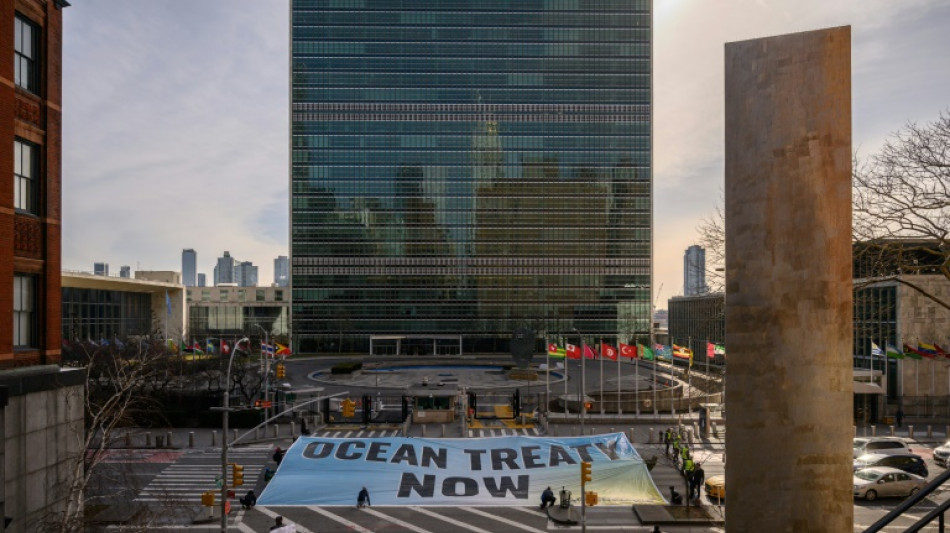
Treaty ahoy? Talks to protect high seas enter last day / Photo: Ed JONES - AFP/File

 ستاندرد آند بورز تثبت تصنيف السعودية عند A+
 Lights out in Laos as electricity exports surge

 Steven Strogatz weighs AI mathematics advances and their consequences for researchers

 Anthropic boss calls for AI slowdown, Altman and Musk agree

 French IT giant Capgemini sells subsidiary after row over ICE links

 Quebec Brokerage Qubit Insurance Announces New Data on Coverage Shortfalls as Rebuilding Costs Rise

 Lady Gaga welcomes first child with fiance: US media

 Bhutan business bets on hazelnuts for farming future

 'Widow's Bay' and 'The Pitt' are favorites for Emmys night

 Coastal erosion forces cancellation of California music festival

 Argentina's Dirty War rears its head in Venice film

 UK lawmakers throw out bill to legalise assisted dying

 US inflation steady in August, fueling Fed rate hike expectations

 New York marks 25th anniversary of 9/11 attacks

 Nepal flood reconstruction bill to be $4.78 bn: foreign ministry

 JUMO and Standard Bank launch Social Finance Framework to scale inclusive finance in Africa

 Doomsday tech: could AI really kill us all?

 French comedy show 'Call my agent' makes film comeback

 It's all coming back: Celine Dion fans gear up for Paris return

 Researchers eye AI revolution in natural disaster forecasts

 US braces for inflation report that may push Fed to hike rates

 Musk threatens legal action over documentary

 Latin America fact-check group asks Meta not to replace verification practice

 AI Risks to Enter 60–80% of Liability and Cyber Insurance Underwriting by 2028, ScienceSoft Predicts

 Tribal Launches Campfire, Letting Business and Technical Teams Build on Salesforce Together

UN countries will try to overcome their differences on Friday to finally agree a treaty to protect the high seas, a fragile and vital treasure that covers nearly half the planet.
After more than 15 years of informal and then formal talks, negotiators are coming to the end of two more weeks of discussions, the third "final" session in less than a year.
"I would ask for all delegations to do some warm-up exercises and stretches and be prepared to run the marathon to the finish line," said Rena Lee, chair of the conference that could run late into Saturday's early hours.
But on the eve of the scheduled end of discussions, long-standing disputes were still posing problems.
They include the procedure for creating marine protected areas, the model for environmental impact studies of planned activities on the high seas, and the sharing of potential benefits of newly discovered marine resources.
"We're still pretty far from a clean text," said Liz Karan of the Pew Charitable Trusts NGO.
Observers are hoping the final stretch will see a political boost from the Our Ocean conference, which is taking place in parallel in Panama. Many government officials are there to discuss the protection and sustainable use of the oceans.
"Life on earth depends on a healthy ocean," said Monica Medina, United States Assistant Secretary of State for Oceans and International Environmental and Scientific Affairs.
She said a high seas treaty is "critical" to ensuring governments meet their commitment to protect 30 percent of the world's land and ocean by 2030, as agreed in Montreal in December.
The high seas begin at the border of countries' exclusive economic zones, which extend up to 200 nautical miles (370 kilometers) from coastlines. They thus fall under the jurisdiction of no country.
While the high seas comprise more than 60 percent of the world's oceans and nearly half the planet's surface, they have long drawn far less attention than coastal waters and a few iconic species.
Only about one percent of the high seas is currently protected.
Ocean ecosystems create half the oxygen humans breathe and limit global warming by absorbing much of the carbon dioxide emitted by human activities.
- North-South 'equity' -
But they are threatened by climate change, pollution and overfishing.
"I think despite all of the different outstanding issues, and there's a long list of them, the overall sense I'm getting is that we will have a deal in this session," Greenpeace activist Li Shuo told AFP.
For him, the political will is there and everything comes down to "global north versus south" and whether "we have the fairness and equity that we need in this deal."
Developing countries, without the means to afford costly research, say they fear being left aside while others make profits from the commercialization of potential substances discovered in the international waters.
In a move seen as an attempt to build trust between rich and poor countries, the European Union pledged 40 million euros ($42 million) in New York to facilitate the ratification of the treaty and its early implementation.
At the Panama conference, the EU also pledged $860 million for research, monitoring and conservation of oceans in 2023.
Observers interviewed by AFP say that resolving these politically sensitive financial issues could help ease other sticking points and finally allow the text to be submitted for approval at the conference.
"I think there is a commitment to try and get this done. People haven't given up yet," said Nathalie Rey of the High Seas Alliance, which includes more than 40 NGOs.
If agreement is reached, it remains to be seen whether the compromises made will result in a text robust enough to protect oceans effectively.
P.Petrenko--CPN