Long lost Madagascar songbird seen again in wild / Photo: John C. Mittermeier - American Bird Conservancy/AFP

 ستاندرد آند بورز تثبت تصنيف السعودية عند A+
 Lights out in Laos as electricity exports surge

 Steven Strogatz weighs AI mathematics advances and their consequences for researchers

 Anthropic boss calls for AI slowdown, Altman and Musk agree

 French IT giant Capgemini sells subsidiary after row over ICE links

 Quebec Brokerage Qubit Insurance Announces New Data on Coverage Shortfalls as Rebuilding Costs Rise

 Lady Gaga welcomes first child with fiance: US media

 Bhutan business bets on hazelnuts for farming future

 'Widow's Bay' and 'The Pitt' are favorites for Emmys night

 Coastal erosion forces cancellation of California music festival

 Argentina's Dirty War rears its head in Venice film

 UK lawmakers throw out bill to legalise assisted dying

 US inflation steady in August, fueling Fed rate hike expectations

 New York marks 25th anniversary of 9/11 attacks

 Nepal flood reconstruction bill to be $4.78 bn: foreign ministry

 JUMO and Standard Bank launch Social Finance Framework to scale inclusive finance in Africa

 Doomsday tech: could AI really kill us all?

 French comedy show 'Call my agent' makes film comeback

 It's all coming back: Celine Dion fans gear up for Paris return

 Researchers eye AI revolution in natural disaster forecasts

 US braces for inflation report that may push Fed to hike rates

 Musk threatens legal action over documentary

 Latin America fact-check group asks Meta not to replace verification practice

 AI Risks to Enter 60–80% of Liability and Cyber Insurance Underwriting by 2028, ScienceSoft Predicts

 Tribal Launches Campfire, Letting Business and Technical Teams Build on Salesforce Together

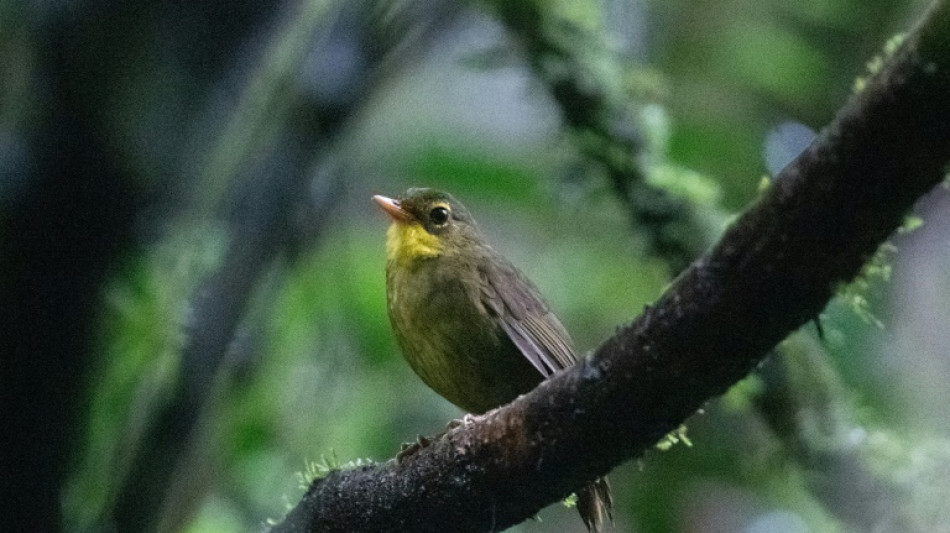
Conservationists were celebrating Wednesday the first sightings in 24 years of the dusky tetraka, a yellow-throated songbird native to Madagascar for which ornithologists had feared the worst.
A expedition to remote regions of the island nation confirmed two recent sightings of the bird.
Scientists also learned something about the petite bird's behaviour that could help explain how it escaped notice for so long, even if it remains extremely rare.
The last documented sighting of dusky tetraka, in 1999, was in the rainforests of northeastern Madagascar, one of the world's most diverse biodiversity hotspots with hundreds of unique vertebrate species.
In December, an international team of researchers led by the US-based Peregrine Fund drove for 40 hours and hiked for half-a-day to the last spot the warbler-like bird had been seen.
Much of the forest, they discovered, had been destroyed and converted to farms for vanilla production, even though the area is officially protected.
After eight days, team member John Mittermeier, director of the lost birds program at American Bird Conservancy, finally spotted one hopping through dense undergrowth on the ground near a rocky river and snapped a photo.
"If dusky tetraka always prefer areas close to rivers, this might help to explain why the species has been overlooked for so long," he said.
- 'Data insufficient' -
"Birding in tropical forests is all about listening for bird calls, and so you naturally tend to avoid spending time next to rushing rivers where you can't hear anything."
Another dusky tetraka located by a second team also spent most of its time in dense vegetation close to a river, presumably looking for insects and other prey in the damp undergrowth.
"Now that we've found the dusky tetraka and better understand the habitat it lives in, we can look for it in other parts of Madagascar," said Lily-Arison Rene de Roland, Madagascar Program director for The Peregrine Fund.
The bird is on the Top Ten Most Wanted Lost Birds list, a collaboration between Re:wild, American Bird Conservancy and BirdLife International, all partners on the expedition.
More than half of Madagascar's birds -- some 115 species -- are endemic, meaning they are found nowhere else.
More than 40 of the island's bird species are classified as threatened with extinction on the Red List of the International Union for the Conservation of Nature (IUCN).
The dusty tetraka -- aka Crossleyia tenebrosa -- is not classified for lack of data.
The main drivers of biodiversity loss on Madagascar are forest destruction to make way for agriculture, habitat degradation, invasive species, climate change and hunting.
About 40 percent of the island's original forest cover was lost between the 1950s and 2000, according to earlier research.
A.Levy--CPN