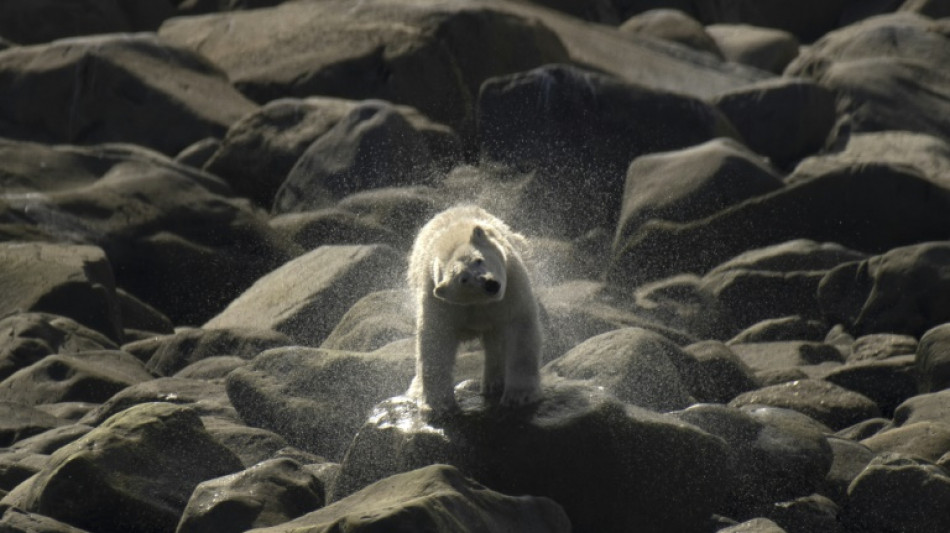
Canadian polar bears disappearing fast: study / Photo: Olivier MORIN - AFP/File

 Kenya's economy faces climate change risks: World Bank

 Apple tops estimates in CEO Cook's final quarter, but shares fall

 Milei demands expulsion of foreigners expressing 'hate' against Argentina

 Italy's Po River valley on drought alert

 Prada profits pinched as growth hard to chase

 Stocks climb on earnings and rates, oil retreats

 US economic growth slows in second quarter, missing expectations

 Russia adds Telegram founder Durov to 'terrorist' blacklist

 Stocks diverge on earnings, as oil steadies

 Eurozone economy grows despite Middle East war

 Singapore group will develop 'most promising' Ebola vaccine

 Shell profit surges as Mideast war fuels oil prices

 Car maker Stellantis says back in profit in second quarter

 Samsung quarterly operating profit up 1,800% on AI boom

 South Korean stocks bounce after rout, oil holds gains on Mideast woes

 South Korea's women web sleuths fight AI deepfake porn

 Anything but programmable: New cost-efficient EC-power-supply-series for the DIN rail by CAMTEC PS

 Meta misses profit expectations, sticks to massive AI spending

 Campari - king of the spritz - hopes to conquer American heartland
 Air France-KLM and Lufthansa bid for Portugal's TAP airline

 Profits soar at Airbus as it delivers more planes

 Rheinmetall shares surge after armsmaker reports record profit

 FIFA hit by furious backlash over plans to sell stake in competitions

 MEXC Integrates World-Check to Fortify Institutional Grade Compliance Architecture
 Spain returns wildfire evacuees as France braces for worsening weather

Polar bears are disappearing fast from the Western part of Hudson Bay, on the southern tip of the Canadian Arctic, according to a new government survey.
The number of female bears and cubs in particular has seen a dramatic decline.
Researchers have flown over the region -- which includes the town of Churchill, a tourist destination touted as the "polar bear capital of the world" -- every five years to count the number of bears and extrapolate population trends.
During the last survey in late August and early September 2021, the results of which were released earlier this month, they spotted 194 bears and, based on that count, estimated a total population of 618 bears, down from 842 five years earlier.
"Comparison to aerial surveys estimates from 2011 and 2016 suggests that the WH (Western Hudson Bay population) may be decreasing in abundance," the study said.
It also "revealed significant declines in the abundance of adult female and subadult bears (cubs) between 2011 and 2021."
"The observed declines are consistent with long-standing predictions regarding the demographic effects of climate change on polar bears," the researchers said.
They also cited possible displacements of bears to neighboring regions and hunting for the population decline.
The bears' sea-ice habitat has been disappearing at an alarming rate, with the far north warming up to four times faster than the rest of the world.
The sea ice has become less thick and is breaking up earlier in the spring as well as freezing later in the fall.
The bears rely on the ice for foraging for seals, movement and reproduction.
Since the 1980s, the ice pack in the bay has decreased by nearly 50 percent in summer, according to the US National Snow and Ice Data Center.
A report published two years ago in the journal Nature Climate Change suggested this trend could lead to the near-extinction of these animals, noting there were 1,200 polar bears on the western shores of Hudson Bay in the 1980s.
St.Ch.Baker--CPN